
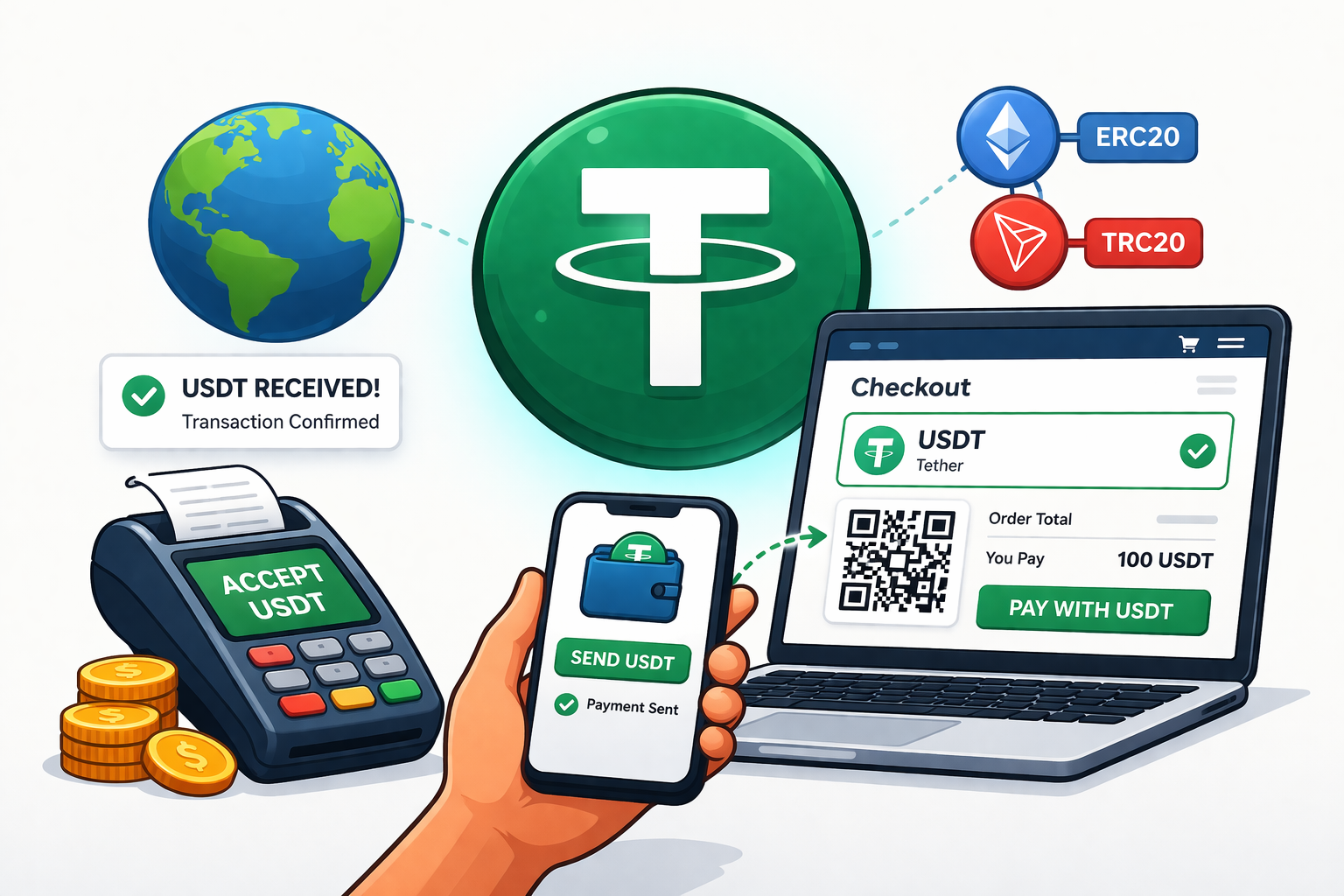








Accepting cryptocurrency is no longer a niche feature. For many online businesses, it has become a practical and often necessary payment method. Among all cryptocurrencies, Tether (USDT) stands out as the most widely used stablecoin, offering the advantages of blockchain technology without the typical volatility seen in assets like Bitcoin or Ethereum.
If you are running an e-commerce project, SaaS platform, or any kind of online service, understanding how to accept USDT payments on your website can significantly improve your payment processing flexibility, reduce fees, and expand your global reach. At the same time, the way you integrate crypto payments matters just as much as the decision to accept them.
This guide explains how to accept USDT payments, how crypto payment gateways work, and why a non-custodial approach like Bcon is fundamentally different from traditional solutions.
What Is a USDT Payment Method and How It Works
A USDT payment method is a way to receive funds in Tether, a stablecoin pegged to the US dollar. Unlike Bitcoin or Ethereum, which fluctuate based on the crypto market, USDT is designed to maintain a stable value close to 1 USD. This makes it far more practical for everyday transactions and pricing.
From a technical perspective, USDT exists on multiple blockchain networks. The most commonly used are Ethereum (ERC20) and TRON (TRC20). These networks differ in transaction fees and speed, which directly impacts the user experience during checkout. For example, TRC20 has traditionally been preferred due to its low fees and fast confirmations. However, after recent Ethereum upgrades, ERC20 transaction costs have become significantly more competitive, making both networks viable depending on use case, infrastructure, and user preference.
When a customer makes a payment, they send USDT from their crypto wallet to a specific wallet address provided during checkout. The transaction is then verified on the blockchain network in real-time. Once confirmed, the payment is considered final. There are no intermediaries, no banks involved, and no need for fiat currency conversion unless the merchant chooses to do so later.
This model is fundamentally different from traditional payment systems and even from many crypto payment gateways.
Why Businesses Choose to Accept USDT Payments
The decision to accept USDT payments is often driven by practical business considerations rather than ideology. Traditional payment methods come with limitations that become more visible as a business grows internationally.
One of the main reasons is the issue of volatility. While Bitcoin and other cryptocurrencies are popular, their price fluctuations make them less suitable for stable pricing. USDT solves this by maintaining parity with the US dollar, allowing businesses to operate with predictable revenue.
Another factor is global accessibility. Accepting payments through banks or card networks often requires dealing with fiat currencies, regional restrictions, and compliance barriers. In contrast, USDT transactions can be sent and received globally without the need for a bank account. This significantly improves global reach and simplifies onboarding for international customers.
Fees also play a major role. Traditional payment processors charge a percentage per transaction, along with additional hidden costs. In comparison, blockchain-based payments offer low fees and faster settlement, with both TRON (TRC20) and Ethereum (ERC20) now providing efficient and scalable transaction options.
There is also the issue of chargebacks. In traditional payment systems, chargebacks can result in lost revenue and additional penalties. With cryptocurrency payments, transactions are irreversible, which eliminates this risk entirely.
Why Use USDT Over Bitcoin or Ethereum
Although Bitcoin (BTC) and Ethereum are the most well-known cryptocurrencies, they are not always the best choice for payments. Bitcoin transactions can be slower and more expensive during peak times, while Ethereum often suffers from high transaction fees.
USDT, as a stablecoin, avoids these issues by combining the benefits of blockchain with price stability. It allows businesses to accept cryptocurrency payments without being exposed to market volatility. This makes it particularly suitable for businesses that need consistent pricing, such as subscription services or digital product platforms.
Additionally, USDT is deeply integrated into the broader crypto ecosystem. It is supported by most wallets, exchanges like Binance, and various payment solutions. This widespread adoption makes it easier for customers to use and for businesses to integrate.
How Crypto Payments Work on a Website
To understand how to accept crypto payments on your website, it is important to look at the underlying flow. Unlike traditional payment gateways, there is no centralized payment processor approving transactions.
Instead, the process is based on blockchain verification. When a customer chooses USDT as a payment option during checkout, the system generates a wallet address or a payment link.
A typical flow looks like this:
- Customer selects USDT as a payment option at checkout
- The system generates a wallet address or QR code
- Customer sends USDT from their crypto wallet
- The transaction is confirmed on the blockchain network
- Payment is verified in real-time
The key difference here is that there is no custody involved unless you explicitly choose a custodial service.
Custodial vs Non-Custodial Payment Gateways
This is where most businesses make a critical mistake.
Custodial crypto payment gateways function similarly to traditional payment systems. They hold your funds, manage your balances, and require KYC verification. In many cases, you do not actually receive the funds until you request withdrawals. This introduces delays, compliance risks, and the possibility of account restrictions.
A non-custodial approach works differently. Instead of holding your funds, the system simply facilitates the transaction. The customer sends USDT directly to your wallet address, and you receive it instantly. There is no intermediary controlling your assets.
This is the model used by Bcon. It aligns with the original idea of blockchain: giving users full control over their digital assets without relying on third parties.
Why Non-Custodial Matters in Practice
At first glance, custodial and non-custodial solutions may seem similar. Both allow you to accept USDT payments. However, the difference becomes clear when you look at how funds are handled.
With custodial systems, you are effectively trusting a payment processor with your revenue. This means dealing with KYC requirements, possible account freezes, and delays in withdrawals. In some cases, funds can be held for compliance checks or AML procedures.
With a non-custodial solution, there is no such dependency. Payments go directly to your USDT wallet, and you have immediate access to your funds. There is no need to convert into fiat unless you choose to, and no third party can block or reverse transactions.
For businesses operating in multiple regions or working with international clients, this level of control is not just convenient—it is essential.
How to Accept USDT Payments on Your Website
The process itself is relatively simple and does not require deep technical knowledge. At a high level, it involves setting up a wallet, integrating a payment solution, and enabling checkout functionality.
You start by creating a crypto wallet that supports USDT. This wallet will generate a unique wallet address, which is used to receive payments. It is important to choose the correct network, such as TRC20 or ERC20, depending on your needs.
Next, you integrate a payment solution. This can be done through an API for custom websites or through plugins if you are using a CMS. The API allows for more advanced functionality, such as automated payment detection and real-time updates.
Once integrated, you add USDT as a payment option at checkout. When a customer selects it, they are provided with payment details, typically in the form of a wallet address or a QR code. After the transaction is sent, the system verifies it on the blockchain and confirms the payment.
That is essentially the entire flow. There are no banks, no intermediaries, and no delays.
How to Receive Money Through USDT
Receiving USDT is straightforward. A customer sends funds to your wallet address, and the transaction is recorded on the blockchain. Once confirmed, the funds are available in your wallet immediately.
There is no need for a bank account, no dependency on fiat currencies, and no waiting for withdrawals. This makes USDT particularly useful for businesses that operate globally or want to avoid traditional financial infrastructure.
Integration Options: API, Plugins, and Payment Links
There are several ways to integrate USDT payments into your website. The choice depends on your technical setup and business requirements.
The most flexible option is API integration. It allows you to fully control the checkout process, automate payment verification, and build custom workflows. This is ideal for businesses that need advanced functionality.
Plugins are a simpler option for platforms like WordPress or other e-commerce systems. They require minimal setup and can be deployed quickly.
Payment links offer the fastest onboarding. You can generate a link and share it with customers without building a full checkout system. This is useful for testing or for businesses that do not require complex integrations.
Common Pitfalls When Accepting USDT Payments
Many businesses approach crypto payments with the wrong assumptions. One common mistake is choosing a custodial payment gateway without understanding the implications. This often leads to unnecessary restrictions and loss of control over funds.
Another issue is ignoring network differences. Choosing the wrong network for your audience can impact transaction costs and user experience. While ERC20 was historically more expensive, recent improvements in Ethereum have made fees more predictable, so the choice between ERC20 and TRC20 should be based on your users and infrastructure rather than outdated assumptions.
Some businesses also fail to optimize their checkout process. Even though crypto payments are simple, poor implementation can create confusion and reduce conversion rates.
Key Advantages of Bcon’s Non-Custodial Approach
Bcon is designed specifically for businesses that want full control.
Key benefits include:
- Non-custodial architecture
- No KYC requirements
- No frozen funds
- Instant settlement
- No withdrawals process
- Checkout handled on your website
- No redirection to external payment systems
This makes onboarding faster and removes friction for both merchants and customers.
Final Thoughts
Accepting tether payments is not just about adding another payment option. It is about rethinking how payments should work in a global, digital-first environment.
USDT provides the stability of fiat with the flexibility of blockchain. It eliminates volatility concerns, reduces transaction fees, and enables real-time settlement. More importantly, it allows businesses to operate without relying on traditional financial systems.
However, the real advantage comes from how you implement it. Custodial payment processors replicate the limitations of traditional systems, while non-custodial solutions like Bcon give you full control over your funds.
If your goal is to build a scalable, global payment system, the non-custodial model is not just an option—it is the logical choice.