
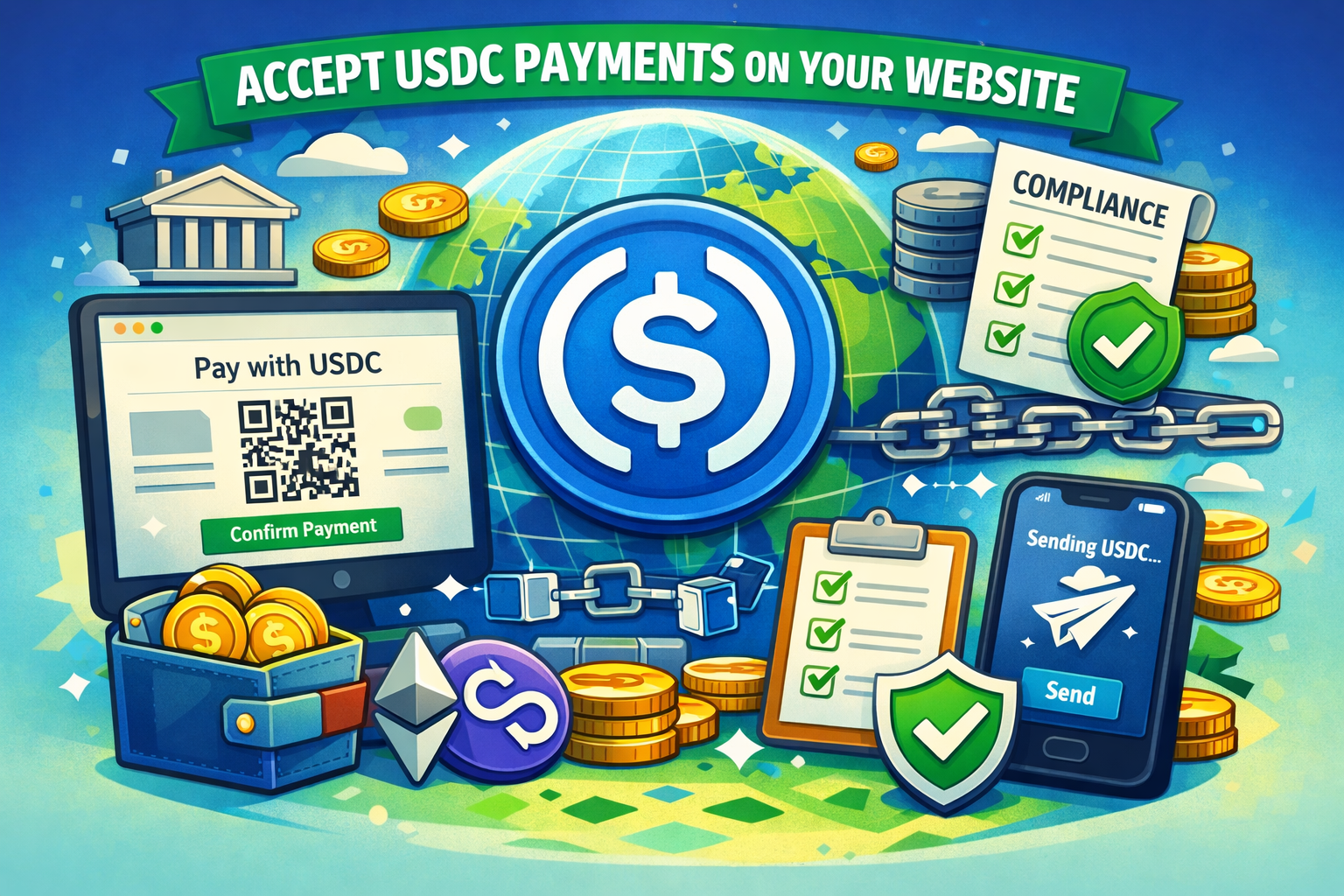








How to Accept USDC Payments on Your Website
Accepting cryptocurrency is no longer experimental. Today, businesses are actively integrating stablecoins as a reliable alternative to traditional payment methods. Among all available options, USD Coin (USDC) has become one of the most in-demand solutions due to its price stability and strong alignment with modern financial standards.
If you run an e-commerce project, SaaS platform, or any online store, learning how to accept USDC payments can help you streamline payment processing, reduce transaction fees, and expand into global payments without relying on traditional banking.
This guide explains how to accept USDC payments, how blockchain technology works in real payment flows, and why a non-custodial model is a more efficient alternative to traditional payment gateways.
What Is USDC and How Stablecoin Payments Work
USDC is a stablecoin designed to maintain a 1:1 value with the US dollar. Unlike volatile cryptocurrencies such as Bitcoin or Ethereum, USDC is built for price stability. This makes it suitable for real business transactions where fluctuations can directly impact revenue.
As a digital currency, USDC operates on multiple blockchain networks. These include Ethereum, Polygon, and other blockchains that support fast and scalable transactions. Because of this, businesses can use USDC across different infrastructures while maintaining consistent pricing.
In simple terms, stablecoin payments allow you to receive funds in a digital asset that behaves similarly to fiat currency, but without depending on a bank account or traditional financial system.
Why Businesses Accept USDC Payments
The shift toward USDC payments is driven by practical needs, not trends. Traditional payment methods like credit cards and bank transfers come with limitations that affect both cost and customer experience.
USDC solves several of these problems at once. It removes the need for intermediaries, reduces transaction fees, and eliminates chargebacks. At the same time, it enables global payment flows without restrictions tied to fiat currencies.
For businesses operating internationally, this creates a more flexible payment solution that is not dependent on traditional banking infrastructure.
Another important factor is predictability. Unlike Bitcoin or Ethereum, where volatility can cause fluctuations in revenue, USDC maintains a stable value. This allows businesses to plan pricing, manage cash flow, and avoid unexpected losses.
Supported Blockchains for USDC Payments
One of the main advantages of USDC is its multi-chain support. It is not limited to a single blockchain network, which gives businesses flexibility when designing payment systems.
Key networks where you can accept USDC payments:
- Ethereum (ERC20) — the most established ecosystem with strong security and deep integration across crypto assets and payment solutions
- Polygon — optimized for low transaction fees and scalable payment processing, widely used in e-commerce platforms
- Other blockchains — emerging ecosystems that support fast and efficient USDC transactions
Comparison of Blockchain Networks for USDC
| Network | Speed | Gas Fees / Costs | Ecosystem | Best Use Case |
| Ethereum | Medium | Moderate (more stable after upgrades) | Very strong | Large payments, DeFi |
| Polygon | Fast | Low | Growing | E-commerce, microtransactions |
Ethereum remains a dominant infrastructure for USDC payments, especially for businesses already integrated into the ETH ecosystem. At the same time, Polygon offers a more cost-efficient alternative for high-volume transactions.
How USDC Payments Work on a Website
To understand how to accept USDC payments, it is important to look at how payment flows function in practice.
When a customer selects USDC at checkout, the system generates a wallet address or QR code. The user sends funds from their crypto wallet, and the transaction is recorded on the blockchain. Once confirmed, the system updates the payment status in real-time.
This process removes the need for a payment processor or bank account. It also eliminates approval delays and reduces transaction costs compared to traditional payment processing.
Unlike credit cards, where chargebacks can occur, USDC transactions are final. This improves security and protects businesses from fraudulent disputes.
Custodial vs Non-Custodial Payment Gateways
A critical decision when integrating USDC payments is choosing between custodial and non-custodial payment gateways.
Comparison Table
| Feature | Custodial Payment Gateway | Non-Custodial Solution |
| Fund Control | Payment processor | Merchant |
| KYC | Required | Not required |
| Withdrawals | Required | Not needed |
| Risk of Freezing | Yes | No |
| Payment Flow | External | On-site checkout |
Custodial payment processors operate similarly to traditional banking systems. They hold your funds, manage payouts, and may impose restrictions. This creates dependency and reduces flexibility.
A non-custodial approach removes these limitations. Payments go directly to your wallet address, giving you full control over your digital assets.
How to Accept USDC Payments on Your Website
Integrating USDC payments does not require complex infrastructure. Most businesses can implement it using existing tools and APIs.
Step-by-step process:
- Create a crypto wallet that supports USDC
- Choose a payment gateway or non-custodial payment solution
- Integrate using API or plugins
- Add USDC as a payment option in your checkout
- Enable real-time payment processing and tracking
This setup allows you to start accepting USDC payments quickly while maintaining full control over payment flows. To enhance your payment capabilities, follow the bcon new address api integration steps. This will enable seamless transactions and integrate easily with your existing systems. By leveraging this API, you can also improve tracking and reporting for enhanced financial oversight.
Integration Methods for Different Use Cases
There are several ways to integrate USDC depending on your platform and technical requirements.
- API integration provides full control over payment processing and workflows
- Plugins simplify setup for e-commerce platforms and online stores
- Payment links allow fast onboarding without building a full checkout system
Each method can be adapted to different payment flows and customer experience requirements.
Compliance Differences: USDC vs Other Cryptocurrencies
Compliance is one of the key reasons businesses choose USDC over other cryptocurrencies like USDT.
Compliance Comparison
| Factor | USDC | Other Stablecoins |
| Transparency | High | Varies |
| Regulatory alignment | Strong | Moderate |
| Reporting clarity | High | Lower |
| Adoption by institutions | Growing | Limited |
USDC is designed to align with regulatory expectations while still operating within blockchain systems. This makes it easier to integrate into financial workflows and reporting structures.
At the same time, when using a non-custodial payment solution, you can accept USDC payments without introducing KYC requirements at the infrastructure level.
Common Mistakes When Accepting USDC
Even though the technology is straightforward, there are common mistakes that can impact results.
Many businesses choose a custodial payment processor without understanding the trade-offs. Others ignore blockchain selection, which affects gas fees and transaction costs.
Another issue is poor checkout design. A complicated payment flow can reduce conversions and negatively impact customer experience.
Finally, some businesses treat USDC like any other cryptocurrency. In reality, it is closer to a digital representation of fiat currency, and should be integrated accordingly.
The Role of USDC in Modern Payment Systems
USDC is becoming a core component of modern payment systems. It bridges the gap between traditional banking and blockchain technology, allowing businesses to operate globally without relying on fiat currencies.
As adoption grows, USDC is increasingly used across e-commerce platforms, SaaS products, and digital services. It enables efficient payment processing, reduces fees, and simplifies global transactions.
For companies looking to streamline operations, USDC offers a practical and scalable solution.
Final Thoughts
Learning how to accept USDC payments is not just about adding another payment method. It is about building a more efficient payment system that aligns with the future of digital commerce. As businesses evolve, it is essential to accept cryptocurrencies on your website to cater to a growing audience that prefers digital currencies. This transition not only enhances customer experiences but also positions your brand at the forefront of technological advancement. Embracing these innovations can lead to increased sales and customer loyalty in an ever-changing marketplace. In addition to accepting crypto payments on WordPress, businesses should consider the security measures necessary to protect these transactions. By implementing robust security protocols, companies can instill trust in their customers and mitigate potential risks. As the digital landscape continues to expand, adapting to these changes becomes vital for maintaining a competitive edge.
USDC combines the benefits of stablecoins with the flexibility of blockchain. It reduces volatility, improves payment flows, and eliminates reliance on traditional banking infrastructure.
The key decision is how you implement it. Custodial payment gateways recreate the limitations of traditional systems, while non-custodial solutions allow you to accept USDC payments directly, without restrictions.
For businesses focused on growth, scalability, and global payments, USDC is one of the most practical tools available today.