
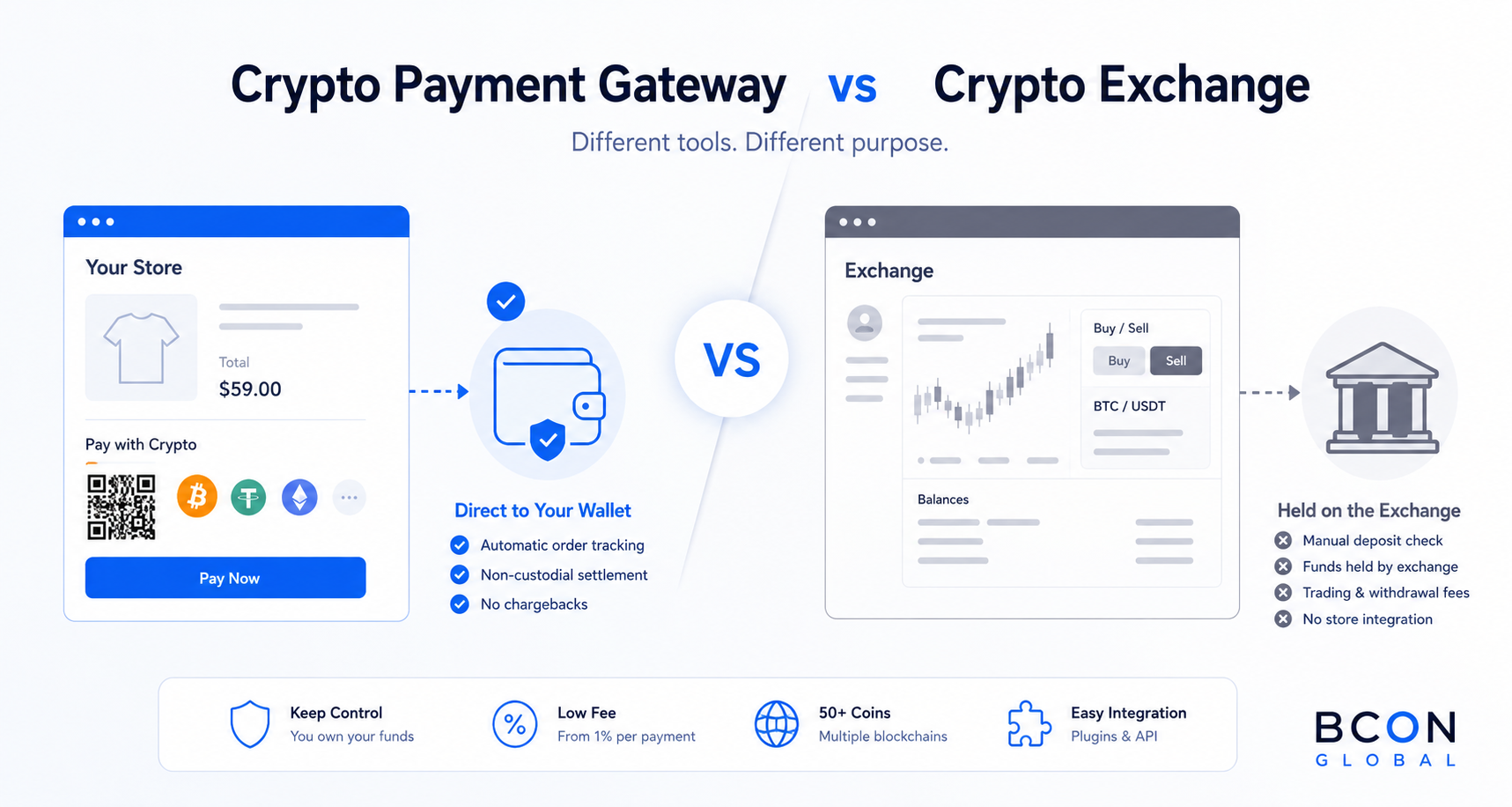








Crypto Payment Gateway vs Crypto Exchange: Differences
What’s the Difference?
If you run an online store and want to start taking digital currency, you will quickly encounter two very different tools: a crypto payment gateway and a crypto exchange. They sound related, and both deal with coins like Bitcoin and USDT, but they solve opposite problems. A gateway helps a business accept payments from customers. An exchange helps people buy, sell and trade coins. At Bcon Global we help merchants accept crypto every day, so in this guide we will break down how each one works, who holds your money, what the fees look like, and which tool your business actually needs.
Getting this distinction right matters more than it first appears. Choosing the wrong tool can mean slow settlement, frozen funds, extra fees and a checkout your customers abandon. By the end of this article you will be able to explain the difference in one sentence and pick the right setup with confidence.
What Is a Crypto Payment Gateway?
A crypto payment gateway is software that lets a business accept cryptocurrency at checkout, the same way a card processor lets you accept Visa. It sits between your customer and the blockchain. When a shopper chooses to pay in crypto, the gateway creates a payment request, shows a wallet address or QR code, watches the network for the incoming transaction, confirms it, and tells your website the order is paid.
The whole point of a gateway is automation for merchants. You do not have to manually check a wallet, calculate exchange rates or reconcile orders by hand. A good gateway plugs into your store through a plugin or an API, supports many coins, and pushes the money straight to a wallet you control. That last detail – where the funds land – is what separates a modern gateway from everything else, and we will come back to it below.
What Is a Crypto Exchange?
A crypto exchange is a marketplace for trading digital assets. People use exchanges to convert dollars into Bitcoin, swap one coin for another, or sell holdings back into fiat. Popular examples include large platforms where you register an account, pass identity checks, deposit funds and place buy or sell orders. The exchange matches your order with another user and takes a trading fee.
Exchanges are excellent at what they are designed for: buying, selling and trading. What they are not designed for is running a checkout. An exchange has no order system for your store, no plugin for your product pages, and no automatic way to tell your website that customer number 482 just paid for their order. It simply was never built to be a merchant tool.
Gateway vs Exchange: The Core Differences
The easiest way to see the gap is side by side. The table below compares the two tools across the factors that matter most to a business.
| Factor | Crypto payment gateway | Crypto exchange |
| Main purpose | Accept payments from customers | Buy, sell and trade coins |
| Who uses it | Merchants and websites | Traders and investors |
| Store integration | Plugins and API for checkout | None |
| Order tracking | Automatic, per transaction | Manual |
| Settlement | Direct to your wallet (non-custodial options) | Held on the exchange until withdrawn |
| KYC for the merchant | Often not required | Required |
| Typical fee | A flat service fee (around 1%) | Trading and withdrawal fees |
| Chargebacks | None (on-chain payments are final) | Not applicable |
Read the table top to bottom and a pattern appears. A gateway is a payment rail; an exchange is a trading venue. Using one for the other is like using a stock brokerage to run your shop’s till.
Why You Cannot Just Use an Exchange to Accept Payments
Plenty of merchants try to shortcut the process by giving customers their personal exchange deposit address. It feels cheaper, but it creates real problems fast. Here is what typically goes wrong:
- No checkout. There is no way to tie a payment to a specific order, so you end up matching amounts by hand and hoping two customers do not send the same figure.
- Manual settlement. You have to log in, confirm the deposit, sometimes convert the coin, and then withdraw – every single time.
- Custody risk. The exchange holds your money. If it freezes your account for a review, your revenue is stuck.
- KYC friction. Exchanges require identity verification, and deposit addresses can change, which breaks any workflow you build around them.
- No support for business cases. Refunds, invoices and reporting simply are not there.
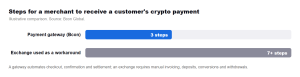
The chart above shows the practical result. A purpose-built gateway turns accepting a payment into a three-step flow, while the exchange workaround stretches it into seven or more manual actions. Multiply that by hundreds of orders and the “free” option becomes the expensive one.
Custodial vs Non-Custodial Gateways
Not all gateways are equal, and the biggest difference is custody – who holds the crypto between the customer paying and you receiving it. This is where a gateway can start to look like an exchange, and where you should pay attention.
A custodial gateway receives payments into its own wallets first and pays you out later, often after checks and delays. A non-custodial gateway never touches your funds; each payment settles directly to a wallet address you own. You share only a public address, never your private keys, so the provider physically cannot freeze or lose your money.
A payment tool should move money to you, not hold it hostage. Non-custodial settlement keeps the merchant in control from the first transaction.
This is the model we built Bcon Global around. Payments go straight to your wallet, there is no KYC to start, the fee is a flat 1%, and you can accept Bitcoin, Ethereum, USDT, USDC, USDS, TUSD and other coins through ready-made plugins or a simple API. In other words, you get the automation of a gateway without the custody risk that makes an exchange a poor fit for merchants.
The choice comes down to what you are actually trying to do. Use this quick guide:
- You want customers to pay you in crypto on your website – you need a payment gateway, ideally a non-custodial one.
- You want to convert crypto revenue into dollars – you may use an exchange after settlement, as a separate step.
- You are investing or trading personally – an exchange is the right home for that activity.
For most online businesses the answer is a gateway for accepting money and, optionally, an exchange later if you want to cash out. The two tools work together; they are not competitors. You can explore how a gateway connects to popular platforms on the Bcon integrations page.
Frequently Asked Questions
Is a crypto payment gateway the same as an exchange?
No. A gateway is built for merchants to accept payments at checkout, while an exchange is built for trading coins. They serve different users and different goals.
Can I accept payments directly through an exchange?
You can technically share a deposit address, but there is no order tracking, no store integration and the exchange holds your funds. For anything beyond a one-off, a gateway is far more practical.
Do payment gateways require KYC?
Non-custodial gateways usually do not require merchant KYC, because they never take custody of your funds and only need a public wallet address. Custodial services and exchanges typically do.
What does a crypto payment gateway cost?
Most charge a flat service fee. Bcon Global uses a simple 1% fee per payment with no monthly minimums, while network fees are paid by the sender.
Which coins can I accept with a gateway?
That depends on the provider. Bcon supports Bitcoin, Ethereum, USDT, USDC and more than 50 other assets across multiple blockchains.
A crypto payment gateway and a crypto exchange are not two versions of the same thing – they are tools for opposite jobs. The exchange is where coins are traded; the gateway is where a business gets paid. If your goal is to add crypto to your checkout, a non-custodial gateway gives you automation, direct-to-wallet settlement and no frozen-funds risk, all for a predictable fee.
If you are ready to accept crypto the right way, Bcon Global lets you start in minutes, keep full control of your money and support the coins your customers actually use.