








Cheapest Cryptocurrencies to Send in 2026 (Lowest Fees)
Transaction fees can quietly eat into every crypto transfer, so knowing the cheapest coins and networks to send is worth real money – especially for businesses moving crypto often. Fees vary enormously: the same payment can cost cents on one network and several dollars on another. At Bcon Global we help merchants keep costs low with a flat 1% fee and low-fee networks, so this guide compares the cheapest cryptocurrencies to send in 2026, why fees differ, and which to choose for payments.
The right choice can cut your transfer costs to almost nothing. Let us start with why fees vary in the first place.
Why Do Crypto Transaction Fees Vary?
A crypto network fee is what you pay validators or miners to process your transaction, and it depends on the blockchain’s design and how busy it is. Older networks like Bitcoin and Ethereum can charge more, especially at peak times, while newer high-throughput chains process transactions for a fraction of a cent.
Two factors drive the cost: the network’s capacity (how many transactions it can handle) and current demand. Pricing rules matter too: Tron charges for the “energy” a token transfer consumes at a rate set by its governance, which is why the same USDT transfer now costs about $2 on Tron but only cents on Ethereum and a fraction of a cent on Solana or BNB Chain (as of October 2026). Choosing the right network, not just the right coin, is the key to low fees.
The Cheapest Cryptocurrencies and Networks to Send
Here is where the real savings are. The chart and table below compare typical fees to send across popular options.
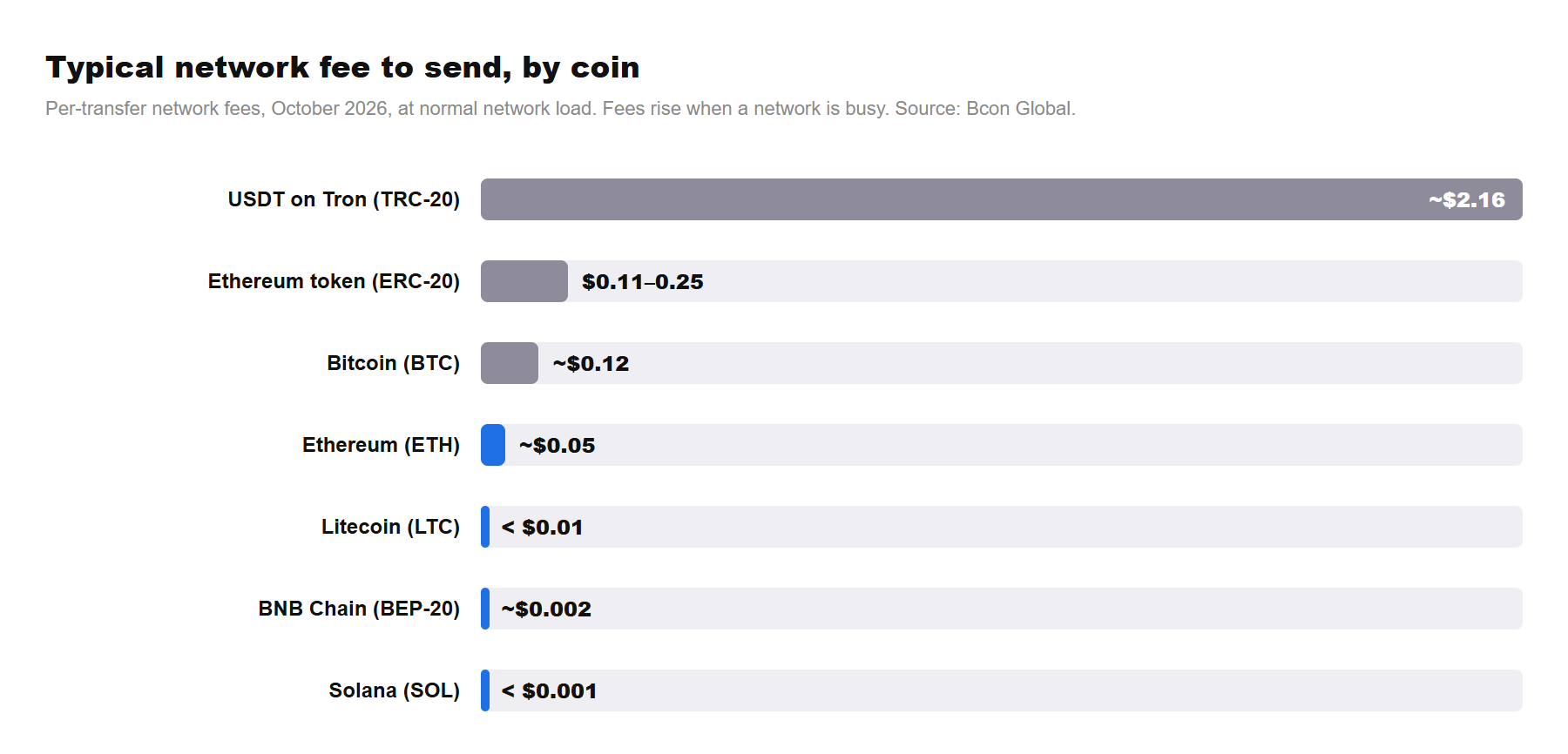
As the chart shows, Solana and BNB Chain cost a fraction of a cent, Bitcoin and Ethereum now cost cents when the networks are quiet, and USDT on Tron has become the most expensive major route. The table adds detail (fees as of October 2026):
| Coin / network | Typical fee (Oct 2026) | Speed | Notes |
| Solana (SOL) | under $0.001 | seconds | Very cheap and fast |
| BNB Chain (BEP-20) | ~$0.002 | seconds | Low fees, wide support |
| Litecoin (LTC) | under $0.01 | minutes | Cheap, established coin |
| Ethereum (ETH/ERC-20) | ~$0.05 for ETH, $0.11–0.25 for tokens | minutes | Low since 2025; can spike when busy |
| Bitcoin (BTC) | ~$0.12 when quiet | 10-60 min | Higher when congested |
| USDT on Tron (TRC-20) | ~$2.20 (~$4.40 to a new address) | ~1 minute | Popular for USDT, now the priciest major route |
The pattern has changed: Solana and BNB Chain now have the lowest transaction fees, Ethereum is down to cents, and TRC-20 – long seen as the cheap option – costs the most of the major stablecoin routes.
Cheapest Ways to Send Stablecoins
For payments, stablecoins are often what you actually send, and the network makes all the difference. In 2026 the cheapest routes are USDT or USDC on Solana or BNB Chain, at a fraction of a cent per transfer, followed by Ethereum at roughly 10–25 cents. USDT on Tron (TRC-20) is still popular and settles in about a minute, but at around $2.20 per transfer – roughly $4.40 to an address that has never held USDT – it is now the most expensive of the major options, so always choose the cheapest network your recipient supports.
If you send stablecoins regularly – paying suppliers, staff or for invoices – standardizing on a low-fee network like Solana or BNB Chain can save a surprising amount over a month.
Fees vs Speed vs Support: The Trade-off
The absolute cheapest option is not always the best. A practical choice balances three things:
- Fee – how much each transfer costs.
- Speed – how fast it confirms.
- Support – whether your recipient or gateway accepts that network.
Solana and BNB Chain win on fee and speed, but the transfer only works if the other side supports them. Bitcoin costs more but is the most widely recognized. For payments, the best network is the cheapest one your counterpart actually accepts.
The Cheapest Way to Accept Payments
Low network fees are only half the cost picture. When you accept crypto for business, the gateway’s service fee matters just as much, and hidden spreads or payout charges can outweigh a cheap network – our comparison of crypto payment gateway fees shows what to look for.
The true cost of a crypto payment is the network fee plus the gateway’s fee. Keep both low and transparent, and you keep almost all of every sale.
That is the approach behind Bcon Global. It charges a flat 1% with no monthly minimums or hidden spreads, supports low-fee networks like Solana and BNB Chain for USDT, and settles every payment directly to your own wallet – non-custodial, no KYC. The customer pays the network fee, so by combining a low-fee network with a flat 1% gateway, you keep costs to the bare minimum.
Frequently Asked Questions
What is the cheapest crypto to send?
Solana and BNB Chain cost a fraction of a cent per transfer. Ethereum now costs cents and Bitcoin about $0.12 when the network is quiet, while USDT on Tron (TRC-20) costs about $2 – the most of the major options (October 2026).
What is the cheapest way to send USDT?
Send USDT on Solana or BNB Chain, where a transfer costs a fraction of a cent. On Ethereum it costs roughly 10–25 cents, and on Tron (TRC-20) about $2.20 – twice that to an address that has never held USDT.
Is Tron cheaper than Ethereum for stablecoins?
Not any more. As of October 2026, a USDT transfer on Tron costs about $2.20, while the same transfer on Ethereum costs roughly 10–25 cents. Tron is still fast and widely used, but it is no longer the low-fee option.
What is the cheapest stablecoin to send?
The network matters more than the token: USDT or USDC on Solana or BNB Chain are the cheapest stablecoin routes for everyday payments, at a fraction of a cent per transfer.
Does a low network fee mean low overall cost?
Not always. The gateway’s service fee and any hidden spreads matter too. Combine a low-fee network with a transparent flat fee to keep total cost lowest.
The cheapest cryptocurrencies to send in 2026 are Solana and BNB Chain, with Ethereum now close behind at a few cents per transfer, while USDT on Tron has become the priciest major route. For payments, pick the cheapest network your counterpart supports, and remember that total cost is the network fee plus the gateway fee.
Bcon Global keeps both low – low-fee networks plus a flat 1% fee, settled straight to your own wallet – so you send and accept crypto for the least possible cost.