
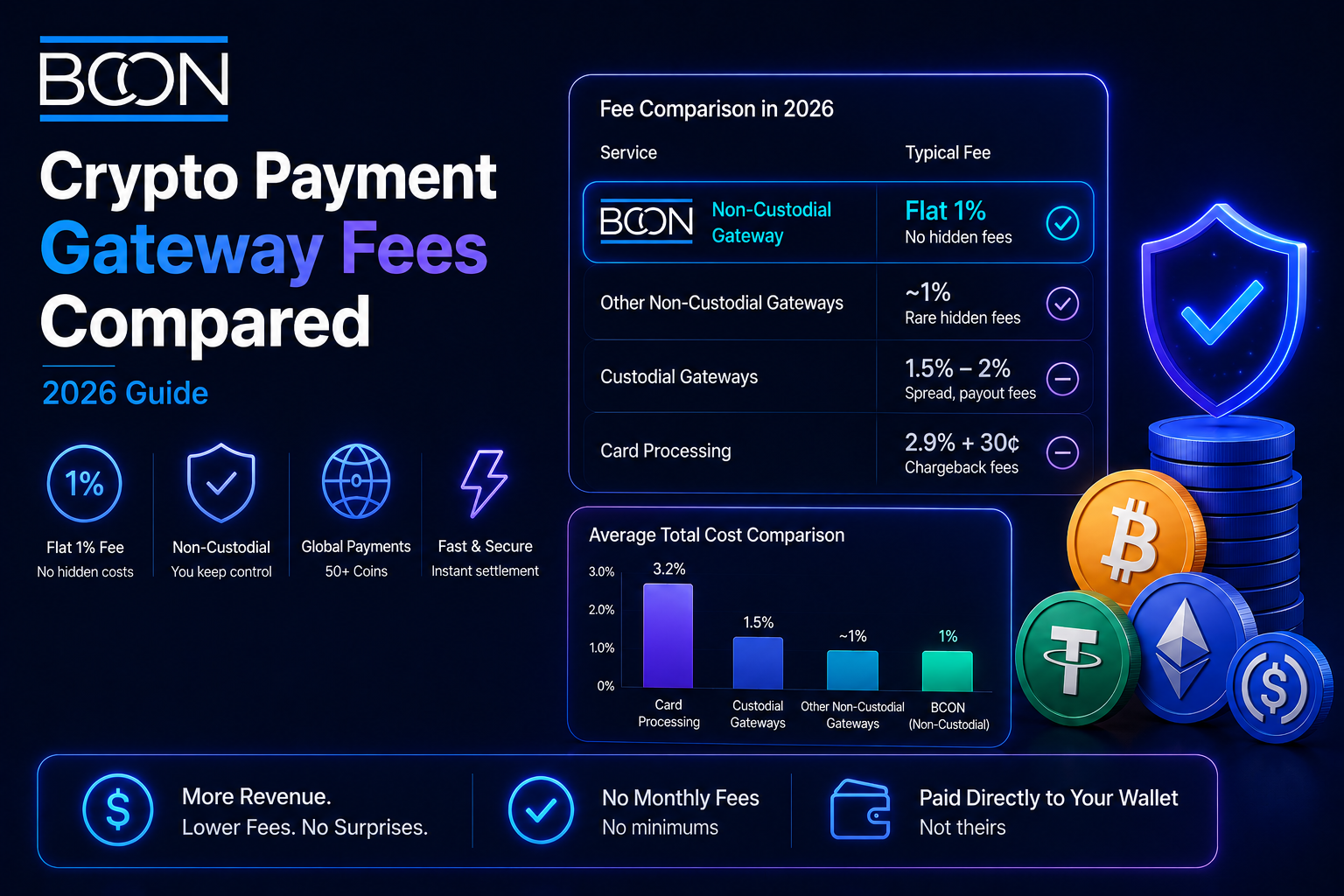








Crypto Payment Gateway Fees Compared: 2026 Guide
Fees decide how much of every sale you actually keep, so understanding them is the most practical part of choosing a crypto gateway. The headline rate is only half the story; hidden conversion spreads, withdrawal charges and monthly minimums can quietly cost more than the advertised percentage. At Bcon Global we keep pricing to a single flat fee on purpose, so this guide breaks down every type of crypto payment gateway fee in 2026, how to compare providers fairly and how crypto stacks up against card processing.
By the end you will be able to look at any pricing page and see the true cost, not just the number in large font.
The Types of Fees to Understand
A crypto gateway can charge in several places, and a fair comparison accounts for all of them. Here are the fees to look for:
- Service fee. The provider’s charge per payment, usually a percentage. This is the main number and is often flat, around 1%.
- Network fee. The blockchain’s own fee for processing a transaction. It is usually paid by the customer, not the merchant.
- Conversion spread. If a gateway auto-converts crypto to fiat, it may build a margin into the exchange rate – an easy cost to miss.
- Withdrawal or payout fee. Some custodial services charge to move your money out of their system.
- Monthly or minimum fees. Fixed charges regardless of volume, common with legacy processors.
The cheapest advertised rate is not always the cheapest in practice. A “0.5%” gateway with a conversion spread and withdrawal fee can cost more than a transparent flat 1%.
Flat Fee vs Percentage vs Hidden Costs
The clearest pricing model is a single flat percentage with nothing bolted on. You know exactly what each sale costs and can forecast margins with confidence. Trouble starts when providers split the cost across several line items, because the total becomes hard to predict.
This is why we recommend judging a gateway on its all-in cost. Add the service fee, any conversion spread and any payout fee together, then compare that figure across providers. A non-custodial gateway usually wins here, because it does not hold or convert your funds, so there is no spread or withdrawal charge to hide.
Fee Comparison: What to Expect in 2026
The table and chart below show typical ranges across common options. Exact numbers vary by provider, but the pattern is consistent year to year.
| Option | Typical fee | Hidden costs | Who holds funds |
| Non-custodial gateway (Bcon) | Flat 1% | None | You |
| Other non-custodial gateways | ~1% | Rare | You |
| Custodial gateways | 1.5-2% | Spread, payout fees | Provider |
| Card processing | 2.9% + 30c | Chargeback fees | Processor |
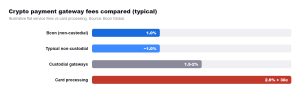
The chart makes the hierarchy clear. Non-custodial gateways sit around a flat 1%, custodial services run higher once you include spreads, and card processing remains the most expensive for most sales. For a business processing meaningful volume, the difference compounds into serious money over a year.
Crypto vs Card Fees
Cards charge roughly 2.9% plus a fixed amount per transaction, and they add chargeback risk on top. A flat 1% crypto gateway roughly cuts the percentage cost by two-thirds and removes chargebacks entirely, since on-chain payments are final. On a $100 order you might pay about $3.20 with cards versus around $1.00 with a 1% gateway.
When you compare all-in costs, a transparent flat-fee crypto gateway is consistently cheaper than card processing – and there are no disputes to claw back revenue.
The savings are not only in the headline rate. Removing chargebacks, monthly minimums and payout fees often matters as much as the percentage itself.
Why Non-Custodial Is Usually Cheaper
Custody drives cost. When a provider holds your funds, it takes on conversion, storage and payout, and it charges for each. A non-custodial gateway skips all of that: the payment settles directly to your wallet, so there is no conversion spread, no withdrawal fee and no float for the provider to monetize. That structural simplicity is why non-custodial pricing tends to be both lower and easier to understand.
It is the model behind Bcon Global: a flat 1% per payment, no monthly minimums, no payout fees, with support for BTC, USDT, USDC and 50+ other coins settled straight to your wallet.
How to Compare Gateways on Cost
Use this quick checklist to compare any two providers fairly:
- Find the service fee and confirm whether it is flat or tiered.
- Check for a conversion spread if the service converts to fiat.
- Look for withdrawal or payout fees.
- Check monthly minimums or setup charges.
- Confirm who pays the network fee (ideally the customer).
- Add it all up for your typical order value and volume.
Run that math and the true winner is often the transparent flat-fee option, not the one with the smallest headline number.
Real Examples: What Fees Look Like on Real Orders
Numbers make the difference tangible, so here is how a flat 1% gateway compares with card processing across three order sizes. The card figure uses the common 2.9% plus 30 cents, while the crypto figure uses a flat 1% with the network fee paid by the customer.
| Order value | Card processing cost | Crypto gateway (1%) | You keep extra |
| $50 | ~$1.75 | ~$0.50 | ~$1.25 |
| $500 | ~$14.80 | ~$5.00 | ~$9.80 |
| $2,000 | ~$58.30 | ~$20.00 | ~$38.30 |
Scale those savings across a month of orders and the impact on margin is obvious. A store processing $50,000 a month would pay roughly $1,450 in card fees versus about $500 with a flat 1% gateway – and it keeps that gap every single month, with no chargebacks eating into it further.
Frequently Asked Questions
How much do crypto payment gateways charge?
Most non-custodial gateways charge a flat service fee around 1%. Custodial services often run 1.5-2% once spreads and payout fees are included.
What is the cheapest crypto payment gateway?
The cheapest in practice is usually a transparent flat-fee, non-custodial gateway with no hidden spreads or withdrawal fees. Bcon uses a flat 1%.
Are crypto fees cheaper than credit card fees?
Generally yes. Cards cost about 2.9% plus a fixed amount and carry chargeback risk, while a 1% crypto gateway is cheaper and has no chargebacks.
Who pays the blockchain network fee?
The network fee is usually paid by the customer sending the payment, not the merchant.
Does Bcon have monthly fees?
No. Bcon charges a flat 1% per payment with no monthly minimums or payout fees.
Crypto gateway fees are simple once you look past the headline rate and add up the all-in cost. Non-custodial, flat-fee gateways are consistently the cheapest and most predictable, beating both custodial services and card processing while removing chargebacks. Compare the total cost, and the transparent option almost always wins.
Want pricing with no surprises? See the flat 1% model at Bcon Global and keep more of every sale.