
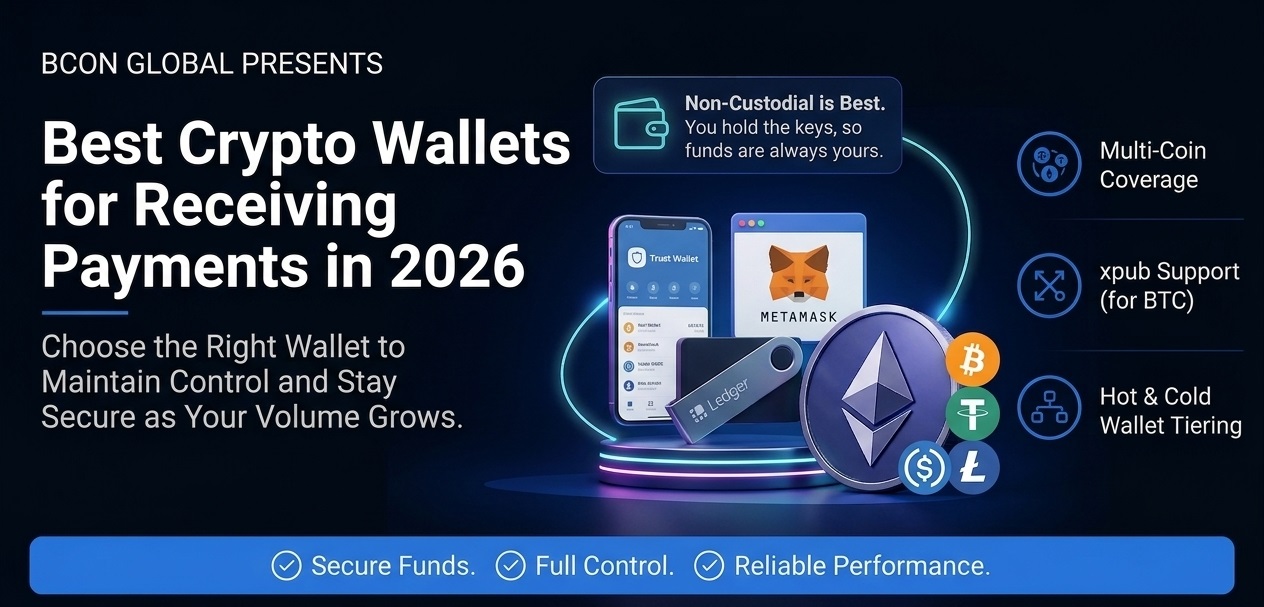








Best Crypto Wallets for Receiving Payments in 2026
Choosing the right wallet is the first real decision any business makes when it starts accepting crypto – and it matters more than the payment button on your site. The wallet is where your money actually lives, so the best crypto wallet for receiving payments is the one that keeps you in control, supports the coins your customers use, and stays secure as your volume grows. At Bcon Global we help merchants receive crypto directly to their own wallets every day, so in this guide we will break down what to look for, compare the leading options, and help you pick the right wallet for accepting payments in 2026.
This is not a generic “top 10 coins” list. It is a practical guide for anyone who wants to get paid in Bitcoin, USDT or other coins and keep every payment safe. Let us start with the single most important distinction.
Non-Custodial vs Custodial: The First Decision
Before comparing brands, you need to understand the difference that shapes everything else: custody. A wallet is either non-custodial, meaning you hold the private keys and control the funds, or custodial, meaning a third party holds the keys for you.
For receiving payments, this distinction is critical. A custodial wallet – like the balance on an exchange – is convenient, but the provider controls your money and can freeze, limit or lose it. A non-custodial wallet puts the keys in your hands, so no one can move your funds without you. The trade-off is responsibility: you must protect your recovery phrase, because there is no “forgot password” button.
For a business, non-custodial is almost always the right choice. It removes the risk of frozen balances and account reviews, and it is the model that makes a payment truly yours the moment it arrives. Everything below focuses on non-custodial wallets for that reason.
What to Look For in a Payment Wallet?
Not every good personal wallet is a good payment wallet. When you are receiving money – potentially many transactions a day – a few features matter more than others. Here is what to prioritize:
- Non-custodial control. You hold the keys, so the funds are always yours.
- The coins and networks you need. At minimum Bitcoin, Ethereum, USDT and USDC across the networks your customers use.
- Fresh receiving addresses. For Bitcoin, xpub support lets a gateway generate a new address per invoice while funds stay in your wallet.
- Strong security options. Seed-phrase backup, optional passphrase, and hardware-wallet pairing.
- Ease of reconciliation. Clear transaction history and export, so accounting is simple.
- Reliability. An established wallet with a solid track record and active development.
Keep these in mind as we compare the options, because the “best” wallet depends on which of these matters most to your business.
Hot vs Cold Wallets: Where Each Fits?
Wallets also split into hot and cold. A hot wallet stays connected to the internet – it is convenient for receiving and moving funds day to day. A cold wallet, usually a hardware device, keeps your keys offline, which is far safer for storing larger balances.
The best setup for a business combines both. Use a hot wallet as your working wallet to receive customer payments and handle everyday activity, then sweep larger balances to a hardware wallet on a schedule. Helpfully, most hot wallets can pair with popular hardware wallets, so you get the convenience of a hot wallet at checkout and the security of cold storage for savings.
Treat your hot wallet like the cash register and your hardware wallet like the safe. Receive into the register, move the bulk into the safe.
This layered approach is how serious merchants balance speed and security without choosing one over the other.
The Best Crypto Wallets for Receiving Payments
With the criteria set, here are the leading non-custodial wallets for accepting crypto in 2026, each with its strengths. The table after these summaries compares them at a glance.
Trust Wallet – best for multi-coin coverage
Trust Wallet is a mobile-first, non-custodial wallet that supports a very broad range of blockchains and tokens. If your customers pay in many different coins and networks, its breadth removes a lot of friction – you can hold Bitcoin, Ethereum, USDT on multiple chains and dozens of other assets in one app. It is approachable for non-technical teams and pairs with hardware wallets for added security.
MetaMask – best for Ethereum and EVM
MetaMask is the standard for the Ethereum world. It runs as a browser extension and mobile app and excels with ETH, ERC-20 tokens like USDT and USDC, and other EVM-compatible networks. If most of your payments are on Ethereum and its low-cost layer-2s, MetaMask is a natural home, and it also connects to hardware wallets.
Ledger – best for security (hardware)
Ledger is a hardware wallet, keeping your private keys offline on a physical device. It supports thousands of assets and is the gold standard for securing larger balances. For receiving payments, you would typically pair Ledger with a hot wallet interface, so incoming funds are easy to manage while the keys stay protected. For any business holding meaningful crypto, a hardware wallet is worth the small cost.
Exodus – best for a simple multi-asset desktop/mobile experience
Exodus is a user-friendly non-custodial wallet across desktop and mobile that supports a wide set of assets with a clean interface and built-in portfolio view. It suits merchants who want simplicity and multi-coin support without a steep learning curve, and it also integrates with hardware wallets.
Electrum and Bitcoin-focused wallets – best for Bitcoin and xpub
If Bitcoin is your priority, established wallets like Electrum provide an xpub (extended public key), which is exactly what a payment gateway needs to generate a fresh receiving address for every invoice while your coins stay in your wallet. Hardware wallets such as Ledger and Trezor also provide an xpub, combining Bitcoin-grade security with gateway compatibility.
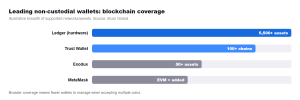
As the chart suggests, coverage varies widely. A hardware wallet like Ledger and a broad app like Trust Wallet span many networks, while MetaMask concentrates its strength in the EVM ecosystem. Your priority – breadth versus depth – points you toward the right pick.
Best Wallets Compared
The table below summarizes the options against the factors that matter for receiving payments.
| Wallet | Type | Best for | Custody | Hardware pairing |
| Trust Wallet | Hot (mobile) | Multi-coin coverage | Non-custodial | Yes |
| MetaMask | Hot (browser/mobile) | Ethereum & EVM | Non-custodial | Yes |
| Ledger | Cold (hardware) | Security / storage | Non-custodial | N/A (is hardware) |
| Exodus | Hot (desktop/mobile) | Simple multi-asset | Non-custodial | Yes |
| Electrum | Hot (desktop) | Bitcoin + xpub | Non-custodial | Yes |
There is no single winner – the right choice depends on which coins you accept and how much you value breadth, simplicity or maximum security.
Best Wallet by Use Case
To make the decision concrete, here is a quick guide by what you need most:
- You accept many coins and networks – Trust Wallet for breadth, or Exodus for a simple multi-asset experience.
- You mainly receive ETH and stablecoins – MetaMask for the EVM ecosystem.
- Bitcoin is your focus – a Bitcoin wallet with xpub (Electrum) or a hardware wallet (Ledger/Trezor).
- You hold significant balances – a hardware wallet (Ledger) paired with a hot wallet for daily receiving.
- You want the simplest safe setup – a reputable hot wallet plus a hardware wallet for savings.
Most businesses end up with a pairing: a hot wallet for receiving and a hardware wallet for storage. That combination covers both convenience and security.
Security Best Practices for a Payment Wallet
A non-custodial wallet is only as secure as your habits, since you are the custodian. Follow these essentials without exception:
- Back up your seed phrase offline. Write it down and store it safely; never keep it as a photo or in cloud notes.
- Never share private keys or seed phrases. No legitimate service will ever ask for them.
- Use a hardware wallet for larger balances, and consider an optional passphrase for extra protection.
- Verify addresses before receiving or sending, and watch for clipboard-hijacking malware.
- Download only from official sources to avoid fake wallet apps.
- Sweep to cold storage on a regular schedule rather than leaving large sums in a hot wallet.
Do these consistently and your wallet gives you bank-grade control over your own funds, with none of the third-party risk.
Best Wallet by Coin: Bitcoin, USDT and Ethereum
Because different coins have different needs, it helps to think about the best wallet per asset – especially if one coin dominates your payments.
For Bitcoin, prioritize xpub support and security. Electrum is a long-standing desktop choice that provides an xpub, and hardware wallets like Ledger and Trezor combine an xpub with offline key storage. This lets a gateway generate a fresh Bitcoin address for every invoice while your coins never leave your wallet – the ideal setup for receiving BTC at scale.
For USDT, the network matters as much as the wallet, because Tether exists on several chains. Choose a wallet that supports the networks your customers use, such as Tron (TRC-20) for low fees or Ethereum (ERC-20) for broad compatibility. Trust Wallet and MetaMask both handle USDT across multiple networks, so you can receive Tether wherever it comes from.
For Ethereum and ERC-20 tokens, MetaMask is the natural fit, with deep support for ETH, USDT, USDC and the low-cost layer-2 networks that have made Ethereum payments far cheaper than they once were. Trust Wallet also covers Ethereum well if you want a single app for everything.
The takeaway is simple: match the wallet to the coins you actually receive, and confirm it supports the specific networks your customers pay on. A wallet that “supports USDT” but not the right network will still cause failed payments.
Common Mistakes When Choosing a Payment Wallet
A few avoidable errors trip up businesses new to accepting crypto. Watch for these:
- Using an exchange balance as your “wallet.” That is custodial – the exchange controls your funds and can freeze or limit them. Use a non-custodial wallet you control.
- Ignoring network support. A wallet may support a coin but not the network your customers use. Always check both.
- Leaving large balances in a hot wallet. Sweep bigger sums to cold storage on a schedule.
- Skipping the seed-phrase backup. Without it, a lost device means lost funds. Back it up offline before receiving anything.
- Sharing more than the public address. A gateway only needs your public address or xpub – never your private keys.
Avoiding these keeps your setup both secure and reliable as your payment volume grows.
How a Wallet Works With a Payment Gateway?
A wallet stores and controls your money, but it does not, on its own, run a checkout. To accept payments smoothly, you connect your wallet to a payment gateway that generates invoices, watches the blockchain, and confirms payments – all without ever needing your private keys.
This is exactly how Bcon Global works. You link your wallet’s public address (or an xpub for Bitcoin), and every customer payment settles directly to it. Because Bcon is non-custodial, it only needs the public address to monitor for incoming payments – it can never move your funds. You keep whichever wallet you chose above fully under your control, while the gateway handles the checkout, confirmations and order updates for you.
That separation is the ideal arrangement: the wallet keeps your money, and the gateway does the work of getting you paid. You can review the options on the Bcon wallet FAQ and the xpub guide.
Frequently Asked Questions
What is the best crypto wallet for receiving payments?
The best wallet is a non-custodial one that supports the coins your customers use and keeps you in control of the keys. Trust Wallet suits multi-coin payments, MetaMask suits ETH and stablecoins, and a hardware wallet like Ledger is best for security.
Is a hot or cold wallet better for a business?
Use both. A hot wallet is convenient for receiving daily payments, while a cold hardware wallet safely stores larger balances. Pairing them gives you speed and security.
Are these wallets non-custodial?
Yes. Trust Wallet, MetaMask, Ledger, Exodus and Electrum are all non-custodial, meaning you hold the private keys and control your funds – no third party can freeze them.
What is the safest crypto wallet?
A hardware wallet such as Ledger or Trezor is the safest, because it keeps your keys offline. Pair it with a hot wallet for convenient receiving.
Can I use these wallets with a payment gateway?
Yes. With Bcon you provide your public wallet address (or xpub for Bitcoin) and payments route directly to it, with no need to share private keys.
The best crypto wallet for receiving payments in 2026 is a non-custodial one that fits your coins and keeps you in control – Trust Wallet for breadth, MetaMask for the EVM ecosystem, and a hardware wallet like Ledger for security. Most businesses run a hot wallet for receiving and a hardware wallet for storage, and secure both with a backed-up seed phrase.
Whichever you choose, Bcon Global lets you accept crypto straight to it – non-custodial, no KYC, with a flat 1% fee – so your wallet stays yours and getting paid stays simple.