








What Are Stablecoins? Types, Risks & Use in Payments
Stablecoins are the quiet workhorse of crypto payments. While Bitcoin grabs headlines for its price swings, most day-to-day business transactions in crypto now happen in stablecoins, because they hold a steady value. A stablecoin is a cryptocurrency designed to track the price of another asset, usually the US dollar, so one token stays worth about one dollar. At Bcon Global we see stablecoins used for the majority of merchant payments, so this guide explains what they are, the main types, the risks to know and why they work so well at checkout.
If you have ever hesitated to accept crypto because “the price moves too much,” stablecoins are the answer to that objection. Let us break down how they stay stable and where they fit.
What Is a Stablecoin, Exactly?
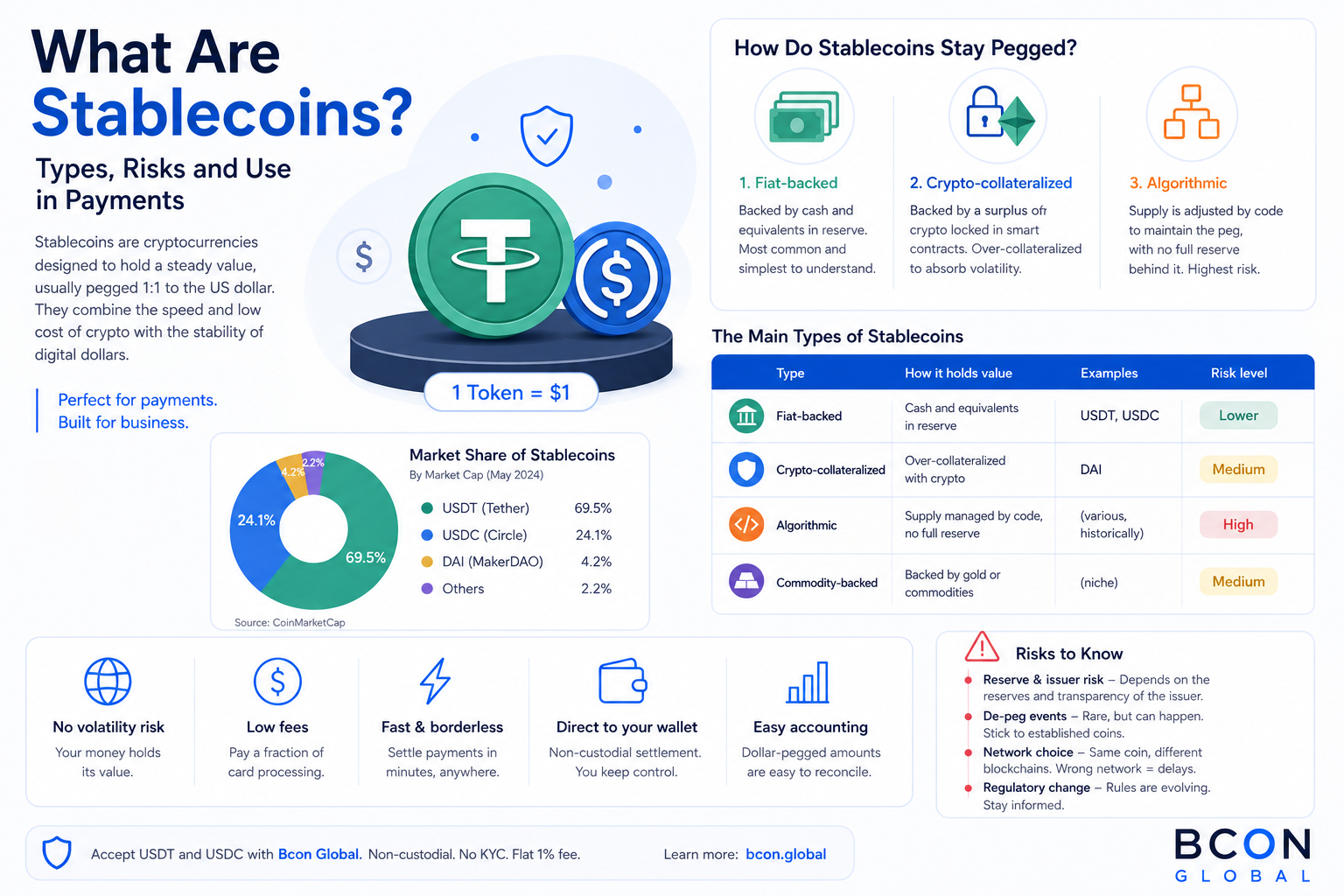
A stablecoin is a digital token engineered to keep a constant value against a reference asset. Most are pegged to the US dollar, so USDT and USDC each aim to stay at $1. Because they live on blockchains, they move with the speed and low cost of crypto while behaving like digital dollars in your accounting.
That combination is powerful for payments. A merchant can price goods in USD, accept a stablecoin, and receive an amount that keeps its value from checkout to settlement. There is no waiting to convert before the price shifts, which is the core problem stablecoins were built to solve.
How Do Stablecoins Stay Pegged?
Different stablecoins hold their peg in different ways, and the method matters for how much you can trust them. There are three broad approaches:
- Fiat-backed. Each token is backed by real dollars or equivalents held in reserve. USDT and USDC use this model, and it is the most straightforward to understand.
- Crypto-collateralized. Tokens are backed by a surplus of other crypto locked in smart contracts, like DAI. Over-collateralization absorbs price swings in the backing assets.
- Algorithmic. Supply is expanded or contracted by code to push the price toward the peg, with no full reserve behind it. This model is the riskiest and has failed dramatically in the past.
For payments, fiat-backed stablecoins are the standard choice because their peg is the simplest and most reliable.
The Main Types of Stablecoins
It helps to see the categories side by side, since the trade-offs shape which ones you accept.
| Type | How it holds value | Examples | Risk level |
| Fiat-backed | Cash and equivalents in reserve | USDT, USDC | Lower |
| Crypto-collateralized | Over-collateralized with crypto | DAI | Medium |
| Algorithmic | Supply managed by code, no full reserve | (various, historically) | High |
| Commodity-backed | Backed by gold or commodities | (niche) | Medium |
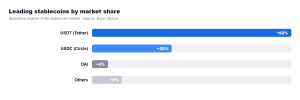
As the chart shows, a small number of fiat-backed coins dominate real usage. USDT leads by a wide margin, followed by USDC, with the rest sharing a modest slice. For a merchant, that concentration is good news: supporting USDT and USDC covers the vast majority of what customers will actually send.
Why Merchants Use Stablecoins for Payments
Stablecoins hit a sweet spot between traditional money and crypto. They give you the reach and speed of blockchain with the predictability of the dollar. The benefits are concrete:
- No volatility risk. A $200 invoice paid in USDC is worth $200 when it lands.
- Low fees. On efficient networks, transfers cost a fraction of card processing.
- Fast, borderless settlement. Payments clear in minutes from anywhere.
- Direct to your wallet. With a non-custodial gateway, stablecoins settle to an address you control.
- Clean accounting. Dollar-pegged amounts are easy to reconcile.
This is why so many businesses that were nervous about Bitcoin’s swings are comfortable accepting stablecoins. You can receive USDT and USDC directly with Bcon Global, which routes each payment straight to your wallet with no KYC and a flat 1% fee. USDC works the same way through the USDC option.
The Risks You Should Know
Stablecoins are practical, but they are not risk-free, and a good merchant understands the caveats. Keep these in mind:
- Reserve and issuer risk. A fiat-backed coin is only as sound as the reserves and the company behind it. Stick to established, transparent issuers.
- De-peg events. In rare stress moments a coin can briefly trade below $1. Fiat-backed coins have generally recovered quickly, while algorithmic ones have not.
- Network choice. The same USDT exists on several blockchains with different fees and speeds; sending on the wrong network can cause delays.
- Regulatory change. Rules around stablecoins are evolving, especially in the US, so stay informed.
For everyday payments, a well-established fiat-backed stablecoin gives you the stability of the dollar with the speed of crypto – the risk is manageable when you choose the issuer carefully.
None of these should stop a business from accepting stablecoins; they simply argue for sticking to the major, well-reserved coins rather than exotic ones.
Which Networks Should You Accept?
Because a single stablecoin lives on multiple chains, the network affects cost and speed. USDT on Tron (TRC20) is popular for low fees, while Ethereum (ERC20) is widely supported and Solana offers speed. A capable gateway lets you accept across networks so customers can pay on whichever chain they already use, and it handles the routing for you.
Stablecoins vs Bitcoin for Payments
Merchants often ask whether to accept stablecoins, Bitcoin, or both, and the honest answer is usually both, because they serve different customers. Bitcoin is the most recognized asset and some buyers simply prefer to spend it, but its price can move between the moment of checkout and settlement. Stablecoins remove that movement entirely, which makes them ideal for invoices, larger orders and any business that wants predictable, dollar-denominated accounting.
A practical setup accepts Bitcoin for its reach and stablecoins for their stability, then lets the customer choose at checkout. You keep clean records because stablecoin amounts map directly to dollars, while still welcoming the crypto-native audience that pays in BTC. The good news is that a capable gateway supports both from a single integration, so offering the full range adds no extra work on your side.
Frequently Asked Questions
What is a stablecoin in simple terms?
It is a cryptocurrency designed to hold a steady value, usually pegged to the US dollar, so one token stays worth about one dollar while moving with the speed of crypto.
Are stablecoins safe to accept?
Established fiat-backed stablecoins like USDT and USDC are widely trusted for payments. The main things to check are the issuer’s reserves and using the correct network.
What is the difference between USDT and USDC?
Both are dollar-pegged and fiat-backed. USDT (Tether) has the largest circulation, while USDC (Circle) is known for its regulated, transparent reserves. Many merchants accept both.
Which stablecoin is best for payments?
USDT and USDC are the practical choices because they are the most widely held and supported. Accepting both covers almost every customer.
Can I receive stablecoins directly to my wallet?
Yes. A non-custodial gateway like Bcon settles USDT and USDC straight to a wallet you control, with no third party holding the funds.
Stablecoins turn crypto into something a business can rely on: digital dollars that move fast, cost little and hold their value from checkout to settlement. Focus on the major fiat-backed coins, accept the popular networks, and you remove the volatility objection entirely.
If you want to accept USDT and USDC directly to your wallet, Bcon Global makes it simple, non-custodial and low-cost.