








Trust Wallet vs MetaMask: Which to Use (updated)
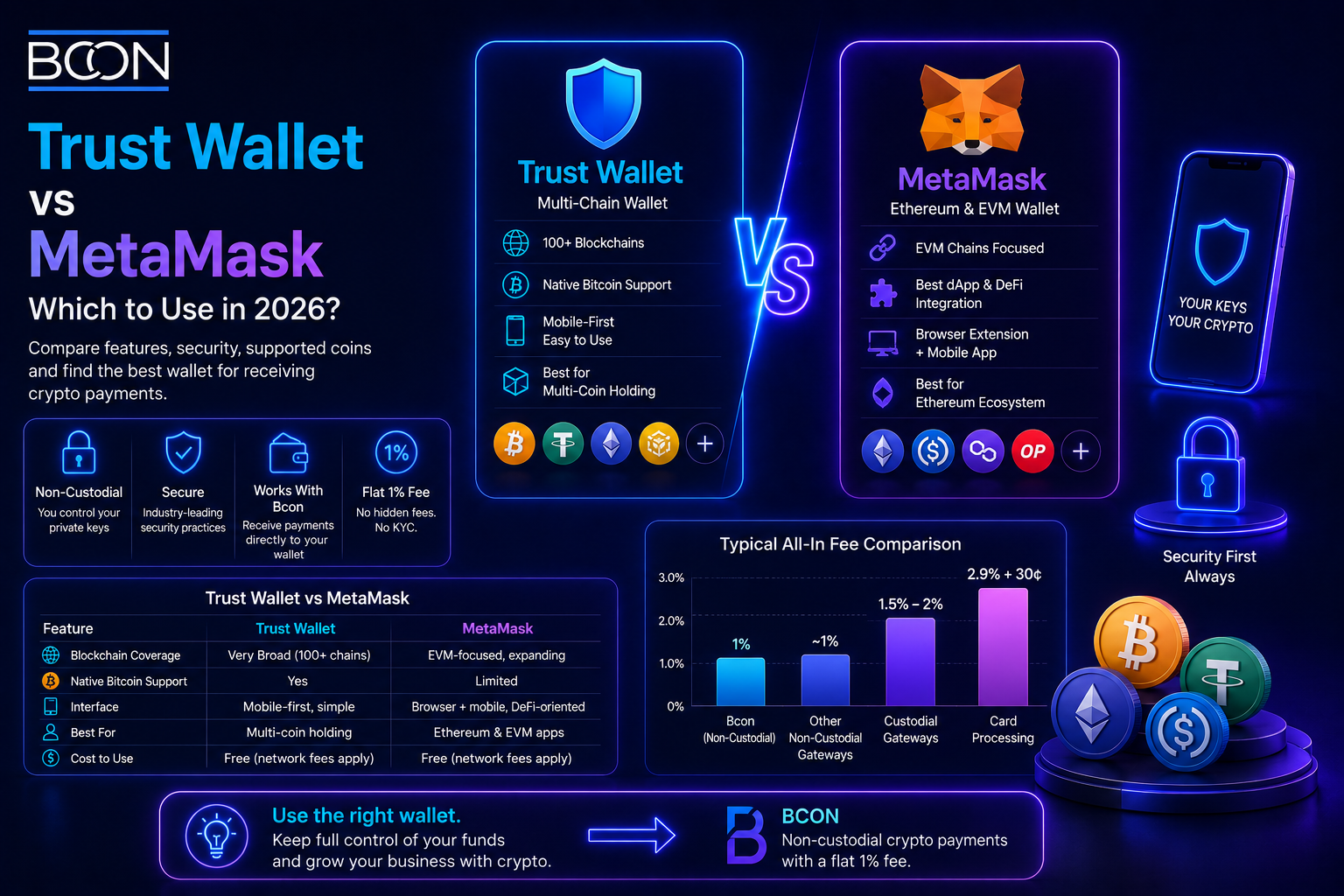
Trust Wallet and MetaMask are two of the most popular non-custodial wallets, and if you are receiving crypto payments, the choice affects which coins you can hold and how easily you manage them. Both put you in control of your private keys, but they take different approaches to coverage, interface and ecosystem. At Bcon Global we help merchants pick a wallet to receive payments every day, so this comparison lays out how the two differ, their strengths, and which one fits your needs in 2026.
Neither wallet is “wrong.” The right pick depends on what you hold and how you plan to use it. Here is the short answer, then the details.
The Quick Answer
If you want the widest coin coverage in a simple mobile app, Trust Wallet is usually the better fit. If you live in the Ethereum ecosystem and use browser-based apps and DeFi, MetaMask is hard to beat. Both are non-custodial, so in either case your funds stay under your control – which is exactly what you want for receiving payments.
What Trust Wallet Is
Trust Wallet is a mobile-first, non-custodial wallet that supports a very broad range of blockchains and tokens. It is designed to be approachable, so new users can store many different coins in one app without juggling separate wallets. It handles Bitcoin, Ethereum and dozens of other chains natively, which makes it convenient if you accept payments in several currencies.
Its breadth is the headline strength. For a merchant who wants to receive BTC, ETH, USDT on multiple networks and other assets in a single place, that coverage removes a lot of friction.
What MetaMask Is
MetaMask is a non-custodial wallet best known as the gateway to the Ethereum world. It runs as a browser extension and a mobile app, and it excels at connecting to decentralized applications, token swaps and EVM-compatible networks. Originally Ethereum-only, it now supports additional EVM chains, and its ecosystem integrations are unmatched.
MetaMask’s strength is depth in the Ethereum and EVM space rather than breadth across every blockchain. If most of your activity is ETH, ERC-20 tokens and stablecoins on EVM networks, it is a natural home.
Trust Wallet vs MetaMask: Side by Side
The table compares the two on the factors that matter for holding and receiving crypto.
| Factor | Trust Wallet | MetaMask |
| Custody | Non-custodial | Non-custodial |
| Blockchain coverage | Very broad (100+ chains) | EVM-focused, expanding |
| Native Bitcoin support | Yes | Limited |
| Interface | Mobile-first, simple | Browser + mobile, DeFi-oriented |
| Best for | Multi-coin holding | Ethereum and EVM apps |
| Cost to use | Free (network fees apply) | Free (network fees apply) |
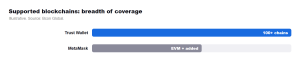
As the chart illustrates, Trust Wallet leads on the sheer number of supported chains, while MetaMask concentrates its power in the Ethereum ecosystem. Your priority – breadth versus EVM depth – points you to one or the other.
Which Is Better for Receiving Payments?
For accepting crypto, the decisive factors are coin coverage and control. If customers pay you in many different coins and networks, Trust Wallet’s breadth is convenient. If you mainly receive ETH and stablecoins on EVM chains, MetaMask works perfectly. Crucially, both are non-custodial, so whichever you choose, payments settle to an address you alone control.
For receiving payments, the best wallet is a non-custodial one that supports the coins your customers actually send – and keeps the private keys in your hands.
A payment gateway sits comfortably alongside either. With Bcon Global, you simply provide your wallet’s public address, and payments route directly to it. Because Bcon is non-custodial, it never needs your private keys – only the address, so your Trust Wallet or MetaMask stays fully under your control while the gateway handles checkout and confirmations.
Security: Keeping Either Wallet Safe
Both wallets are only as secure as your habits, since non-custodial means you are the custodian. Follow these essentials:
- Back up your seed phrase offline and never store it as a photo or in cloud notes.
- Never share private keys or seed phrases with anyone or any website.
- Verify addresses before receiving or sending, and beware of clipboard malware.
- Use a hardware wallet for large balances, pairing it with either app.
- Download only from official sources to avoid fake wallet apps.
Do these consistently and either wallet gives you bank-grade control over your own funds.
Hot vs Cold: Where These Wallets Fit
Both Trust Wallet and MetaMask are hot wallets, meaning they stay connected to the internet for convenience. That is ideal for receiving payments and moving funds day to day, but it is not where you want to keep a large treasury sitting idle. A cold wallet – a hardware device kept offline – is far safer for long-term storage because its keys never touch an internet-connected machine.
The practical setup for a business combines both. Use Trust Wallet or MetaMask as your working wallet to receive customer payments and handle everyday activity, then sweep larger balances to a hardware wallet on a regular schedule. Helpfully, both apps can pair with popular hardware wallets, so you get the convenience of a hot wallet at checkout and the security of cold storage for savings. This layered approach keeps operating funds handy while protecting the bulk of your crypto.
Frequently Asked Questions
Is Trust Wallet better than MetaMask?
Neither is universally better. Trust Wallet supports more blockchains in a simple app, while MetaMask is stronger for Ethereum and EVM apps. Both are non-custodial.
Which wallet is best for receiving crypto payments?
Choose the one that supports the coins your customers send. Trust Wallet suits multi-coin payments; MetaMask suits ETH and EVM stablecoins. Both keep you in control.
Are Trust Wallet and MetaMask non-custodial?
Yes. Both give you sole control of your private keys, so no third party can access or freeze your funds.
Do these wallets charge fees?
The wallets themselves are free to use. You only pay the standard blockchain network fee when sending transactions.
Can I use these wallets with a payment gateway?
Yes. With Bcon you provide your public wallet address and payments route directly to it, with no need to share private keys.
Trust Wallet and MetaMask are both excellent non-custodial wallets, and the winner depends on your needs: breadth of coins favors Trust Wallet, while Ethereum and EVM depth favor MetaMask. For receiving payments, either keeps you in control of your funds, which is what matters most.
Whichever you pick, Bcon Global lets you receive crypto straight to it – non-custodial, no KYC, with a flat 1% fee.