








How to Cash Out Crypto to Cash: A Merchant’s Guide
If your business receives crypto, sooner or later you will want to turn some of it into spendable dollars. The good news is that cashing out is straightforward once you know the routes and their trade-offs. At Bcon Global we help merchants accept crypto directly to their own wallets, so we see this question daily – and this guide walks through every practical way to cash out Bitcoin, USDT and other coins, what each costs, and how to do it while keeping full control of your funds.
Whether you cash out a little each week or convert in bulk, the process below applies. Let us start with when it actually makes sense to do it.
Why (and When) to Cash Out Crypto
Cashing out simply means converting cryptocurrency into fiat money like US dollars. Businesses do it to cover expenses, pay suppliers, or lock in value. But it is worth being deliberate, because every conversion can trigger fees and a taxable event.
A common middle path is to keep part of your revenue in stablecoins, which hold their dollar value, and only cash out to a bank when you actually need fiat. That way you avoid unnecessary conversions while still having predictable value on hand. If you already accept stablecoins, much of your “cashing out” problem disappears.
The Main Ways to Cash Out Crypto
There are several routes, and the best one depends on your amount, speed needs and location. The main options are:
- Crypto exchange to bank. Sell your crypto on an exchange and withdraw dollars to your bank account. Reliable for larger amounts.
- Peer-to-peer (P2P). Sell directly to another person or through a P2P marketplace, often faster and sometimes cheaper.
- Crypto debit card. Spend crypto directly or withdraw cash at an ATM; convenient for small, frequent amounts.
- OTC desk. For very large sums, an over-the-counter desk offers better rates and less market impact.
- Payment processor payout. Some custodial services convert and pay out fiat, though that means giving up custody.
Each route trades convenience for cost or control. The table later in this guide compares them directly.
How to Cash Out Crypto, Step by Step
The most common route – exchange to bank – follows a simple sequence. Here is how it works in practice:
- Choose a reputable exchange that supports your currency and country.
- Send your crypto from your wallet to your exchange deposit address, on the correct network.
- Sell the crypto for fiat (for example, sell BTC or USDT for USD).
- Withdraw the fiat to your linked bank account.
- Record the transaction for your accounting and taxes.
P2P and card methods skip the bank-withdrawal wait but add their own steps, such as matching with a buyer or loading a card. Whichever you use, always double-check the network before sending, since a wrong network can delay or lose funds.
Cash-Out Costs Compared
Cost is where the routes really differ. Fees come from the exchange or platform, the network, and sometimes a spread on the price. The chart below shows typical costs to cash out around a thousand dollars.
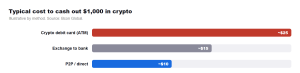
As the chart suggests, direct and P2P methods tend to be cheapest, while card ATM withdrawals cost the most in convenience fees. The table breaks down the trade-offs.
| Method | Typical cost | Speed | Best for |
| Exchange to bank | ~1-2% + network | 1-3 days | Larger amounts |
| P2P marketplace | ~1% or less | Minutes-hours | Speed, flexibility |
| Crypto debit card | ~2-3% | Instant | Small, frequent use |
| OTC desk | Negotiated | Same day | Very large sums |
Cashing Out Stablecoins Is Easier
If you hold USDT or USDC, cashing out is simpler and cheaper, because there is no price volatility to manage. A stablecoin is already worth a dollar, so you only pay the conversion and withdrawal fees, not a spread on a moving price. Sending USDT on a low-fee network like Tron keeps the transfer cost to roughly a dollar.
This is one reason many businesses prefer to accept stablecoins in the first place. You get the speed of crypto with the predictability of the dollar, and turning it into bank money is a short, low-cost step.
Fees, Taxes and Timing
Two things deserve attention beyond the headline fee. First, taxes: in most places, converting crypto to fiat is a taxable event, so record the value at the time of each cash-out and keep clean books. Because every transaction is on a public ledger, your records are easy to verify.
Second, timing. Bank withdrawals can take a few business days, while P2P and cards are faster. If cash flow is tight, plan cash-outs ahead rather than relying on same-day bank transfers. Splitting large conversions can also reduce market impact on volatile coins.
Keep Control: Receive to Your Own Wallet First
Here is the part many guides skip. The safest cash-out starts with actually owning your crypto in the first place. If you accept payments through a custodial service that holds your funds, you are already trusting a third party – and cashing out means waiting on their payout schedule and rules.
The cleanest way to cash out is to receive payments to a wallet you control, then convert on your own terms – not to wait for a provider to release funds it has been holding.
This is how Bcon Global works. Payments settle directly to your own wallet, non-custodial, with no KYC and a flat 1% fee. Because the crypto is already yours, you decide when and how to cash out – exchange, P2P or card – without anyone else in the way. You keep full control from the moment a customer pays.
Frequently Asked Questions
What is the best way to cash out crypto?
For larger amounts, an exchange-to-bank transfer is reliable; for speed, P2P is often faster and cheaper; for small, frequent use, a crypto card is convenient. Choose based on the amount and how quickly you need fiat.
How do I cash out Bitcoin to my bank account?
Send your BTC to an exchange, sell it for dollars, then withdraw the fiat to your linked bank account. It typically takes one to three business days.
Can I cash out crypto without fees?
Not entirely – there is usually an exchange or platform fee plus a network fee. You can minimize costs by using low-fee networks and P2P routes, and by cashing out less often.
Do I pay tax when I cash out crypto?
In most jurisdictions, converting crypto to fiat is a taxable event. Record the value at the time of each conversion and keep clear records for reporting.
How do I cash out USDT?
Because USDT is a stablecoin worth about a dollar, you sell it on an exchange or P2P for fiat and withdraw. Sending on a low-fee network like Tron keeps transfer costs low.
Cashing out crypto is simple once you match the method to your needs: exchanges for large amounts, P2P for speed and cost, cards for small everyday use. Keep fees down by using low-fee networks and stablecoins, plan for taxes, and cash out only when you actually need fiat.
Most importantly, own your crypto first. Bcon Global lets you receive payments straight to your own wallet – non-custodial, no KYC, 1% fee – so cashing out is always on your terms.