
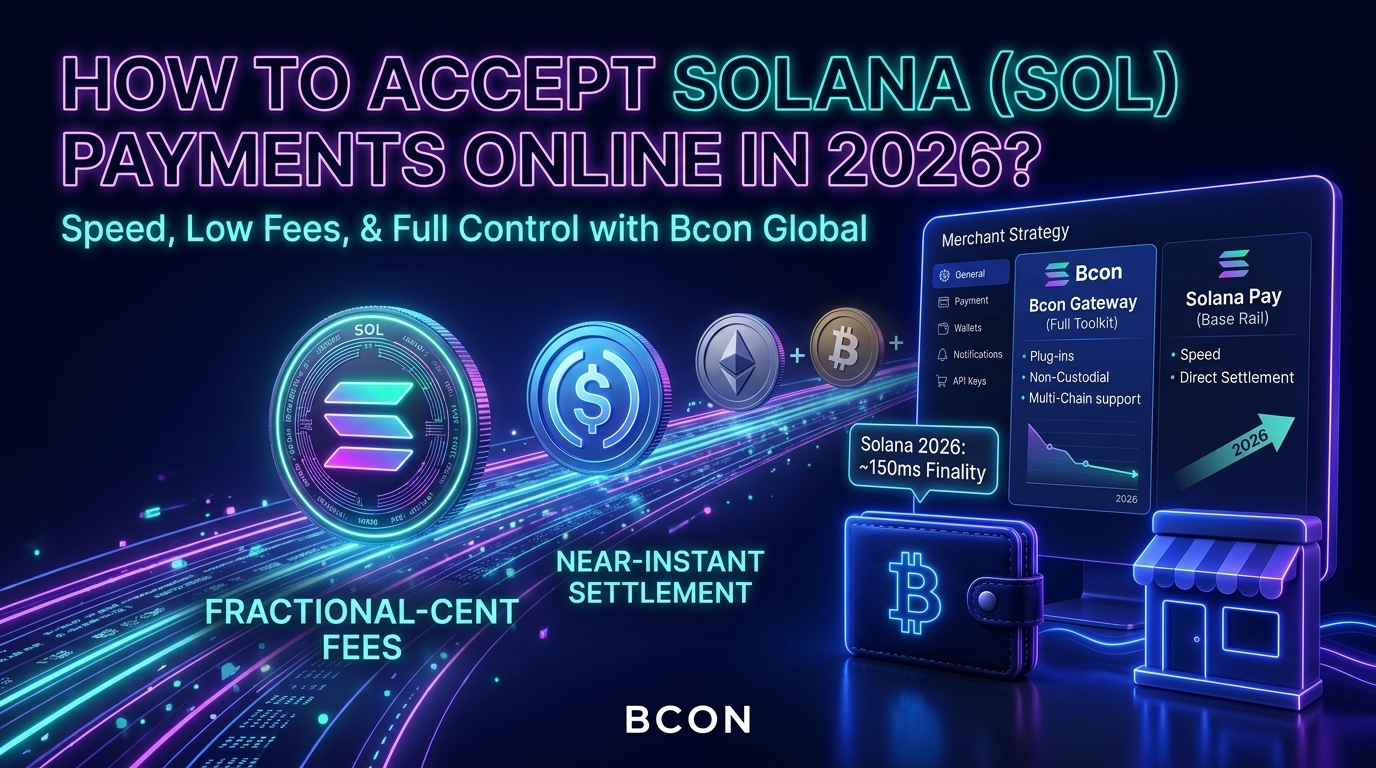








How to Accept Solana (SOL) Payments Online in 2026?
Solana has quietly become one of the best blockchains for accepting crypto payments, and 2026 is the year it went mainstream for merchants. The reason is simple: near-instant settlement and fees measured in fractions of a cent make it ideal for real-world checkout. At Bcon Global we help businesses accept Solana and other coins directly to their own wallets, so this guide covers why Solana works so well for payments, the up-to-date fees and speed, how to accept SOL and USDC on Solana, and how to set it up while keeping full control of your funds.
If you already accept Bitcoin or Ethereum, adding Solana is a small step that opens your checkout to a fast-growing, payments-focused ecosystem. Let us start with why it is worth doing.
Why Accept Solana Payments?
Solana was built for speed and low cost at scale, which is exactly what payments need. For a merchant, that translates into concrete advantages:
- Ultra-low fees. Solana transactions cost a fraction of a cent, so even small payments make economic sense.
- Near-instant settlement. Payments confirm in well under a second, so customers are not left waiting at checkout.
- Stablecoin support. USDC runs natively on Solana, letting customers pay in steady dollar value with the same low fees.
- High capacity. The network handles thousands of transactions per second, so it does not slow down under load.
- A growing payments ecosystem. Solana Pay and broad wallet support make it easy for customers to pay in SOL or USDC.
Together, these make Solana one of the most practical chains for accepting crypto in 2026, especially for high-volume or lower-value transactions where fees and speed matter most.
Solana Fees and Speed in 2026
This is where Solana genuinely stands apart, and it is worth using current figures rather than older assumptions, because network costs have shifted a lot across chains. In 2026, a typical Solana transaction costs around $0.00025 – well under a cent – even including small priority fees during busy periods.
Speed is just as striking. Solana produces blocks roughly every 0.4 seconds and processes thousands of transactions per second in practice. Following the network’s 2026 upgrade, finality dropped to around 150 milliseconds, meaning a payment is effectively irreversible almost the instant it is sent. For a checkout, that is as close to instant as crypto gets.
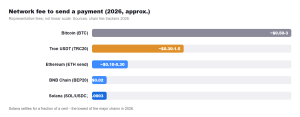
As the chart shows, Solana sits far below other networks on cost. It is important to note these are 2026 figures: Ethereum’s base fees have fallen sharply, Tron remains a low-cost route for USDT, and Bitcoin fees vary with congestion. Solana, however, is consistently the cheapest and fastest of the major payment chains – which is why it has become a default choice for merchants who value both.
SOL vs USDC on Solana: Which Should You Accept?
Solana lets you accept two very different assets, and offering both covers most customers. SOL is the network’s native coin, popular with crypto-native users who hold it. USDC on Solana is a dollar-pegged stablecoin, ideal for anyone who wants price stability – a $50 invoice paid in USDC is worth $50 when it lands.
For most businesses, the answer is to accept both. SOL captures the crypto-native audience, while USDC on Solana gives you steady dollar value with the same sub-cent fees and instant settlement. Because both run on Solana, there is no extra integration work – you simply enable the assets you want.
What You Need to Start?
Accepting Solana payments requires only a few basics, and no bank-style merchant account:
- A Solana-compatible wallet you control, where payments will land.
- A crypto payment gateway that supports Solana (SOL and SPL tokens like USDC).
- A store integration – a plugin for platforms like WooCommerce and OpenCart, or an API for a custom site or app.
With a non-custodial provider you generally do not need KYC, and there is no approval process before you begin. You connect a wallet and go live.
How to Accept Solana Payments, Step by Step?
Here is the practical sequence to start accepting SOL and USDC on Solana. Most stores complete it in an afternoon:
- Create a gateway account and connect your Solana wallet address.
- Install the plugin or connect the API to your store.
- Enable Solana assets – SOL and USDC on Solana.
- Set your display currency so prices convert automatically at checkout.
- Run a test payment to confirm the flow end to end.
- Switch it live and start accepting Solana payments.
When a customer checks out, they choose Solana, pay from their wallet, and the payment confirms almost instantly. The gateway detects the transaction, confirms it on-chain, and marks the order paid – no manual checking on your side.
Solana Pay vs a Payment Gateway: What’s the Difference?
You may have heard of Solana Pay, an open payments protocol that lets merchants accept SOL and SPL tokens like USDC directly, with settlement in seconds and sub-penny fees. It is a powerful standard, and it powers integrations across the ecosystem.
The practical question for most merchants is whether to build on Solana Pay directly or use a payment gateway that supports Solana. A gateway typically gives you more out of the box: ready-made plugins for common platforms, multi-coin support beyond Solana, automatic order updates, and non-custodial settlement to your own wallet. Solana Pay is excellent for Solana-only, developer-led setups, while a gateway suits businesses that want Solana alongside Bitcoin, Ethereum and stablecoins in one integration.
Solana Pay is the rail; a gateway is the toolkit. If you want Solana plus every other coin your customers use, a gateway is the simpler path.
Either way, the underlying benefit is the same – Solana’s speed and low cost – so the choice comes down to how much of the ecosystem you want to support and how much you want handled for you.
Solana vs Other Chains for Payments
It helps to see where Solana fits against the other networks you might accept, because each has a role. The comparison below focuses on what matters for payments – cost, speed and typical use.
| Network | Typical fee (2026) | Settlement speed | Best for |
| Solana | fraction of a cent | under a second | High-volume, low-value, everyday payments |
| Ethereum (mainnet) | ~$0.10-0.30 (ETH send) | minutes | ETH/EVM ecosystem, larger payments |
| Ethereum L2 | cents | fast | Low-cost Ethereum payments |
| Tron (USDT) | ~$0.30-1.5 | ~a minute | Low-fee USDT transfers |
| Bitcoin | ~$0.50-3 (varies) | 10-60 minutes | Store-of-value, brand recognition |
The pattern is clear: Solana leads on the two factors that matter most at checkout – cost and speed. That does not make other chains obsolete; Bitcoin brings recognition, Ethereum brings a huge ecosystem, and Tron remains a cheap USDT route. But for fast, near-free everyday payments, Solana is hard to beat, which is why it is worth adding alongside your existing coins.
Common Use Cases for Solana Payments
Solana’s speed and low cost make it especially useful in situations where fees and delays would otherwise hurt. Businesses commonly use it for:
- Small-ticket and micro-payments, where a fraction-of-a-cent fee finally makes tiny transactions viable.
- High-volume checkouts, where the network’s capacity keeps payments flowing without slowdowns.
- Digital goods and subscriptions, where instant settlement improves the customer experience.
- Stablecoin invoicing in USDC, giving clients steady dollar value with near-instant, near-free transfers.
- Global payments, where traditional rails are slow or expensive and Solana settles in seconds regardless of location.
If any of these describe your business, Solana is likely to become one of your most-used payment options once you enable it.
Keep Control: Non-Custodial Settlement
As with any crypto, the most important decision is custody. A custodial service receives your SOL and USDC into its own wallets and pays you out later, which reintroduces delays and the risk of frozen funds. A non-custodial gateway routes each payment straight to a wallet you control.
This is how Bcon Global works. Solana payments – SOL and USDC – settle directly to your own wallet, non-custodial, with no KYC and a flat 1% fee. Bcon only needs your public Solana address to watch for incoming payments; it never holds or controls your funds. You get Solana’s instant, near-free settlement without giving up control of your money, and you can accept other coins like Bitcoin, Ethereum and USDT through the same integration.
Security and Best Practices
Keeping Solana payments safe comes down to protecting your wallet, since non-custodial means you hold the keys. Back up your seed phrase offline, never share private keys, and verify your receiving address before use. For larger balances, pair your hot wallet with a hardware wallet. The gateway only needs your public address, so it can never move your funds.
A couple of Solana-specific tips help too. Make your accepted assets clear at checkout so customers know they can pay in SOL or USDC on Solana, and keep a small amount of SOL in your wallet if you plan to move funds, since Solana uses it for its tiny transaction fees. These small steps keep the experience smooth for you and your customers.
Is Solana Reliable Enough for Payments?
It is a fair question, because Solana had a reputation for occasional network slowdowns in earlier years. The picture in 2026 is very different. A series of upgrades focused on stability and speed – including the network’s move to faster finality – has made Solana far more robust, and it now routinely processes very high transaction volumes without the interruptions that made headlines in the past.
For a merchant, the practical safeguards are the same as on any chain. A payment gateway waits for the required confirmation before marking an order paid, so even in the rare event of a delay, you never ship against an unconfirmed payment. And because settlement is near-instant, those waits are measured in fractions of a second rather than minutes. In short, Solana’s reliability has caught up with its speed, which is a big part of why so many businesses adopted it for payments in 2026.
A Quick Solana Payments Checklist
Before you promote Solana at checkout, run through this short checklist to make sure everything is ready:
- Wallet connected – your Solana address (or the address your gateway generates) is linked and correct.
- Assets enabled – both SOL and USDC on Solana are switched on if you want to accept them.
- Test payment done – you have sent a small live payment and confirmed it appeared as paid.
- Checkout labelling – your payment page clearly shows customers they can pay in SOL or USDC on Solana.
- A little SOL on hand – keep a small SOL balance if you plan to move funds, to cover the tiny network fees.
- Reconciliation ready – you know where paid orders appear so accounting stays simple.
With those boxes ticked, you are ready to accept Solana payments smoothly, and your customers get the fast, near-free experience the network is known for.
The Bigger Picture: Solana’s Payments Momentum
It is worth stepping back to see why Solana matters beyond the raw numbers. In 2026, Solana became one of the most active networks for real payments, not just trading. Stablecoin activity on Solana has grown sharply, major payment integrations have rolled out – including support within large commerce platforms – and directories now list hundreds of businesses accepting SOL. The combination of sub-cent fees and near-instant finality is exactly what merchants and payment providers were waiting for.
For your business, that momentum has a practical upside. As more wallets, tools and customers standardize on Solana for payments, accepting it becomes easier and more expected. Adding SOL and USDC on Solana now positions you with a fast, cheap rail that a growing share of crypto users already prefer – and because a good gateway lets you enable it alongside Bitcoin, Ethereum and other coins, you capture that momentum without limiting your other options. Solana is not replacing the other chains; it is becoming the default for the payments where speed and cost matter most.
Frequently Asked Questions
How do I accept Solana payments on my website?
Connect a Solana wallet to a non-custodial gateway, install a plugin or the API, enable SOL and USDC on Solana, and run a test payment. You can be live the same day.
What are Solana transaction fees in 2026?
Solana fees are extremely low – around a fraction of a cent per transaction – even during busy periods. This makes it one of the cheapest chains for payments.
Is Solana good for payments?
Yes. Solana combines sub-cent fees with near-instant settlement (finality dropped to around 150 milliseconds after its 2026 upgrade), which makes it well suited to real-world checkout.
Can I accept USDC on Solana?
Yes. USDC runs natively on Solana, so you can accept dollar-pegged stablecoin payments with the same low fees and instant settlement as SOL.
What is the difference between Solana Pay and a gateway?
Solana Pay is an open protocol for accepting SOL and SPL tokens. A gateway adds ready-made plugins, multi-coin support and non-custodial settlement to your own wallet, handling more of the work for you.
Solana is one of the best chains for accepting crypto in 2026, thanks to fees of a fraction of a cent and near-instant settlement. Accept both SOL and USDC on Solana to cover crypto-native and price-sensitive customers, choose a non-custodial setup to keep control, and you add a fast, near-free payment option in one integration.
Ready to accept Solana? Bcon Global settles SOL and USDC on Solana straight to your own wallet – non-custodial, no KYC, flat 1% fee – alongside every other coin your customers use.