
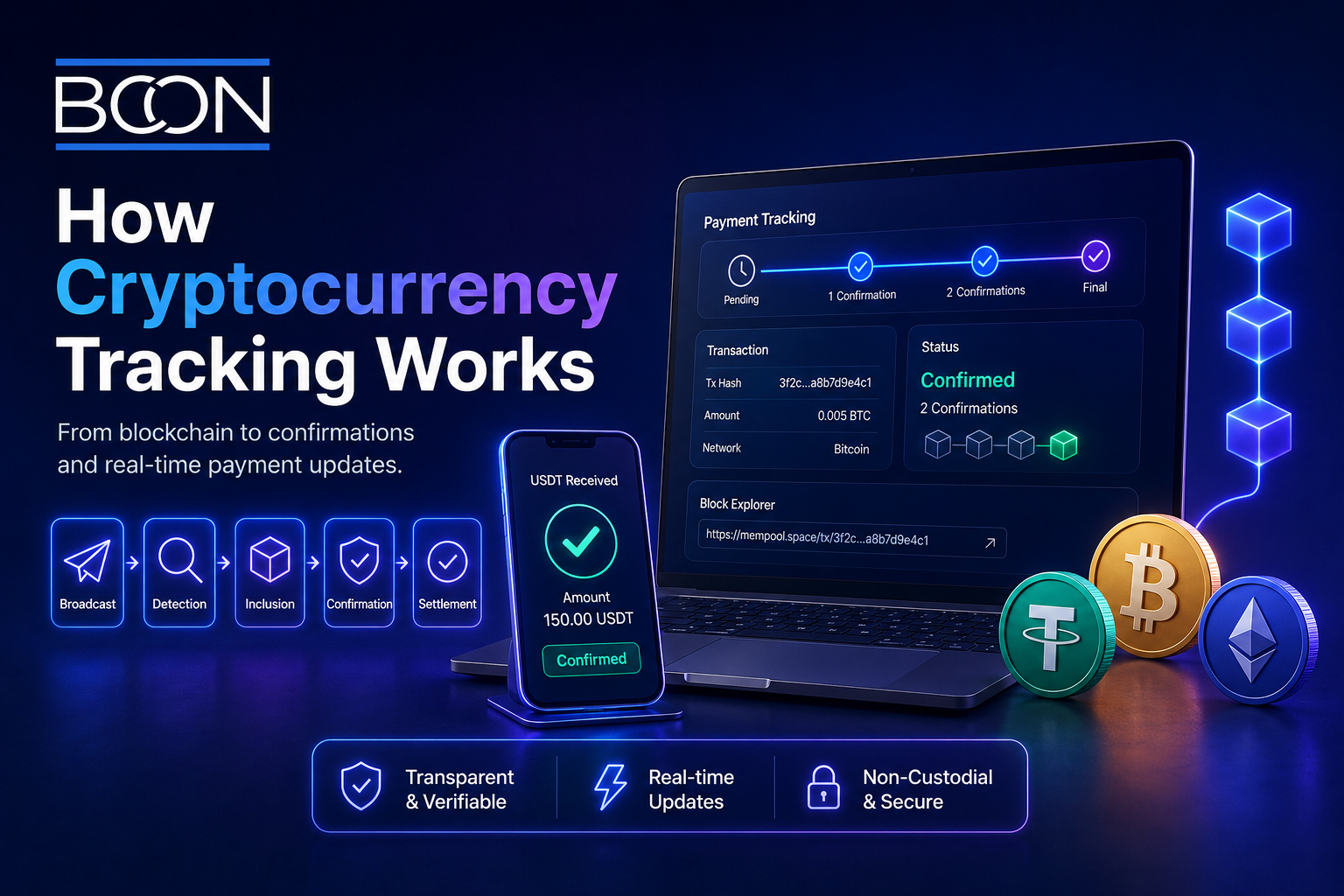








How Cryptocurrency Tracking Works (updated)
Every crypto payment leaves a permanent, public trail – and that is exactly what makes accepting it reliable for a business. When a customer sends you Bitcoin or USDT, the transaction is recorded on a blockchain that anyone can inspect. Understanding how this tracking works helps you confirm payments with confidence and explain the process to customers. At Bcon Global we turn this raw blockchain data into clean, real-time order updates, so this guide explains how crypto tracking works, from the public ledger to confirmations and automated notifications.
The idea sounds technical, but the mechanics are simpler than most people expect. Let us start with what “tracking” actually refers to.
What Does “Crypto Tracking” Mean?
Crypto tracking is the process of following a transaction from the moment it is sent to the moment it is final and recorded. Because blockchains are transparent by design, you can watch a payment move across the network in real time using its transaction ID, known as a hash. For a merchant, tracking answers three practical questions: did the payment arrive, is it confirmed, and is the correct amount now in my wallet.
This visibility is a major advantage over some traditional methods, where a payment can feel like a black box until it clears. With crypto, the status is always verifiable on a public record.
The Blockchain Is a Public Ledger
At the core of tracking is a simple fact: a blockchain is a shared, public ledger of every transaction. When funds move, the network of computers that maintain the chain records the sender’s address, the receiver’s address, the amount and a timestamp. Anyone can look this up through a tool called a blockchain explorer.
You never see a customer’s name or identity on the ledger, only wallet addresses and amounts. That is why crypto is often described as pseudonymous rather than anonymous – the money trail is fully visible, but it is tied to addresses instead of personal details.
How a Payment Is Tracked, Step by Step
Here is what happens behind the scenes when a customer pays you, and how each stage is followed:
- Broadcast. The customer’s wallet sends the transaction to the network, and it enters a waiting area called the mempool.
- Detection. A payment gateway watching your address sees the incoming transaction almost immediately and marks the order as pending.
- Inclusion. Miners or validators add the transaction to a new block on the chain.
- Confirmation. Each new block built on top adds a confirmation, making the payment harder to reverse.
- Settlement. After enough confirmations, the payment is treated as final and the funds are yours.
Throughout this flow you can verify each step yourself on an explorer using the transaction hash, which is useful if a customer ever asks for proof.
Confirmations: When Is a Payment Final?
A confirmation is simply a block added on top of the one containing your transaction. More confirmations mean more certainty that the payment cannot be undone. Different networks are considered final after different numbers of confirmations, based on their design and speed.
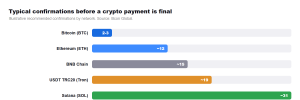
The chart shows common thresholds. Bitcoin is often accepted after two to three confirmations, while faster networks like Solana settle after more but much quicker blocks. The table below summarizes what each stage means for you.
| Status | What it means | Merchant action |
| Pending | Detected, not yet in a block | Wait; do not ship yet |
| 1 confirmation | Included in a block | Safe for small orders |
| 2-3+ confirmations | Multiple blocks on top | Safe for most orders |
| Final | Enough confirmations reached | Fulfil the order |
How Payment Gateways Automate Tracking
Doing all of this by hand for every order would be impractical, which is why a gateway automates it. Instead of you refreshing an explorer, the gateway monitors your wallet addresses, counts confirmations and then sends your store a signal called a webhook the instant a payment reaches the required status.
Good tracking means you never have to check a blockchain manually – the payment status arrives in your order system automatically, in real time.
This is how Bcon Global works: it watches the chain for you, confirms each payment and updates your order with no manual reconciliation. Because it is non-custodial, it only reads the public data tied to your address – it never controls your funds. You get instant, reliable status without touching a line of blockchain code.
Can Crypto Payments Be Traced?
Yes, and this is a feature, not a flaw. Every transaction is permanently recorded and can be followed from address to address on a public explorer. What is not automatically visible is the real-world identity behind an address. This transparency is why crypto payments are auditable and why disputes are rare – there is always a definitive record of what was sent and received.
For a business, traceability means clean bookkeeping and easy verification, while your customers keep their personal details private at the point of sale.
Tracking Different Coins and Networks
Not every coin is tracked in exactly the same way, and knowing the differences avoids confusion. Bitcoin has its own explorers and confirmation rhythm, while assets on Ethereum, Tron, BNB Chain and Solana each use their own explorers and block times. The same stablecoin, such as USDT, exists on several of these networks, so a payment must be tracked on the specific chain the customer used – a USDT transfer on Tron will not appear on Ethereum’s explorer.
This is another place where a gateway saves effort. Instead of you knowing which explorer to open for each coin, it watches every supported address across every network you enable and reports a single, unified status back to your store. A customer paying in USDT on Tron and another paying in Bitcoin both land in the same order dashboard, already confirmed. You get one consistent view no matter how many coins and chains you accept.
Frequently Asked Questions
How do I track a crypto payment?
Use the transaction hash in a blockchain explorer to see its status, or let a payment gateway track it for you and update your order automatically.
How many confirmations does a payment need?
It depends on the network. Bitcoin is commonly accepted after two to three confirmations, while other chains use different thresholds. A gateway applies the right number for you.
Can cryptocurrency transactions be traced?
Yes. Blockchains are public ledgers, so every transaction is visible and traceable by address, though it does not reveal the person’s identity by itself.
What is a blockchain explorer?
It is a free web tool that lets anyone look up transactions, addresses and confirmations on a blockchain in real time.
How does Bcon track my payments?
Bcon monitors your wallet addresses, counts confirmations and sends your store a real-time update when a payment is final, without ever holding your funds.
Crypto tracking works because the blockchain records every payment on a transparent, permanent ledger that anyone can verify. From detection in the mempool to final confirmation, each step is visible, and a good gateway turns that raw data into instant order updates. The result is reliable, auditable payments with no manual checking.
Want tracking handled for you? Bcon Global confirms and reports every payment in real time, straight to your store, while your funds stay in your own wallet.