








The rise of cryptocurrency has fundamentally changed how businesses think about money. What started with bitcoin has evolved into a full-scale financial ecosystem built on blockchain technology. Today, companies accept crypto payments, manage digital assets, and interact with Web3 infrastructure in ways that were impossible just a few years ago.
But as adoption grows, one question becomes unavoidable:
Who actually controls your funds?
This is where the distinction between custodial and non-custodial systems becomes critical. It is not just a technical detail. It defines your exposure to risk, your operational flexibility, your liquidity, and even your ability to scale across different jurisdictions.
What Is a Cryptocurrency Wallet?
A cryptocurrency wallet is not a storage device in the traditional sense. It does not “hold” coins. Instead, it provides access to funds recorded on a blockchain.
At its core, every crypto wallet relies on two elements:
- A public key used to receive funds
- A private key used to sign and authorize crypto transactions
This is why control matters. Whoever holds the private keys controls the crypto assets.
Modern crypto wallets come in different wallet types, including software wallets like MetaMask and hardware wallets, which are often used for cold storage.
What Is a Private Key?
A private key is the most important component in any blockchain system. It is a cryptographic credential that allows you to access and move your funds.
Private keys are usually backed up using a seed phrase. This phrase is the only recovery method available in most decentralized systems. Unlike traditional finance, there are no built-in recovery options if the seed phrase is lost.
This creates a fundamental shift in responsibility. Instead of relying on a service provider, the user becomes responsible for securing their own assets.
What Is a Non-Custodial Wallet?
A non-custodial wallet is a wallet where the user retains full control over their private keys. This is often referred to as self-custody.
With non-custodial wallets, transactions are signed directly by the user and executed on-chain without intermediaries. This model is the foundation of decentralized finance and enables direct interaction with DeFi, staking, and other blockchain-based services.
However, these benefits come with trade-offs. Users must manage their own security, including storing their seed phrase and protecting access to their wallet.
What Is a Custodial Wallet?
In contrast, custodial wallets are managed by custodial providers such as Coinbase and Kraken.
These platforms are examples of centralized exchanges that operate under a custodial model. They hold users’ private keys and manage funds internally.
This answers a common question clearly:
Is Kraken a custodial exchange?
Yes, it is.
Custodial systems are typically more user-friendly, offering customer support, simplified onboarding, and built-in compliance features such as KYC, AML, and identity verification.
Can You Lose Crypto With a Custodian?
Yes, and this is one of the most important risks to understand.
When you use custodial services, you introduce counterparty risk. This means your funds depend on the stability and integrity of the provider.
Risks include:
- Large-scale hacks targeting centralized systems
- Platform insolvency
- Frozen accounts due to regulatory actions
- Restrictions based on jurisdiction
Even if a provider follows strict regulatory compliance standards, your access to funds can still be affected.
In other words, you may not lose your password—but you can lose access to your money.
What Is a Crypto Payment Gateway?
A crypto payment gateway is a system that allows businesses to accept cryptocurrency payments.
It acts as a bridge between customers and merchants, handling:
- Invoice generation
- Address creation
- Payment tracking
- Integration via API
However, not all payment gateways operate the same way. Some are custodial, while others are non-custodial.
Custodial vs Non-Custodial Payment Gateways
The difference lies in how funds move.
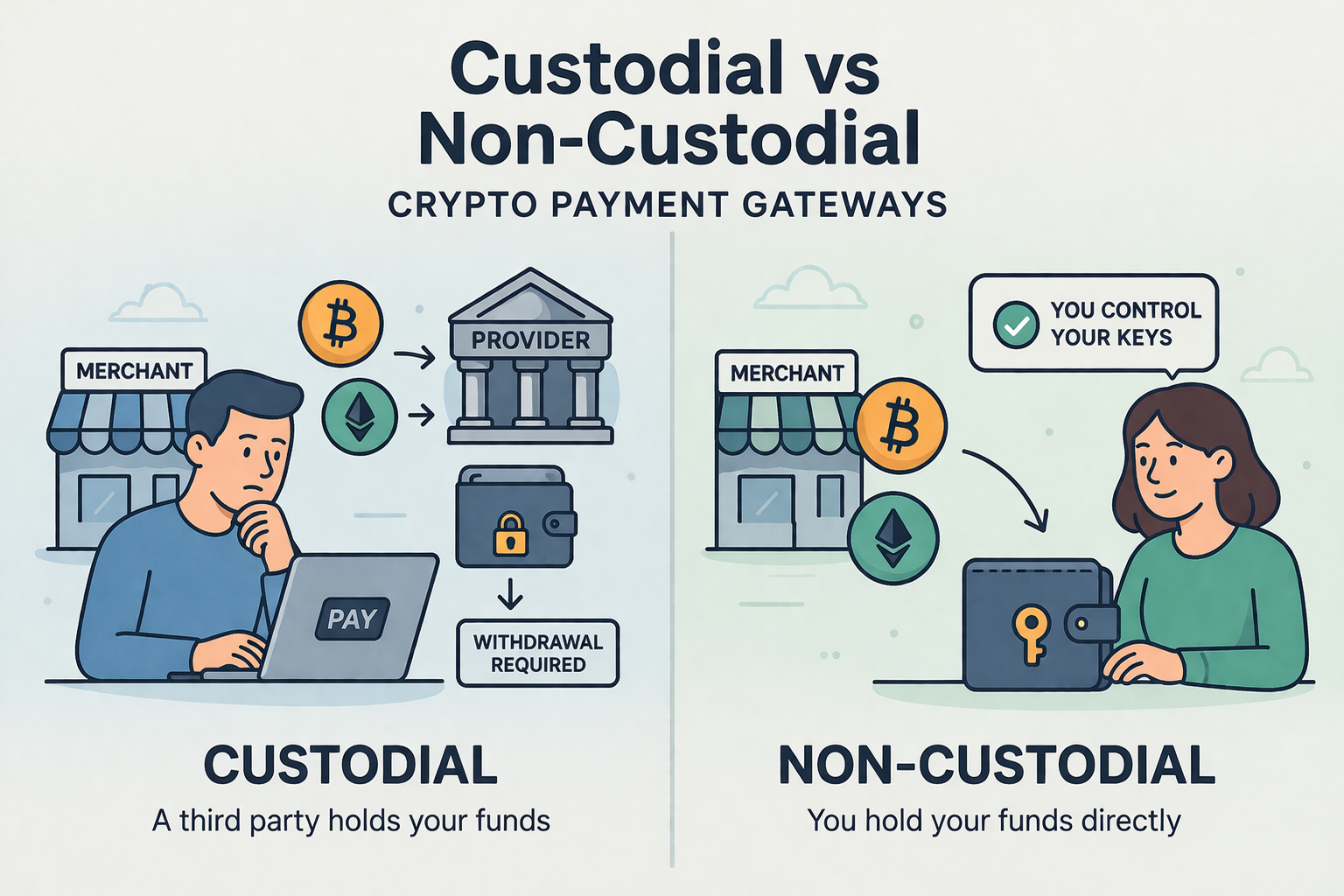
In a custodial model, the gateway receives payments on behalf of the merchant. Funds are stored within the platform, and merchants must request withdrawals to access them.
In a non-custodial model, funds are sent directly to the merchant’s wallet. There are no intermediaries, and no custody of funds.
This is the core of non-custodial crypto infrastructure.
Key Differences That Matter in Practice
| Aspect | Custodial Solutions | Non-Custodial Crypto |
| Control | Limited | Full control |
| Private keys | Held by provider | Held by user |
| Intermediaries | Required | Removed |
| Withdrawals | Required | Not needed |
| Fees | Higher | Lower |
| Compliance | KYC / AML heavy | Minimal |
| Speed | Delayed | Real-time |
These key differences directly affect how businesses operate.
Fees and Financial Efficiency
Fees in custodial systems are layered. You may encounter processing fees, withdrawal costs, and conversion fees between cryptocurrency and fiat.
Non-custodial systems are simpler. Most costs are limited to network fees, which are transparent and predictable.
Over time, this affects profitability—especially for businesses processing large volumes of crypto payments.
Security: A Balanced Perspective
Security is often misunderstood in this context.
Custodial systems centralize security. They invest heavily in infrastructure, but they also create attractive targets for attackers.
Non-custodial systems distribute security. There is no central pool of funds to attack, but users must protect their own access.
For experienced crypto users, non-custodial systems often provide better long-term security because they eliminate entire categories of risk.
Disadvantages of Non-Custodial Wallets
Despite their advantages, non-custodial wallets are not perfect.
They require users to manage their own keys and seed phrases. Losing access means losing funds permanently.
They may also lack the customer support and convenience offered by custodial services.
For beginners, this can be a barrier. However, modern tools are making non-custodial systems increasingly user-friendly.
The Role of Compliance and Regulation
Custodial providers operate within strict regulatory frameworks. This includes know your customer (KYC) and anti-money laundering (AML) requirements designed to prevent money laundering.
While this ensures compliance, it also introduces friction:
- Slower onboarding
- Additional verification steps
- Restrictions based on location
Non-custodial systems reduce this friction because they do not hold funds. This allows businesses to operate more freely across different jurisdictions.
Real-World Business Scenario
Imagine two companies accepting stablecoins and ethereum payments.
The first uses a custodial gateway. Funds accumulate within the platform, requiring periodic withdrawals. Fees are applied at multiple stages, and access depends on the provider.
The second uses a non-custodial gateway. Funds are received instantly into their wallet. They can immediately use those funds for operations, convert them, or deploy them into DeFi strategies.
Over time, the second company benefits from faster access, lower costs, and greater independence.
Where the Industry Is Moving
The broader trend in the crypto space is clear. More businesses are moving toward self-custody wallets, non-custodial crypto wallets, and direct interaction with blockchain systems.
This shift is driven by:
- Demand for full control
- Reduced reliance on intermediaries
- Growth of Web3 and decentralized applications
As the ecosystem evolves, non-custodial solutions are becoming the standard for businesses that prioritize autonomy and efficiency.
Final Thoughts
The difference between custodial and non-custodial systems is ultimately about control.
Custodial systems offer convenience but require trust in a third party. Non-custodial systems remove that dependency but require responsibility.
For businesses, the decision is strategic. It affects not only how payments are processed but also how risk is managed and how capital is deployed.
In a world where blockchain enables direct ownership, the most efficient systems are often the ones that stay closest to that principle.