








Custodial vs Non-Custodial Crypto Payment Gateways: The Complete Guide
The adoption and acceptance of cryptocurrencies have created new challenges for the traditional financial system by changing the fundamental principles of how every part of the financial sector operates. The blockchain technology at the core of cryptocurrencies has made it possible to build an open financial infrastructure that has fundamentally transformed the very concept of ownership and the global accessibility of finance. Today, any developer can create their own wallets, services, and payment solutions. Likewise, any user can choose and use the solutions that best suit their needs from anywhere in the world while independently storing and managing their own funds.
In this article, we will discuss two approaches to storing and managing funds in crypto payment gateways: custodial and non-custodial models. These approaches differ not only technically but also fundamentally affect your exposure to risk, operational flexibility, liquidity, and even your ability to scale operations across different jurisdictions.
What Is a Cryptocurrency Wallet?
A cryptocurrency wallet is a software application that does not store funds in the literal sense. Instead, it communicates with the blockchain, where a record of your ownership of a particular digital asset and its corresponding balance is stored. This software can take various forms, whether embedded into a dedicated hardware device, installed on a computer or smartphone, or provided as a web-based application.
At its core, every crypto wallet relies on two elements:
- A public key used to receive funds
- A private key used to sign and authorize crypto transactions
The public key is essentially your wallet address — the address of your account. It can only be used to identify the destination or source of funds, indicating where funds are being sent to or received from.
The private key is the access key to your account. It is used to authorize access and digitally sign transactions for sending funds.
What Is a Private Key?
The private key is a fundamental element of any cryptographic system, including blockchain. It allows the blockchain to identify you as the owner of a wallet and its associated assets, giving you full control over the funds held in that wallet.
For better readability and convenience, a seed phrase is used as the means of accessing your wallet. There are no other access or recovery keys beyond it. This is one of the key differences from the traditional banking system. Instead of delegating responsibility to a third party, you alone are responsible for the security of your funds. At the same time, you can independently perform many of the same functions that would traditionally be handled by a bank.
What Is a Non-Custodial Wallet?
Non-custodial wallets, also referred to as self-custody wallets, are wallets that give you full control through your private keys. No one but you knows these keys, can manage your funds, or hold them on your behalf.
Any wallet application you choose to use for receiving and sending cryptocurrency will either ask you to import the private keys of an existing wallet or offer to generate a new one. This is because the private key is used to authorize access and digitally sign outgoing transactions.
This model is the foundation of decentralized finance (DeFi) and allows you to interact directly with DeFi protocols, staking, smart contracts, and virtually any service built on the blockchain.
At the same time, you must understand that you alone are responsible for both the security and the loss of your private key. If it is lost or compromised, no one will be able to recover it or help you regain access to your funds.
What Is a Custodial Wallet?
n the case of custodial wallets, everything works much like it does with banks in the traditional financial sector, except that they enable you to work with crypto assets. There is a custodial service provider that holds the private keys and provides you only with wallet addresses, or account addresses. Through the service interface and your personal account, you can manage these funds, but you do not have access to the private keys.
Custodial services are much easier to use because they are designed around the functionality of their own platform and infrastructure. However, they also comply with the same regulatory requirements as banks and other financial intermediaries. This means they verify your identity through KYC procedures, perform AML checks on your transactions, and have the ability to freeze or hold your funds.
Can You Lose Crypto With a Custodian?
Yes, of course, you can lose your funds, and this can happen for a variety of reasons. Your assets depend on the stability and security of a third party. As a result, you are exposed to the following counterparty risks:
- The service can be hacked and robbed.
- The service can experience technical failures or become unavailable.
- Your funds can be frozen for various reasons, such as regulatory requirements or suspicious activity, just as with any traditional bank.
- Restrictions related to jurisdiction.
Custodial providers must comply with numerous regulations that change over time and vary significantly depending on the jurisdiction in which the service operates. Even if you have access to your account, it does not necessarily mean that you will be able to use or access your funds.
What Is a Crypto Payment Gateway?
A cryptocurrency payment gateway is a system that enables businesses to accept cryptocurrency payments. It acts as a bridge between the customer and the merchant by automating the payment process, including:
- Creating an invoice and a payment address.
- Tracking the payment and its status.
- Automating payment-related actions.
However, just like cryptocurrency wallets, there are several types of crypto payment gateways. They differ significantly, both technically and conceptually.
Custodial vs Non-Custodial Payment Gateways
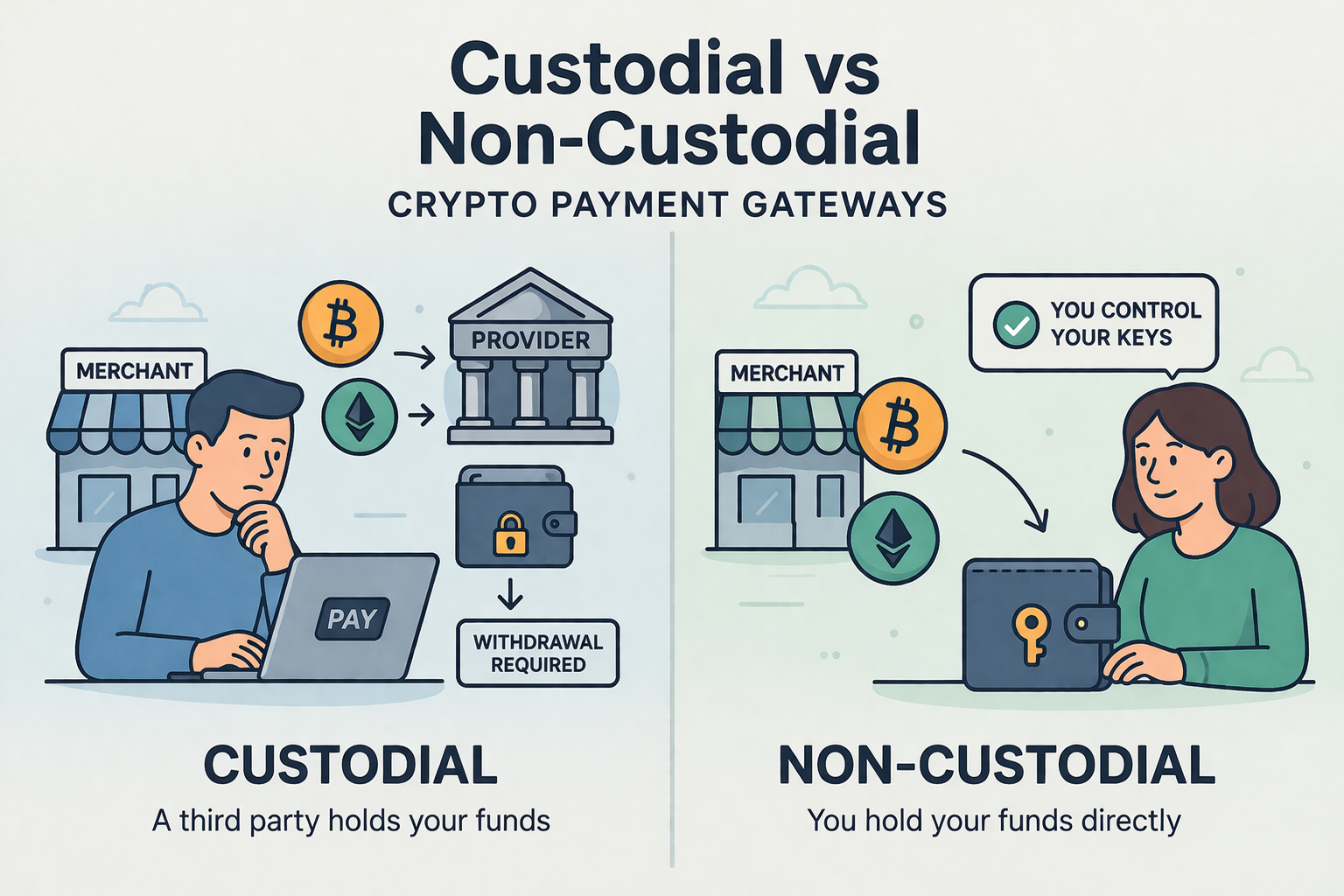
In the custodial model, the payment gateway provides its own infrastructure and receives payments into its own accounts. The funds are stored within the platform, and you can withdraw them upon request. In addition, these services offer extra functionality within their own infrastructure.
In most cases, using custodial payment gateways is technically simpler because the service handles part of the operational processes for you. However, it is important to understand that, like any financial intermediary, a custodial payment gateway must comply with the requirements of regulators and the jurisdictions in which it operates. As a result, these requirements are also applied to you, including document verification, identity checks (KYC), and other compliance procedures.
As long as your funds are held by a third party, you remain subject to its rules, policies, and regulatory obligations.
The non-custodial model is a completely different approach. With this model, you receive funds directly into your own wallets that you specify yourself. In other words, the payment gateway simply monitors the blockchain and tracks payments on the public network, notifying you of their status while automating the payment process.
From an automation perspective, everything works the same way as in the custodial model. The difference is that you receive funds directly from your customer, wallet to wallet, without an intermediary holding your assets.
The implementation is slightly more complex because you need to have your own wallets and manage them yourself. However, your funds remain under your control, and no one can dictate how you use them, let alone block or freeze them.
Key Differences
| Aspect | Custodial Solutions | Non-Custodial Crypto |
| Control | Limited | Full control |
| Private keys | Held by provider | Held by user |
| Intermediaries | Required | Removed |
| Withdrawals | Required | Not needed |
| Fees | Higher | Lower |
| Compliance | KYC / AML heavy | Minimal |
| Speed | Delayed | Real-time |
Fees and Financial Efficiency
Custodial services automatically deduct their fees from incoming payments. They also charge for various services within their ecosystem, such as token swaps. In many cases, they also charge withdrawal fees when you transfer funds to your own wallets.
Non-custodial services cannot deduct fees from your incoming payments because they do not have access to your wallets. Instead, their services are paid for separately, such as by topping up your account balance on the platform, through a subscription, or using other billing models. The exact payment model depends on the service.
Security: A Balanced Perspective
Custodial services are attractive targets for hackers because of their large and complex infrastructures, which may contain security vulnerabilities. Naturally, the primary target is the funds held in the service’s accounts. In many ways, it is similar to robbing a bank.
Non-custodial payment gateways, on the other hand, do not hold customer funds within their own accounts due to the nature of their architecture. As a result, there are no centralized funds for hackers to steal. Instead, the security of your assets depends on you and your ability to securely manage the wallets and software you use. If you are an experienced user and follow good security practices, your funds remain under your own control.
The Role of Compliance and Regulation
Custodial providers, both wallet providers and payment gateways, operate under strict regulatory oversight. As a result, you should be prepared not only for AML (Anti-Money Laundering) checks on your funds and KYC (Know Your Customer) verification, but also for the possibility of your funds being frozen.
Some custodial payment gateways also require identity verification from your customers, as they must comply with the sanctions policies and regulatory requirements of the jurisdictions in which they operate. This can significantly affect your sales.
Non-custodial payment gateways eliminate these types of risks, they do not store your funds and are technically incapable of freezing or withholding them. As a result, you assume full responsibility for your assets, but in return, you are free to operate without such restrictions from anywhere in the world.
Where the Industry Is Moving
More and more businesses are choosing to take advantage of non-custodial wallets and payment gateways, interacting directly with the blockchain. This is part of an ongoing evolution, as these technologies are gradually becoming part of everyday life and are increasingly difficult to ignore. However, they can be adopted effectively.
As part of this evolution, businesses and developers use APIs to accept cryptocurrency payments and build custom solutions for their specific needs. Even large investment funds and corporations are adapting to the changing financial landscape.
Whenever possible, choose the best crypto gateways for online transactions. Doing so will help ensure the stability of your business, provide uninterrupted access to your funds, and allow you to use them immediately whenever needed.