








Crypto Payments vs Credit Cards: Which Is Better for Business?
Every business that sells online eventually weighs the same question: is it worth accepting crypto alongside credit cards, or instead of them? The honest answer depends on your margins, your customers and how much you value control of your money. At Bcon Global we help businesses add crypto to their checkout every week, so this guide compares crypto payments and credit cards head to head – on fees, chargebacks, speed, reach, privacy and control – so you can decide what is right for your business.
This is not about crypto replacing cards overnight. It is about understanding where each one wins, so you can make an informed choice. Let us start with how each actually works.
How Each Payment Method Works?
The two methods move money in fundamentally different ways, and that difference drives everything else.
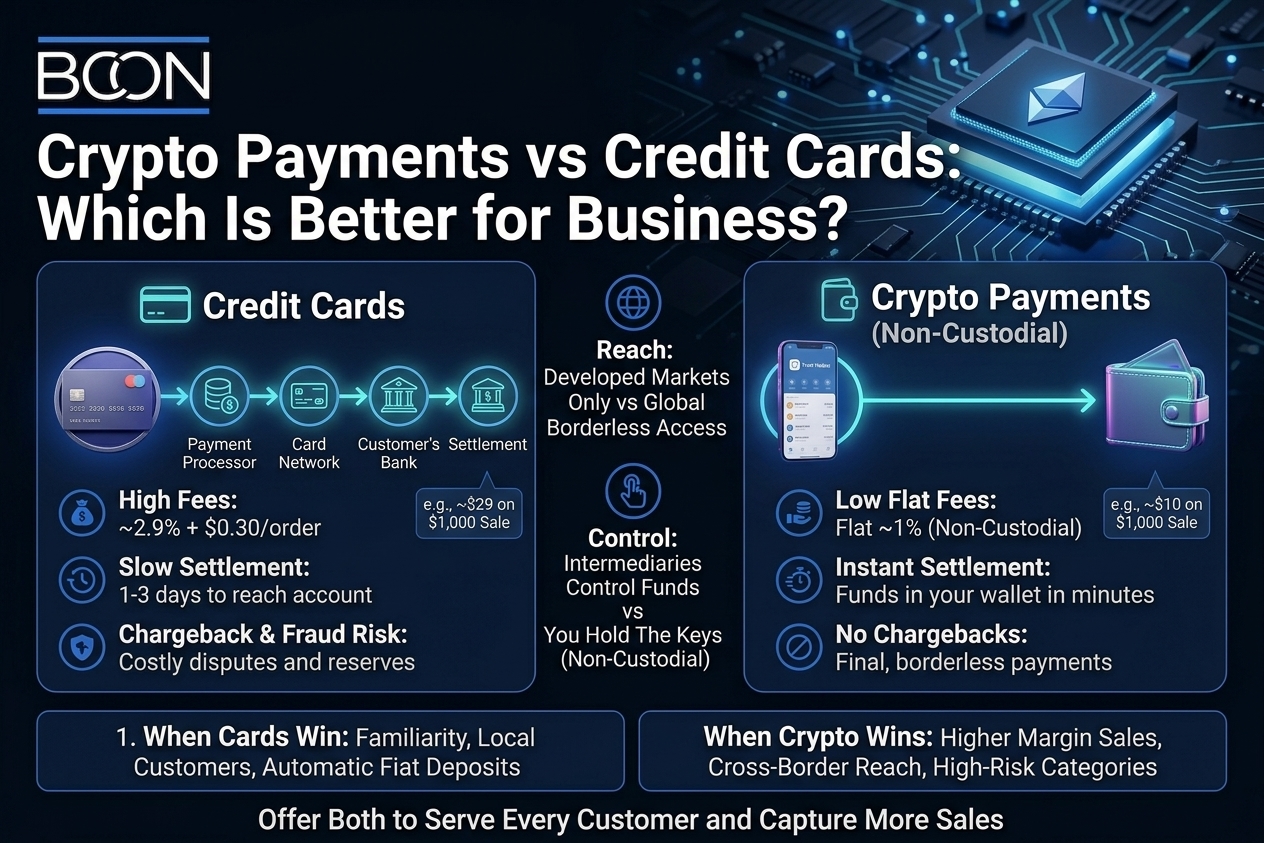
A credit card payment passes through several intermediaries. When a customer pays, the transaction goes from your payment processor to the card networks to the customer’s bank, which approves it. The money is not truly yours immediately – it settles to your account later, and it can be reversed through a chargeback. Each party in that chain takes a cut.
A crypto payment moves directly on a blockchain from the customer’s wallet to yours. There is no bank or card network in the middle. Once the network confirms the transaction, the money is in your wallet and the payment is final. With a non-custodial gateway, the funds never even pass through the provider – they go straight to an address you control.
That structural gap – a chain of intermediaries versus a direct transfer – is why crypto and cards differ so much on cost, speed and risk.
Fees Compared
For most businesses, fees are the headline. Credit card processing typically costs around 2.9% plus a fixed fee (often about $0.30) per transaction, and cross-border or premium cards can push that higher. A flat-fee crypto gateway usually charges around 1%, with the small network fee paid by the customer rather than you.

The chart makes the gap concrete. On a $1,000 sale, typical card processing takes around $29, while a 1% crypto gateway takes about $10. The table below breaks the costs down further.
| Cost factor | Credit cards | Crypto (non-custodial) |
| Processing fee | ~2.9% + $0.30 | Flat ~1% |
| Network/interchange | Included, varies | Small, paid by customer |
| Chargeback fees | Yes, per dispute | None |
| Monthly minimums | Often | None with a flat-fee gateway |
| Cross-border surcharge | Common | None |
Across a year of sales, the difference compounds. For a business processing meaningful volume, moving even part of that volume to crypto is a direct margin improvement.
Chargebacks and Fraud
This is where crypto has a decisive edge. Card payments can be reversed through chargebacks weeks after a sale, even after you have shipped the goods – a constant drain for online sellers, especially of digital products. “Friendly fraud,” where a customer disputes a legitimate purchase, is a real and growing cost.
Crypto payments are final. Once a transaction confirms on-chain, it cannot be reversed. There are no chargebacks, which removes an entire category of fraud and the fees that come with it. If you need to refund a customer, you do it deliberately by sending crypto back – you are never forced into it by a dispute.
The single biggest hidden cost of card payments is chargebacks. Crypto removes them entirely, which for many merchants matters as much as the lower fee.
For high-risk categories or digital goods, this alone can justify accepting crypto.
Speed and Settlement
Cards feel instant at checkout, but the money is not. Card settlements often take one to three business days to reach your account, and processors may hold funds on a rolling reserve. Crypto settles in minutes – sometimes seconds on fast networks – directly to your wallet, with no payout cycle to wait on.
That speed helps cash flow, especially for smaller businesses. Instead of waiting days and hoping a processor does not place a hold, you have the money as soon as the network confirms it. With a non-custodial setup, there is no third party deciding when you can access your own revenue.
Global Reach and Access
Cards work well in developed markets, but they quietly exclude a large part of the world. Customers without access to major card networks, or who have been de-platformed by a processor, or who simply prefer not to share card details, cannot always pay you. Cross-border card payments also add surcharges and higher decline rates.
Crypto is borderless by design. Anyone with a wallet can pay you from anywhere, instantly, without a bank’s permission. For businesses selling internationally or to underbanked audiences, that reach is not a rounding error – it is a new customer base that cards cannot serve.
Privacy and Control
With cards, a chain of intermediaries sees and controls the transaction, and your funds sit with a processor until settlement. With a non-custodial crypto gateway, the payment goes straight to a wallet you control, and no provider holds your money. That means no account freezes, no reserves, and no third party that can restrict access to your revenue.
For customers, crypto also offers more privacy at the point of sale – they do not hand over card numbers to yet another merchant. For businesses, the control is the bigger benefit: your money is yours the moment it arrives.
When Credit Cards Still Win?
Crypto is not the answer to everything, and a balanced guide should say so. Cards still make sense in several situations:
- Mainstream, local customers who expect to pay by card and may not hold crypto.
- Instant familiarity – cards need no explanation, while some customers are new to crypto.
- Built-in fiat – card revenue lands as dollars automatically, with no conversion step.
- Buyer protection expectations – some customers value the ability to dispute a charge.
For many businesses, the right move is not to drop cards but to add crypto as an option that captures the sales and savings cards cannot.
Using Both Together
The practical answer for most merchants is to offer both. Keep cards for customers who expect them, and add crypto to capture lower fees, no chargebacks, faster settlement and global reach. Offering crypto does not cost you card sales – it adds a payment method that serves customers cards turned away.
A non-custodial gateway makes this easy. You can add crypto alongside your existing card checkout, and each crypto payment settles directly to your wallet at a flat 1% with no chargebacks. It is an addition, not a replacement.
The Hidden Costs of Card Processing
The headline 2.9% rate is only part of what cards cost. A fuller accounting reveals expenses that rarely appear in the sales pitch but quietly erode margins. Card merchants often face monthly account fees, statement fees, gateway fees and PCI-compliance costs for handling card data securely. Rolling reserves can lock up a percentage of your revenue for weeks as a hedge against chargebacks. And when a dispute does occur, you typically pay a chargeback fee on top of losing the sale.
Crypto avoids most of this by design. There is no card data to store, so no PCI burden. There are no reserves, because the payment is final and already in your wallet. And with a flat-fee, non-custodial gateway, there are no monthly minimums or statement fees to chip away at what you keep. When you compare the true all-in cost rather than the advertised rate, the gap between cards and crypto widens further in crypto’s favor.
A Real-World Example
Numbers make the difference tangible, so consider a store processing $50,000 a month. With card processing at roughly 2.9% plus $0.30 per order, fees land somewhere around $1,450 a month before any chargeback costs or monthly fees. Moving that same volume through a flat 1% crypto gateway costs about $500 a month, with no chargeback fees on top.
That is a difference of roughly $950 every month, or over $11,000 a year, on a single mid-sized store – and it does not count the chargebacks avoided or the cross-border surcharges removed. Of course, not every customer will pay in crypto, so real savings depend on adoption. But even shifting a third of volume to crypto turns into meaningful, recurring margin that goes straight to your bottom line.
What About Volatility?
A common objection to crypto is price volatility – the worry that a coin’s value could drop between the sale and when you convert to cash. It is a fair concern for volatile coins like Bitcoin, but it is easily solved. By accepting stablecoins such as USDT or USDC, you receive dollar-pegged value that does not move: a $100 invoice paid in USDC is worth $100 when it lands and when you cash out.
Cards, of course, have no volatility, since they settle in fiat. But stablecoins close that gap almost entirely, giving you the low fees and finality of crypto with the price stability of the dollar. For any business worried about volatility, accepting stablecoins alongside or instead of Bitcoin removes the concern while keeping every other advantage.
How to Add Crypto Alongside Your Card Checkout?
If the comparison has convinced you to offer both, the good news is that adding crypto does not disrupt your existing card setup. It sits beside your current checkout as an extra option, and the process is quick. Here is the practical path:
- Choose a non-custodial gateway so crypto payments settle directly to a wallet you control.
- Connect your wallet address to receive payments, keeping your keys in your hands.
- Install a plugin or use the API to add a “Pay with crypto” option next to your card button.
- Enable the coins your customers use – Bitcoin, Ethereum and stablecoins like USDT and USDC.
- Run a test payment, then go live and let customers choose their preferred method.
Nothing changes for card-paying customers; they continue as before. What you add is a second rail that captures the lower fees, missing chargebacks and global reach that cards cannot provide. Most businesses complete this in an afternoon, and because the gateway is non-custodial, every crypto payment lands in your wallet with no new counterparty risk. It is a low-effort, low-risk way to test how much of your volume prefers crypto – and to start capturing the savings on the volume that does.
Which Is Better for Your Business?
To make it concrete, here is a quick guide by business type:
- Thin-margin or high-volume sellers – crypto’s lower fees and no chargebacks directly improve your bottom line.
- Digital goods and services – crypto removes chargeback fraud, a major cost in this category.
- International or underbanked audiences – crypto reaches customers cards cannot serve.
- Purely local, mainstream retail – cards remain essential, with crypto as a useful add-on.
- Businesses tired of frozen funds and holds – non-custodial crypto keeps you in control.
For most modern online businesses, the answer is “both,” with crypto steadily taking a larger share as customers adopt it.
Frequently Asked Questions
Are crypto payments cheaper than credit cards?
Generally yes. Cards cost around 2.9% plus a fixed fee, while a flat-fee crypto gateway is about 1% with no chargeback fees, so crypto is usually cheaper overall. Once you also account for card extras like monthly fees, PCI compliance and rolling reserves, the true all-in gap is often even wider.
Do crypto payments have chargebacks?
No. On-chain crypto payments are final and cannot be reversed, which removes chargebacks and the fraud and fees that come with them.
Is crypto safer than cards for a business?
For control of funds, yes – a non-custodial gateway sends payments straight to your wallet with no chargebacks and no third party that can freeze your money. Both methods are safe when set up properly.
Which is better for business, crypto or cards?
It depends. Crypto wins on fees, chargebacks, speed and global reach; cards win on mainstream familiarity and built-in fiat. Most businesses benefit from offering both.
Should I accept both crypto and cards?
Yes, for most businesses. Keep cards for customers who expect them and add crypto to capture lower fees, no chargebacks and customers cards cannot reach.
Crypto payments beat credit cards on fees, chargebacks, settlement speed, global reach and control, while cards keep an edge in mainstream familiarity and built-in fiat. For most businesses, the smart move is to offer both – keep cards, add crypto – and let crypto capture the savings and customers cards leave on the table. The decision does not have to be all-or-nothing, and it does not require a costly rebuild: adding a crypto option sits beside your existing checkout and takes an afternoon. Start by enabling it, watch how much of your volume prefers it, and let the savings on that volume compound month after month. As crypto adoption keeps growing, the businesses that offer it early are the ones best positioned to benefit.
Ready to add crypto to your checkout? Bcon Global lets you accept crypto at a flat 1% with no chargebacks, settled directly to your own wallet – see the pricing and start today.