
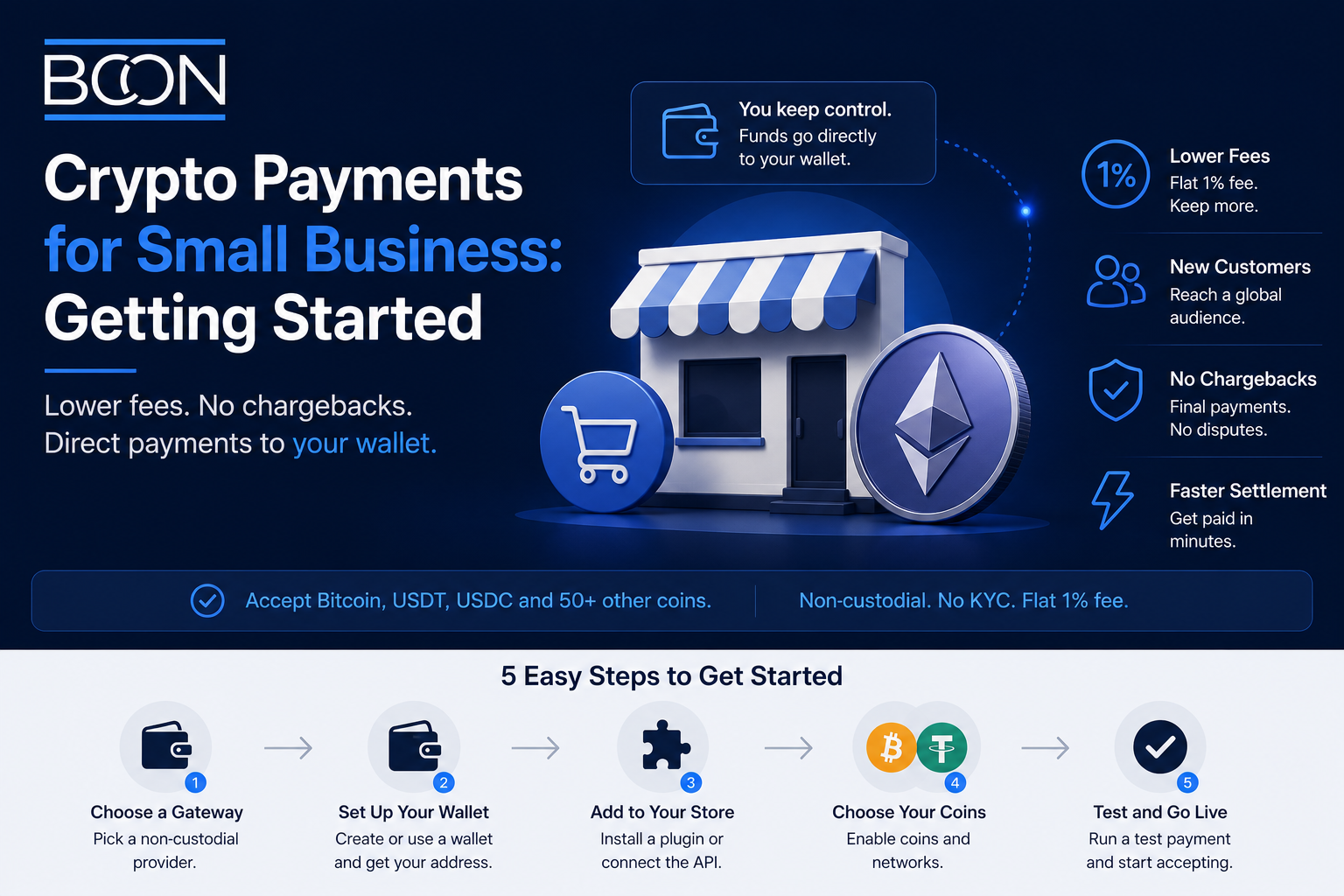








Crypto Payments for Small Business: Getting Started
Accepting crypto used to feel like something only tech giants did, but it has quietly become a practical option for small businesses. A local shop, a freelancer or an online store can now take Bitcoin and stablecoins with the same ease as adding any other payment method. At Bcon Global we set up small businesses to accept crypto every week, so this guide covers the real benefits, the honest trade-offs, and the exact steps to start without a big budget or a developer.
The goal here is not hype. It is a clear-eyed look at whether crypto is worth it for your business and how to do it well.
Why Small Businesses Are Adding Crypto
Small businesses feel card fees and chargebacks more acutely than large ones, which is exactly why crypto appeals to them. The most common reasons owners cite are practical and financial:
- Lower processing fees. Card costs of 2.5-4% hurt thin margins; a flat 1% crypto fee keeps more of each sale.
- New and global customers. Crypto lets you sell to buyers who prefer it or lack easy card access, including internationally.
- No chargebacks. On-chain payments are final, which removes friendly-fraud disputes that drain small merchants.
- Faster access to funds. Payments settle in minutes, not on a card processor’s schedule.
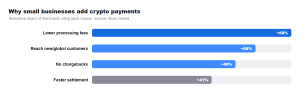
As the chart shows, lower fees and reaching new customers lead the list, followed closely by the end of chargebacks. For a small operation, any one of these can justify the switch.
Is Crypto Right for Your Business?
Crypto is not a fit for absolutely everyone, so it is worth a quick honest check. Consider adding it if several of these apply:
- Your margins are tight enough that a 2-3% fee difference matters.
- You sell online, internationally, or to a tech-savvy audience.
- You deal with digital goods or services and get hit by chargebacks.
- Customers have asked to pay in crypto, even occasionally.
- You have ever had a processor delay or hold your funds.
If none of these ring true and you serve a purely local, card-only crowd, the upside is smaller. For most modern small businesses, though, at least a few will apply.
How to Start Accepting Crypto in a Few Steps
Getting started is simpler than most owners expect, and it does not require technical skills:
- Choose a non-custodial gateway so funds land in a wallet you control.
- Set up a wallet and connect its address to the gateway.
- Add the payment option to your store with a plugin, or share a payment link or QR code if you sell in person or by invoice.
- Pick your coins – Bitcoin for reach, USDT and USDC for stable value.
- Test a small payment, then start accepting.
You do not need a merchant account, and with a non-custodial provider you usually skip KYC entirely. Many small businesses are live the same day.
Managing Volatility and Taxes
Two concerns come up often, and both are manageable. Volatility worries evaporate when you accept stablecoins: a $200 invoice paid in USDC is worth $200 when it lands, so you are not exposed to price swings unless you choose to hold Bitcoin. Offering both lets customers pick while you keep predictable records.
The simplest way for a small business to avoid crypto volatility is to accept stablecoins – you get the speed of crypto with the steadiness of the dollar.
On taxes, treat crypto income like any other income: record the value at the time of each sale and keep clear books. Because every transaction is on a public ledger, your records are easy to verify. When in doubt, a quick word with an accountant familiar with crypto keeps you compliant.
Keep It Simple and Keep Control
The best setup for a small business is one that is cheap, easy and keeps your money in your hands. That points to a non-custodial gateway with transparent pricing. It is the model behind Bcon Global: payments settle directly to your wallet, there is no KYC to start with, the fee is a flat 1% with no monthly minimums, and you can accept Bitcoin, USDT, USDC and 50+ other coins through plugins or a simple payment link.
Because the provider never holds your funds, there is no account that can be frozen and no payout schedule to wait on. That control is especially valuable when cash flow is tight.
Common Concerns, Answered Briefly
A few worries stop owners from starting, so here is the short version. You do not need to understand blockchain to accept crypto – the gateway handles the technical side. You do not have to hold crypto if you prefer stablecoins. And you are not locked in; you can enable or disable it whenever you like. None of the usual barriers hold up under a closer look.
Frequently Asked Questions
How can a small business accept crypto payments?
Choose a non-custodial gateway, set up a wallet, add a plugin or payment link to your store, pick your coins and test a payment. Most small businesses are live the same day.
Is accepting crypto worth it for a small business?
For many, yes. The main gains are lower fees, no chargebacks, faster settlement and access to new customers. Accepting stablecoins removes the volatility concern.
Do I need to understand blockchain to accept crypto?
No. The gateway handles confirmations and tracking. You only need a wallet address and a few minutes to set up.
How do I avoid crypto price swings?
Accept stablecoins like USDT and USDC, which hold a steady dollar value, instead of or alongside Bitcoin.
What does it cost a small business to accept crypto?
With Bcon it is a flat 1% per payment, no monthly minimums, and the customer pays the network fee.
Crypto payments are now a realistic, low-cost option for small businesses, offering lower fees, no chargebacks and faster settlement. Accept stablecoins to sidestep volatility, choose a non-custodial gateway to keep control, and you can start in a day without a developer or a big budget.
Ready to begin? Bcon Global helps small businesses accept crypto simply and keep every payment in their own wallet.