








The rapid growth of cryptocurrency has transformed how people move money around the world. Over the last decade, blockchain technology has created new financial tools that operate outside traditional banking systems.
One of the most important innovations in this space is the stablecoin. Unlike volatile digital currencies such as Bitcoin, stablecoins are designed to maintain a stable price. They typically track fiat currencies like the US dollar.
The most widely used stablecoin today is Tether, commonly known as USDT. USDT plays a central role in the modern crypto ecosystem. It is used for trading, payments, decentralized applications, and international transfers.
However, one important detail often confuses new users:
USDT does not exist on just one blockchain.
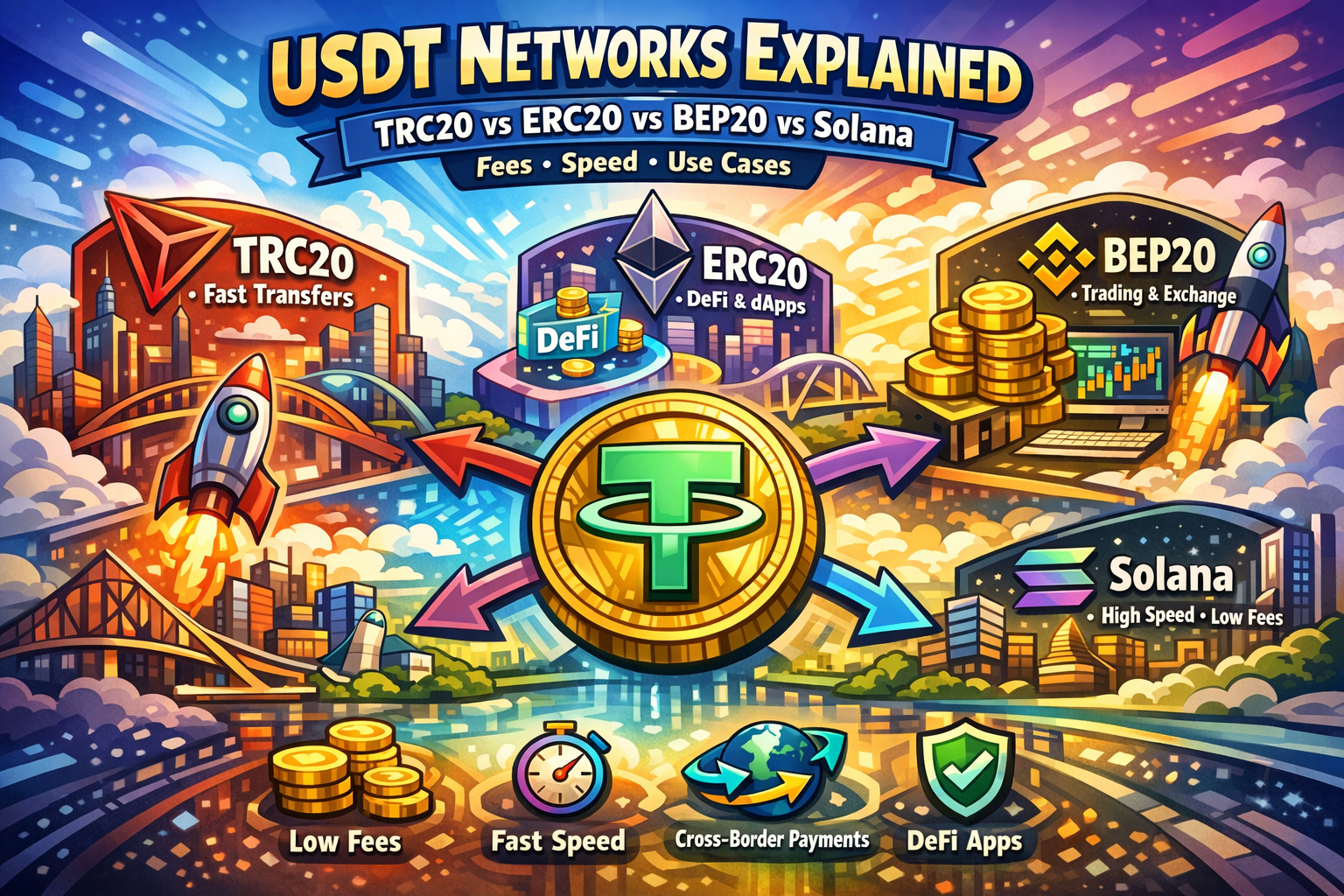
Instead, it operates across several blockchain networks, including:
- Ethereum
- TRON
- BNB Smart Chain
- Solana
Each of these networks has different transaction fees, transaction speed, scalability, and ecosystem support. Choosing the correct network can reduce costs, improve performance, and make USDT transactions more efficient.
This guide explains:
- what Tether USDT is
- how USDT works
- the difference between TRC20 and ERC20
- which USDT network is fastest
- how transaction costs vary across different blockchains
- which network is best for different use cases
What Is Tether (USDT)?
USDT is a stablecoin issued by Tether Limited. Its goal is simple: maintain a stable value equal to 1 US dollar.
In most situations:
1 USDT ≈ 1 USD
Stablecoins were created to reduce the volatility that exists in traditional cryptocurrencies.
For example, BTC and ETH can fluctuate significantly within a single day. For traders, businesses, and payment providers this volatility can create serious financial risk.
USDT solves this problem by acting as a digital representation of the US dollar on a blockchain network.
According to transparency reports, reserves backing USDT include:
- cash equivalents
- treasury bills
- secured loans
- other financial instruments
Because of this design, USDT has become one of the most widely used digital assets in the global cryptocurrency ecosystem.
It consistently ranks among the highest assets by trading volume across major exchanges.
How Does Tether Work?
Tether combines traditional financial reserves with modern blockchain technology. When new USDT tokens are issued, an equivalent value of assets is held in reserve. This system helps maintain price stability. Every USDT transaction is recorded on a blockchain network, making transfers transparent and secure. Unlike traditional banking, blockchain systems allow money to move globally without centralized intermediaries.
This enables real-time international payments, cross-border transfers, and efficient digital settlements.
Another key advantage is multi-chain support.
Because USDT exists on several different blockchains, users can select a network based on:
- transaction costs
- transaction speed
- ecosystem compatibility
- exchange support
This design improves liquidity, increases scalability, and expands the potential use cases of the stablecoin.
Diagram — How USDT Works Across Blockchains
┌────────────────────┐
│ Tether Reserves │
│ (USD & Assets) │
└─────────┬──────────┘
│
Issues USDT
│
┌─────────────┬─────────────┬─────────────┬─────────────┐
│ │ │ │
Ethereum TRON BNB Chain Solana
ERC20 TRC20 BEP20 SPL
│ │ │ │
│ │ │ │
DeFi Ecosystem Transfers Trading High-Speed Apps
Smart Contracts Remittances Exchanges Web3 & Payments
This diagram shows how USDT tokens operate across multiple blockchain networks while being backed by centralized reserves.
What Are the Different Types of USDT Networks?
USDT originally launched on Bitcoin through the Omni Layer protocol. As the industry evolved, new blockchain ecosystems emerged with better scalability and performance.
Today the most common USDT networks include:
- TRC20 USDT (TRON)
- ERC20 USDT (Ethereum)
- BEP20 USDT (BNB Smart Chain)
- Solana USDT
Each network uses different address formats, validators, and consensus systems.
This multi-chain infrastructure allows USDT to maintain strong liquidity across major exchanges and decentralized applications.
Infographic — USDT Network Comparison (2026)
| Network | Avg Fee | Speed | Ecosystem Size | Best Use |
| TRC20 | $1–$4 | ~3 sec | Large | Transfers |
| ERC20 | $0.1–$1 | 10–15 sec | Very large | DeFi |
| BEP20 | $0.05–$0.30 | ~3 sec | Large | Trading |
| Solana | <$0.01 | <1 sec | Growing | Payments |
Transaction fees depend on network congestion, gas prices, and validator activity.
Sources: etherscan.io, tronscan.org, solscan.io, bscscan.com
What Is TRC20 USDT?
TRC20 USDT operates on the TRON blockchain. TRON was designed for high throughput, strong scalability, and efficient digital payments.
Transactions use a resource system based on:
- bandwidth
- energy
If a wallet does not have sufficient resources, the network charges fees in TRX.
Typical TRC20 costs include:
- ~6.5 TRX for transfers to active addresses
- ~13 TRX for transfers to new wallets
Depending on the market price of TRX, this usually equals $1.8 – $4 per transaction. Despite these costs, TRON remains extremely popular for USDT transfers because of strong exchange support and a large circulating supply.
Typical use cases include:
- remittances
- cross-border payments
- exchange withdrawals
- merchant payments
What Is ERC20 USDT?
ERC20 USDT runs on the Ethereum blockchain. Ethereum introduced programmable smart contracts, which allow developers to build complex decentralized applications. This functionality made Ethereum the foundation of the global DeFi ecosystem.
Common DeFi activities include:
- staking
- yield farming
- decentralized exchanges
- lending protocols
Because ERC20 tokens integrate directly with these platforms, they provide excellent compatibility with decentralized finance. Historically Ethereum had high gas fees, but recent upgrades significantly improved cost efficiency.
Today simple transactions often cost far less than in previous years, making ERC20 USDT increasingly competitive with other networks.
What Is BEP20 USDT?
BEP20 USDT operates on BNB Smart Chain, a network closely linked to the Binance ecosystem. BNB Smart Chain uses a proof-of-stake-based consensus model supported by validators. The network focuses on scalability and relatively low transaction fees.
Advantages include:
- fast confirmations
- low costs
- strong exchange support
Many traders choose BEP20 when interacting with centralized exchanges, especially those connected to Binance.
What Is USDT on Solana?
The Solana blockchain is designed for extremely high transaction throughput. It can process thousands of transactions per second while maintaining extremely low fees. Typical transaction costs are less than one cent.
These characteristics make Solana ideal for:
- micropayments
- Web3 applications
- gaming ecosystems
- high-frequency trading
Although its ecosystem is smaller than Ethereum, Solana continues to grow rapidly.
TRC20 vs ERC20 USDT
| Feature | TRC20 | ERC20 |
| Blockchain | TRON | Ethereum |
| Fee | $1–$4 | $0.1–$1 |
| Speed | ~3 sec | ~15 sec |
| DeFi Support | Moderate | Very High |
| Smart Contracts | Limited | Full |
| Address Format | T… | 0x… |
Cheapest USDT Network
| Network | Typical Fee |
| Solana | <$0.01 |
| BNB Chain | $0.05–$0.30 |
| Ethereum | $0.1–$1 |
| TRON | $1–$4 |
Best USDT Network by Use Case
| Use Case | Best Network |
| Micropayments | Solana |
| DeFi | Ethereum |
| Exchange withdrawals | TRON |
| Trading infrastructure | BNB Smart Chain |
| Web3 apps | Solana |
Which USDT Network Is Fastest?
Solana typically offers the fastest transaction speed.
Approximate confirmation times:
- Solana — <1 second
- TRON — ~3 seconds
- BNB Smart Chain — ~3 seconds
- Ethereum — ~10–15 seconds
These differences come from each network’s consensus design and block structure.
Can You Redeem USDT for USD?
Yes, USDT can theoretically be redeemed directly with the issuer for USD.
However, this process typically requires:
- identity verification
- minimum redemption amounts
- institutional access
For most users the easiest option is converting USDT to fiat currencies through centralized exchanges.
Real-World Use Cases of USDT
The adoption of stablecoins has created many practical applications.
Common use cases include:
Trading
USDT is the most common base pair for crypto trading.
Cross-border payments
Transfers occur faster than traditional banking systems.
Remittances
Workers can send money internationally with lower fees.
DeFi
USDT supports lending, liquidity pools, and yield strategies.
Hedging
Traders move funds into USDT during periods of market volatility.
FAQ — USDT Networks
Which USDT network is fastest?
Solana generally provides the fastest transaction speeds among major USDT networks.
What is the best USDT network to use?
The best network depends on the use case. Ethereum is best for DeFi, TRON for transfers, and Solana for high-speed payments.
What is the difference between TRC20 and ERC20 USDT?
TRC20 operates on TRON, while ERC20 operates on Ethereum. The main differences involve fees, ecosystem size, and smart contract support.
Can I send USDT between networks?
No. Each USDT network uses different address formats and blockchain infrastructure.
Final Thoughts
USDT remains the dominant stablecoin in the global cryptocurrency ecosystem.
Thanks to its multi-chain architecture, it operates across several powerful blockchain networks.
Each network offers unique advantages:
- TRC20 — widely used for transfers
- ERC20 — strongest DeFi ecosystem
- BEP20 — efficient exchange infrastructure
- Solana — fastest transaction speeds
Understanding these differences helps users optimize transaction costs, improve efficiency, and select the best USDT network for their needs.