








What Are the Four Types of Stablecoins?
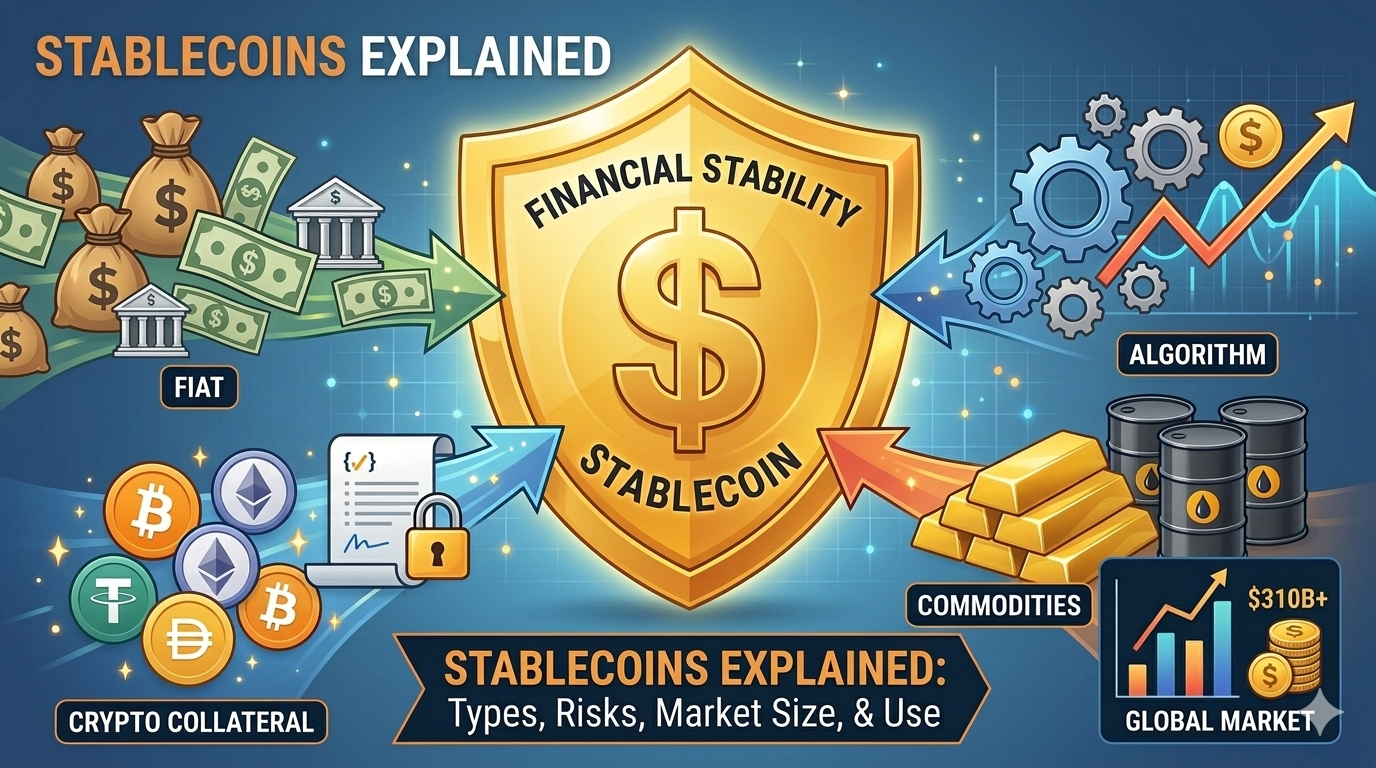
Although the stablecoin ecosystem includes dozens of projects, most of them fall into four fundamental categories. The classification depends on what underlying assets support the coin and how the system maintains a stable value.
Fiat-backed stablecoins
Fiat-backed stablecoins are the most common type. These coins maintain their peg by holding traditional currency reserves, usually USD, in bank accounts or in short-term liquid assets such as US Treasury bills.
Examples include:
- USDT issued by Tether
- USDC issued by Circle
- FDUSD issued by First Digital
- PYUSD issued by PayPal
These stablecoins are sometimes described as tokenized dollars. Each token represents a claim on real-world reserve assets held by the issuing company.
Because they rely on centralized issuers, these systems depend on risk management, financial audits, and a clear regulatory framework.
Crypto-backed stablecoins
A second category is crypto-backed stablecoins. Instead of holding traditional currency reserves, these systems lock crypto assets such as ETH or Bitcoin in smart contracts. The locked collateral supports the issuance of stablecoins. The best known example is DAI ( USDS ), issued by the MakerDAO protocol.
In these systems, users deposit more collateral than the value of the stablecoins they mint. This mechanism helps absorb price volatility in the collateral. For example, a user might deposit $150 worth of ETH to generate $100 worth of stablecoins.
This design keeps the system solvent even if the price of ETH declines.
Algorithmic stablecoins
Algorithmic stablecoins attempt to maintain a peg without collateral. Instead of backing the coin with assets, the protocol adjusts supply using smart contracts and incentives such as arbitrage. The most famous example was TerraUSD (UST) from the Terra ecosystem. The system relied on a relationship between the stablecoin TerraUSD and the governance token LUNA. When the stablecoin price moved away from $1, traders could exchange one token for the other, theoretically restoring the peg. However, in 2022 the system collapsed during a massive de-pegging event. The collapse wiped out billions of dollars and became one of the largest failures in the history of digital crypto assets.
Commodity-backed stablecoins
The fourth category is commodity-backed stablecoins. These coins are backed by physical commodities rather than fiat currency.
Typical collateral includes:
- gold
- silver
- oil or other raw materials
Examples include:
- Pax Gold (PAXG)
- Tether Gold (XAUT)
Each token represents ownership of a specific quantity of a physical commodity stored in secure vaults. This model allows users to hold tokenized commodities while transacting on chain.
How Stablecoins Maintain Their Peg
Stablecoins rely on several mechanisms to maintain their peg to the USD or other currencies such as EUR.
The main tools include:
Collateral reserves
Fiat-backed coins hold reserve assets such as Treasury bills or cash equivalents.
Overcollateralization
Crypto-backed systems require more collateral than the value of the coins issued.
Arbitrage incentives
Traders buy underpriced stablecoins and redeem them for collateral, restoring the peg.
Supply adjustment
Algorithmic systems increase or decrease token supply. In practice, maintaining a peg requires constant risk management and monitoring of market liquidity. When confidence falls or liquidity disappears, a de-pegging event may occur.
Top Stablecoins in the Market
The stablecoin sector has grown dramatically in recent years. Today it represents one of the largest segments of the cryptocurrency industry.
As of 2026, the top five stablecoins by market cap are generally:
- USDT (Tether)
- USDC (Circle)
- DAI ( USDS ) (MakerDAO)
- FDUSD (First Digital)
- PYUSD (PayPal)
Previously, Binance USD (BUSD) was one of the largest stablecoins. However, its issuance was halted in 2023 after regulatory pressure in the United States. As a result, the supply has gradually declined and the coin is no longer widely used.
The stablecoin sector now exceeds $250–350 billion in total market value, making it one of the largest segments of the digital asset economy.
Stablecoins are widely used across:
- crypto exchanges
- decentralized finance platforms
- remittances
- international payments
- trading and hedging
They act as a digital medium of exchange and sometimes even as a store of value in countries with unstable local currencies.
Infographic: Stablecoin Market Structure
| Stablecoin | Market Share | Visualization |
|---|---|---|
| USDT (Tether) | ~65–70% | ███████████████████████████████ |
| USDC (Circle) | ~20–25% | ███████████████ |
| DAI (USDS) | ~4–5% | ███ |
| FDUSD | ~2–3% | ██ |
| Other stablecoins | ~2–4% | ██ |
Total market size: $310B+ (2026)
Data sources:
Are Stablecoins Backed by Anything?
The answer depends on the type of stablecoin.
Fiat-backed stablecoins are supported by liquid assets held in financial institutions. These may include:
- cash
- US Treasury bills
- money market funds
Crypto-backed stablecoins rely on crypto assets locked inside smart contracts. Commodity-backed coins use physical assets like gold. Algorithmic stablecoins, however, may have little or no collateral.
The collapse of TerraUSD demonstrated the risks of stablecoins that rely purely on market incentives.
Is Bitcoin a Stablecoin?
No. Bitcoin is not a stablecoin. Bitcoin was designed as a decentralized digital currency and potential store of value, but its price can fluctuate dramatically. Bitcoin often experiences significant price volatility, sometimes moving several percent within a single day.
Stablecoins were created specifically to avoid this volatility.
How Stablecoins Differ From Other Cryptocurrencies
Traditional cryptocurrencies such as Bitcoin or Ethereum behave more like speculative assets.
Stablecoins, in contrast, are designed to maintain a stable value.
This difference creates several unique properties:
- stablecoins act as a medium of exchange
- they enable real-time settlement on blockchain networks
- they are widely used in financial services
- they support everyday transactions
Because stablecoins are designed for stability rather than speculation, their price normally stays close to one unit of USD or another currency.
Real Transaction Costs: ERC-20 vs TRC-20
One of the most practical differences for users is the cost of transferring stablecoins between wallets.
Ethereum (ERC-20)
Ethereum is the most widely used smart contract platform.
Recent upgrades significantly reduced fees. In 2026 the average transaction fee is around $0.10–$0.20 depending on network conditions. (symbiosis.finance) Historically, fees were much higher during periods of congestion. Ethereum relies on a network of decentralized validators who process transactions and maintain the blockchain.
Tron (TRC-20)
The Tron network is optimized for fast transfers and low fees.
Typical TRC-20 USDT transactions cost roughly:
- $1–$3 without energy staking
- $0–$0.50 with optimized wallets
Because of its low cost and fast settlement, TRC-20 stablecoins are widely used for international transfers and remittances.
Infographic: Transaction Fee Comparison
| Network | Average Transaction Fee |
| Ethereum (ERC-20) | $0.10 – $0.20 |
| Tron (TRC-20) | $0.50 – $2.00 |
| Polygon | $0.001 – $0.01 |
| Solana | $0.0002 – $0.01 |
| Layer-2 Ethereum | $0.001 – $0.05 |
Source data:
Layer-2 networks now process a large share of Ethereum activity and can reduce fees by up to 90–99% compared to earlier versions of the network. (coinpaprika.com)
Transparency: Where to See Stablecoin Reserves
Many stablecoin issuers publish public reports about their reserve assets. These reports help users verify that the coins are backed by real collateral.
Here are official transparency pages:
Tether (USDT)
https://tether.to/en/transparency/
Circle (USDC)
https://www.circle.com/en/transparency
MakerDAO (DAI ( USDS ) collateral dashboard)
https://info.sky.money/collateral
DefiLlama Stablecoin Dashboard
https://defillama.com/stablecoins
These dashboards show:
- supply
- collateral composition
- blockchain distribution
- real-time on-chain metrics
Stablecoin Regulation and AML Compliance
As stablecoins grow, regulators around the world are paying closer attention.
Because stablecoins function similarly to financial instruments, they may eventually fall under banking or payment regulations. One of the most important regulatory developments is MiCA (Markets in Crypto-Assets) in the European Union.
MiCA introduces a comprehensive regulatory framework for digital crypto assets, including stablecoins.
Key requirements include:
- reserve transparency
- capital requirements
- consumer protection rules
- strict AML and anti-money laundering compliance
- licensing for stablecoin providers
Under MiCA, companies issuing stablecoins must demonstrate that they hold sufficient reserve assets and follow strong risk management practices.
Other jurisdictions such as the United States, Singapore, and the United Arab Emirates are developing their own stablecoin regulation.
Freezing Funds and Sanctions
One controversial aspect of centralized stablecoins is their ability to freeze funds. Companies such as Tether and Circle can block specific addresses if required by law enforcement or sanctions authorities. This capability exists because the token contracts include administrative controls. Several real-world cases illustrate this.
Sanction enforcement
Both Tether and Circle have frozen addresses associated with sanctioned entities or cybercrime investigations. For example, wallets linked to the Tornado Cash sanctions were frozen by major stablecoin issuers following regulatory actions.
Law enforcement cooperation
Stablecoin companies have also frozen funds connected to ransomware operations or exchange hacks. These actions are usually carried out in cooperation with regulators and blockchain analytics companies. However, critics argue that these capabilities introduce centralization risks. Because stablecoin issuers can freeze funds, they function somewhat like financial intermediaries within the broader banking system.
Risks Stablecoins Pose to Financial Stability
As stablecoins grow larger, policymakers worry about their potential impact on financial stability.
The main risks include:
- rapid withdrawals that resemble bank runs
- insufficient collateral reserves
- heavy reliance on short-term money market funds
- concentration of liquidity in a few providers
If a large stablecoin suddenly lost its peg, it could affect both crypto assets markets and traditional finance. For this reason, regulators increasingly view stablecoins as an important part of the global financial infrastructure.
The Role of Stablecoins in the Global Financial System
Stablecoins are increasingly viewed as an important bridge between the traditional financial system and the digital economy. They allow users to move value globally using blockchain technology, without relying on slow international banking transfers.
For businesses and individuals, the use of stablecoins offers several practical use cases:
- online payments
- cross-border payments
- trading in the crypto market
- liquidity in DeFi applications
Some researchers believe stablecoins may expand access to financial tools in regions where traditional banking infrastructure is limited. At the same time, central bank researchers continue studying how these digital currencies interact with national monetary systems.
Is the US Dollar Losing Dominance?
Interestingly, stablecoins may actually strengthen the role of the USD in global finance. Most stablecoins are pegged to the US dollar. As a result, millions of people around the world now use digital tokenized dollars on blockchain networks. In regions with unstable local currencies, stablecoins can act as an alternative store of value and payment system. In that sense, stablecoins may expand the global reach of the USD, even outside the traditional banking system.
Companies Leading the Stablecoin Industry
Several organizations dominate the stablecoin market today.
The most influential providers include:
Tether
Tether is the company behind USDT, one of the most widely used stablecoins in the world.
The token was launched in 2014 and quickly became a core liquidity instrument on many cryptocurrency trading platforms.
The company states that the token supply is backed by financial collateral such as cash equivalents and government securities. These holdings are designed to maintain price stability relative to fiat currency, usually the USD. Although the issuer faced criticism in the past, periodic transparency reports now attempt to show the composition of the backing funds.
Today the token exists across several blockchain networks and is widely used in cross-border payments, trading, and the broader crypto market.
Circle
Circle is the company responsible for issuing USDC, another widely used dollar-denominated stablecoin.
This asset was launched in 2018 and quickly gained popularity among developers working with DeFi, payment applications, and digital financial infrastructure built on blockchain technology. Circle promotes transparency by publishing monthly reports showing the composition of the collateral that supports the token supply. These funds typically include Treasury securities and cash equivalents tied to fiat currency.
Because of this transparency model, the token is often considered attractive to institutional investors entering the cryptocurrency sector.
MakerDAO
Developer of the decentralized DAI ( USDS ) stablecoin system.
PayPal
Issuer of PYUSD, designed for integration into global payment networks.
First Digital
Issuer of FDUSD, widely used on major exchanges. These companies are shaping how stablecoins are used in trading, payments, and financial services.
Conclusion
Stablecoins have evolved from a niche trading tool into one of the most important components of the cryptocurrency economy. They enable real-time transfers, global remittances, and new types of blockchain-based financial services. However, their stability depends heavily on transparency, collateral management, and regulation. Different models exist — from fiat-backed coins supported by reserve assets to experimental algorithmic systems like TerraUSD, which collapsed during a dramatic de-pegging event.
As governments introduce clearer regulatory frameworks and stronger AML requirements, the stablecoin ecosystem will likely become more integrated with traditional finance.
For users, the most important lesson is simple.Not all stablecoins are the same.
Understanding how each coin is backed, who controls it, and how it functions on chain is essential before relying on it for payments, trading, or storing digital wealth.