









How to Accept Recurring Crypto Payments (Subscriptions)
Subscriptions and memberships run on recurring payments, and if you want to bill customers in crypto, you quickly hit an interesting challenge: crypto was not originally designed for automatic, repeating charges the way credit cards are. The good news is that recurring crypto payments are entirely possible in 2026 – you just need the right approach. At Bcon Global we help SaaS products, membership sites and service businesses get paid in crypto, so this guide explains why recurring crypto billing is different, the options available, how to set it up, and how to keep it non-custodial.
Whether you sell software, content or a service on a monthly plan, this guide shows how to make crypto work for it. Let us start with why it is not as simple as cards.
Why Recurring Crypto Payments Are Different?
With credit cards, recurring billing is easy because the customer authorizes the merchant to “pull” a payment each cycle. The card network lets you charge a saved card automatically. Crypto works the opposite way: it is a “push” system, where the customer sends funds from their own wallet, and no one can take money from that wallet without their action.
That is a feature, not a flaw – it is exactly what keeps crypto non-custodial and secure. But it means you cannot simply store a card and charge it monthly. Instead, recurring crypto billing uses different mechanisms to prompt or authorize each payment. Understanding those mechanisms is the key to setting up subscriptions that work.
How Recurring Crypto Billing Works?
Because you cannot pull funds automatically, recurring crypto payments rely on one of a few models. Each solves the “push” problem in a different way:
- Invoice per cycle. The system generates a new payment request each period and notifies the customer to pay it – like a recurring invoice. Simple, non-custodial, and works with any wallet.
- Delegated allowance. On smart-contract chains, a customer can pre-authorize a set amount to be charged over time, which a contract then collects each cycle. More automated, but chain- and token-specific.
- Prepaid balance / top-up. The customer funds a balance that the service draws down each period, topping up when needed.
- Manual renewal with reminders. The customer simply pays each cycle when prompted, ideal for lower-frequency memberships.
Most businesses start with the invoice-per-cycle model because it is the simplest and works everywhere, then add automation as they grow.
The Options Compared
Choosing the right model depends on how automated you need billing to be and which coins you accept. This comparison helps:
| Model | Automation | Best for | Notes |
| Invoice per cycle | Semi (customer confirms) | Most subscriptions | Simple, non-custodial, any wallet |
| Delegated allowance | High | On-chain/DeFi-savvy users | Smart-contract based, token-specific |
| Prepaid balance | High (until balance runs low) | Usage-based services | Customer tops up |
| Manual renewal | Low | Annual/low-frequency plans | Reminders drive renewal |
For a typical SaaS or membership business, invoice-per-cycle with clear reminders covers the majority of customers, while power users can opt into a more automated model.
How to Set Up Recurring Crypto Payments?
Getting subscriptions live is straightforward once you pick a model. Here is the practical sequence:
- Choose a non-custodial gateway that supports invoicing and an API for automation.
- Connect your wallet address so every payment settles directly to you.
- Define your plans – amount, currency and billing cycle (monthly, annual, etc.).
- Set up recurring invoices or API-driven billing to generate a payment request each cycle.
- Add reminders so customers know when a renewal payment is due.
- Test the full cycle with a small live payment before launching.
With a flexible API, you can wire recurring billing into your existing subscription logic – creating an invoice at each renewal, receiving a webhook when it is paid, and updating the customer’s access automatically. That gives you card-like automation while staying non-custodial.
Best Coins for Subscriptions
Coin choice matters more for subscriptions than for one-off payments, because you are charging repeatedly and small fees add up. Two factors guide the choice: stability and low fees.
Stablecoins are ideal for subscriptions. A $20 monthly plan billed in USDT or USDC stays worth $20 every cycle, so neither you nor the customer is exposed to price swings between renewals. That predictability is exactly what recurring billing needs.
Low-fee networks keep costs down. Because you process a payment every cycle, the network fee matters. On current 2026 networks, stablecoins on high-speed chains are extremely cheap to move – a fraction of a cent on some networks and around a dollar on others – while sending on congested chains costs more. Accepting stablecoins on a low-fee network keeps each renewal efficient for everyone.
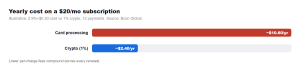
As the chart shows, lower per-charge fees compound across every renewal. Over a year of monthly payments, a flat 1% crypto fee costs a fraction of typical card processing – a real saving for subscription businesses with many recurring charges.
Reducing Failed Renewals
Failed renewals are the enemy of subscription revenue, and crypto’s push model makes proactive reminders essential. A few practices keep churn from missed payments low:
- Send reminders before the due date, not just after, so customers can pay on time.
- Bill in stablecoins so the amount is predictable and never surprises the customer.
- Offer a short grace period and a one-click payment link to recover late renewals.
- Support the wallets and networks your customers use, so paying is effortless.
- Confirm and receipt each payment so customers know their subscription is active.
Because payments settle directly to your wallet and cannot be reversed, once a renewal is paid it is truly paid – there are no chargebacks to claw back subscription revenue later.
Recurring Crypto vs Card Subscriptions
It helps to see how recurring crypto compares with the card subscriptions most businesses know. Card subscriptions are fully automatic – the merchant pulls the charge each cycle – but that convenience comes with costs: per-charge processing fees around 2.9% plus a fixed amount, failed payments from expired or declined cards, and chargebacks that can claw back months of revenue. “Involuntary churn” from card issues is a real drain on subscription businesses.
Crypto subscriptions trade a little automation for meaningful advantages. Yes, the customer confirms or pre-authorizes payments rather than the merchant pulling silently, but in return you get far lower per-charge fees, no chargebacks, and no failed renewals from expired cards. For a subscription business with thin margins and many small recurring charges, those savings and the removal of chargeback risk often outweigh the extra step, especially when reminders and one-click links keep the payment friction low.
Handling Upgrades, Downgrades and Cancellations
Real subscriptions are not static – customers change plans, and your billing needs to handle it cleanly. With crypto, plan changes are actually straightforward because each cycle is billed as its own payment request rather than a stored, auto-charged card. When a customer upgrades, you simply issue the next invoice at the new amount; when they downgrade, the following cycle bills less; and when they cancel, you stop generating invoices.
Because nothing is “pulled” automatically, there is no awkward pro-rata refund to a card, and no risk of over-charging a saved card after a cancellation. If you offer annual plans, the same logic applies at a yearly cadence. Driving this through an API lets your app change the invoice amount whenever a plan changes, so upgrades and downgrades flow through automatically while every payment still settles directly to your wallet.
Crypto Subscriptions for SaaS, Memberships and Services
Different subscription businesses have slightly different needs, and crypto fits all of them with minor tuning. SaaS products benefit most from API-driven billing, where a paid invoice triggers continued access and a missed one pauses it – fully automated around your existing entitlement logic. Membership sites and creators often do well with simple recurring invoices plus reminders, since the audience is engaged and the amounts are small. Service businesses billing monthly retainers can use stablecoin invoices for predictable, low-fee payments that clients settle in seconds.
In each case, stablecoins keep the amount steady and low-fee networks keep costs down. The common thread is that a flexible gateway lets you match the billing model to your business rather than forcing a one-size-fits-all approach, while keeping every renewal non-custodial.
Reconciliation and Accounting
Recurring revenue only works if your books stay clean, and crypto actually helps here. Every subscription payment is recorded on a public ledger, so each renewal is verifiable and timestamped. A good gateway gives you a clear history of paid invoices you can export, tying each payment to a customer and a billing cycle.
Bill in stablecoins and the accounting is even simpler, because each payment maps directly to a dollar amount with no conversion math. Record the value at the time of each renewal, keep the exported records, and your recurring crypto revenue is as easy to reconcile as any other income – arguably easier, given the permanent on-chain trail.
Non-Custodial Recurring Billing
The same principle that governs one-off crypto payments applies to subscriptions: keep it non-custodial so your recurring revenue lands in a wallet you control. Some subscription tools route payments through their own accounts and pay you out later, which adds delay and custody risk across every cycle.
Recurring revenue is your lifeline – it should settle straight to your wallet each cycle, not sit with a middleman waiting for a payout.
This is how Bcon Global approaches it. Whether you use recurring invoices or drive billing through the API, each subscription payment settles directly to your own wallet – non-custodial, no KYC, flat 1% fee. Bcon confirms each renewal and notifies your app so you can update access automatically, but it never holds your funds. You get automated, low-cost recurring crypto billing while keeping full control of every payment.
Best Practices for Launching Crypto Subscriptions
Getting recurring crypto billing right at launch saves a lot of churn later. A few practices consistently separate smooth subscription programs from frustrating ones. Bill in stablecoins so every renewal is a predictable dollar amount, and pick a low-fee network so small recurring charges stay economical. Communicate clearly at sign-up how billing works – that the customer will receive a payment request each cycle – so the push model is expected rather than surprising.
Make paying effortless: send reminders ahead of the due date, include a one-click payment link, and support the wallets and networks your audience already uses. Offer a short grace period so a late payment does not immediately cut off access, and confirm each successful renewal with a receipt. Finally, automate as much as you can through an API, so invoices generate, payments confirm, and access updates without manual work. Follow these and your recurring crypto revenue will be both reliable and low-cost.
Here is a quick launch checklist:
- Stablecoins enabled (USDT/USDC) for predictable amounts.
- Low-fee network selected to keep renewals cheap.
- Clear billing explanation shown at sign-up.
- Reminders + one-click link set up for each cycle.
- Grace period configured to reduce involuntary churn.
- API automation wired to update access on payment.
- Test cycle completed before going live.
Frequently Asked Questions
Can crypto do recurring payments?
Yes. Because crypto is a “push” system, recurring billing uses recurring invoices, delegated allowances or prepaid balances rather than pulling a saved card. A gateway with an API automates the process.
How do crypto subscriptions work?
The system generates a payment request each billing cycle and the customer pays it from their wallet, or pre-authorizes an amount on smart-contract chains. When a payment confirms, the gateway notifies your app to keep the subscription active.
Which coins are best for subscriptions?
Stablecoins like USDT and USDC, because they hold a steady value across renewals. Accepting them on a low-fee network keeps each recurring charge cheap.
How do I reduce failed crypto renewals?
Send reminders before the due date, bill in stablecoins for predictable amounts, offer a one-click payment link and a short grace period, and support the wallets your customers use.
Is recurring crypto billing non-custodial?
It can be. With Bcon, each subscription payment settles directly to your own wallet, and the gateway never holds your funds – so your recurring revenue stays fully under your control.
Recurring crypto payments are very possible in 2026 – they just work differently from cards. Because crypto pushes rather than pulls, subscriptions use recurring invoices, delegated allowances or prepaid balances, ideally billed in low-fee stablecoins for predictable amounts. Add reminders to reduce failed renewals, and automate the cycle through an API. The trade-off is a small one – a confirmation or pre-authorization instead of a silent card charge – and in return you gain lower per-charge fees, no chargebacks, and no failed renewals from expired cards. For subscription businesses running many small recurring payments, those advantages add up quickly across a year. Match the billing model to your business, keep it non-custodial, and crypto becomes a genuinely practical way to power subscriptions.
To run subscriptions in crypto without giving up control, Bcon Global settles every renewal directly to your own wallet – non-custodial, no KYC, flat 1% fee – with an API to automate the whole billing cycle.