
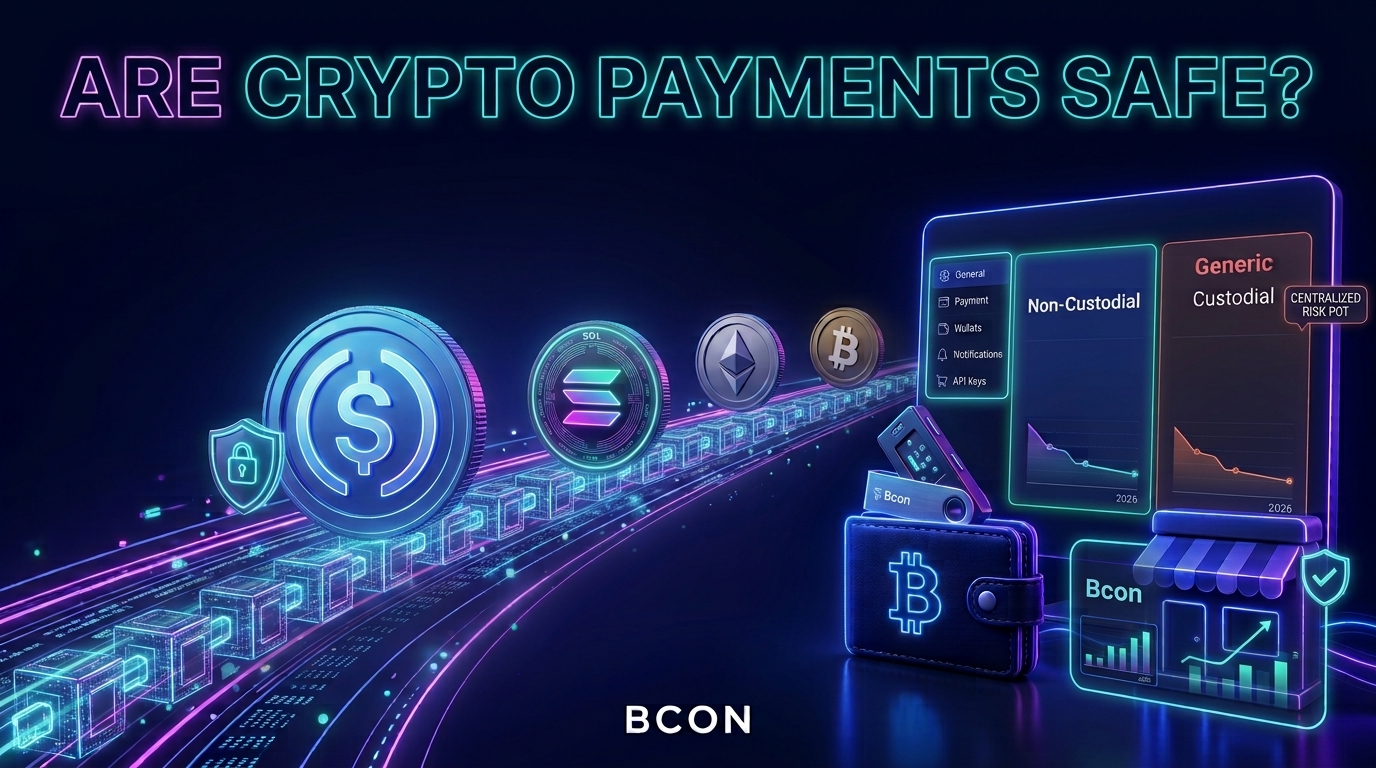








Are Crypto Payments Safe? A Merchant’s Security Guide
“Is it safe?” is the first question most business owners ask before accepting crypto – and it is the right question. The good news is that crypto payments are safe when you understand how they work and choose the right setup. At Bcon Global we help merchants accept crypto securely, directly to their own wallets, so this guide explains exactly why crypto payments are safe, where the real risks live, how they compare with cards, and the best practices that keep your funds protected.
Security in crypto is less about the technology being risky and more about who holds your money and how you protect your own keys. Let us start with the short answer, then unpack it.
Are Crypto Payments Safe? The Short Answer
Yes – accepting crypto payments is safe, and in some ways safer than cards, provided you use a non-custodial setup and protect your wallet. Blockchain payments are validated by a global network, recorded permanently, and impossible to reverse once confirmed, which removes chargeback fraud entirely. The main thing to manage is your own wallet security, which you would do with any crypto.
The nuance is this: “safe” depends on custody. If a third party holds your funds, your safety depends on their security. If the payment settles directly to a wallet you control, there is no central pot for anyone to hack or freeze. The rest of this guide explains why.
How Blockchain Makes Payments Secure?
Crypto payments rest on security built into the blockchain itself. Three features do the heavy lifting:
- Cryptographic verification. Every transaction is signed with the sender’s private key and verified by the network, so it cannot be forged.
- Decentralized validation. Thousands of independent computers confirm each transaction, so there is no single point to attack or manipulate.
- Immutability. Once confirmed, a transaction is permanently recorded and cannot be altered or reversed.
For a merchant, this means a confirmed payment is genuine and final. There is no bank to wrongly reverse it and no processor that can quietly claw it back. The same transparency that makes blockchains auditable also makes payments verifiable – you can always prove exactly what was sent and received.
Custodial vs Non-Custodial: Where the Real Risk Lives
The biggest security decision you make is not which coin to accept – it is who holds the funds between the customer paying and you receiving. This is where “safe” is really decided.
| Factor | Custodial service | Non-custodial gateway |
| Who holds funds | The provider | You (your wallet) |
| Hack exposure | Provider breach = your loss | Provider breach ≠ your funds |
| Frozen-funds risk | Real (account reviews) | None |
| Private keys | Provider controls | You control; never shared |
| What you must secure | Trust in the provider | Your own wallet |
A custodial service pools customer funds, which makes it a target and a single point of failure – if it is breached or freezes your account, your money is at risk. A non-custodial gateway never holds your funds; each payment goes straight to your wallet. The provider only reads public blockchain data, so a breach of the provider cannot touch your money. For safety, non-custodial is the stronger model.
Common Risks and How to Avoid Them
Being honest about risk is part of a good security guide. Crypto payments are safe, but a few real risks exist – and each has a simple defense:
- Losing your keys. If you lose your seed phrase, you lose access. Defense: back it up offline, in more than one secure place.
- Phishing and fake apps. Scammers mimic wallets and support. Defense: download only from official sources and never share your seed phrase.
- Wrong-network transfers. Sending on the wrong chain can lose funds. Defense: use a gateway that fixes the coin and network on each invoice.
- Price volatility. A coin’s value can move before you convert. Defense: accept stablecoins like USDT or USDC for steady value.
- Custodial exposure. A provider holding your funds can be hacked or freeze them. Defense: use a non-custodial gateway.
Notice that none of these are flaws in the blockchain itself – they are operational risks with straightforward defenses. Follow them and crypto payments are very safe.
Are Crypto Payments Safer Than Cards?
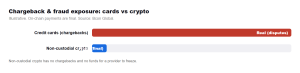
In several ways, yes. Card payments carry chargeback fraud, data-breach exposure from stored card details, and the risk of a processor freezing or holding your funds. Crypto payments have none of these: they are final (no chargebacks), they do not require you to store sensitive card data, and with a non-custodial setup no one can freeze your money.
Cards do offer buyer-side dispute protection, which some customers value, and they land as fiat automatically. But from the merchant’s security standpoint – protecting revenue from fraud, freezes and reversals – non-custodial crypto is often the safer option.
The safest payment is the one where the money is already yours and cannot be reversed or frozen. That is exactly what a confirmed, non-custodial crypto payment is.
How Confirmations Protect You?
One of the most practical safety mechanisms in crypto is the confirmation. When a customer pays, the transaction is broadcast to the network and then included in a block; each additional block built on top is another confirmation, making the payment progressively harder to reverse. After enough confirmations, a payment is considered final and effectively irreversible.
For a merchant, this is a built-in fraud safeguard. A good payment gateway waits for the required number of confirmations before marking an order as paid, so you never fulfill an unconfirmed or fraudulent transaction. Different networks reach finality at different speeds – some fast chains confirm in well under a second, while Bitcoin takes longer – but the principle is the same everywhere: you ship only once the payment is genuinely settled. This removes the “did I really get paid?” uncertainty that card holds and pending charges create.
Are Stablecoins Safe to Accept?
Stablecoins like USDT and USDC deserve their own note, because they are what many merchants actually receive. As payments, they are as safe as any crypto transaction: verified on-chain, final, and settled directly to your wallet with a non-custodial gateway. The main considerations specific to stablecoins are the issuer and the network.
Stick to established, well-reserved stablecoins from reputable issuers, and always accept them on the correct network. Because the same stablecoin exists on several chains, matching the network prevents mis-sent funds – something a gateway handles for you by fixing the network on each invoice. Used this way, stablecoins are one of the safest and most predictable ways to accept crypto, combining on-chain security with steady dollar value.
Watch Out for Scams and Social Engineering
It is worth being clear about where crypto losses usually come from, because it is almost never the blockchain being “hacked.” The real threats are scams and social engineering aimed at you, the wallet holder. Fake support agents, phishing sites, and messages urging you to “verify” your wallet by entering your seed phrase are the common tactics.
The defense is simple and absolute: no legitimate service – no gateway, no wallet, no exchange – will ever ask for your seed phrase or private keys. Anyone who does is trying to steal from you. Bookmark official sites, ignore unsolicited “support” contacts, and never enter your recovery phrase anywhere except your own wallet’s official recovery screen. Treat your seed phrase like the keys to a vault, and the most common cause of crypto loss disappears.
Security Best Practices for Merchants
Making crypto payments safe is mostly about good habits on your side. Follow these essentials:
- Use a non-custodial gateway so funds settle directly to a wallet you control.
- Back up your seed phrase offline and never store it as a photo or in the cloud.
- Never share private keys – a gateway only needs your public address or xpub.
- Use a hardware wallet for larger balances, and sweep hot-wallet funds to it regularly.
- Accept stablecoins to remove price volatility on invoices and larger orders.
- Let the gateway fix the network on each payment request to prevent wrong-network mistakes.
- Wait for confirmations before fulfilling orders – a good gateway does this automatically.
Do these consistently and your setup is secure against the risks that actually matter, while the blockchain handles the rest.
Is the Blockchain Itself Ever at Risk?
People sometimes worry about the blockchain being “hacked” or a transaction being faked. In practice, the major networks that matter for payments – Bitcoin, Ethereum, Solana and the leading chains – are secured by enormous, decentralized networks of validators, which makes altering confirmed transactions economically and technically impractical. A so-called 51% attack, where someone would need to control the majority of a network’s power, is essentially infeasible on large chains and would be ruinously expensive with no guaranteed payoff.
For a merchant accepting payments on established networks, this class of risk is negligible. The transaction you receive is verified by thousands of independent participants, and once confirmed it is part of a permanent, tamper-resistant record. The security concerns worth your attention are the practical ones already covered – protecting your keys, avoiding phishing, and choosing non-custodial – not the integrity of the underlying blockchain, which is precisely the part that is hardest to attack.
Building Customer Trust in Crypto Payments
Safety is not only about protecting your funds; it is also about reassuring your customers that paying you in crypto is legitimate and secure. A few simple steps build that trust at checkout. Show clearly which coins and networks you accept, so customers know they are paying correctly. Use a recognizable payment flow – a clean invoice with a QR code and a fixed amount – rather than asking customers to paste a raw address, which feels risky and invites mistakes.
Confirm each payment with a receipt or order update so the customer sees that their money arrived and their order is processed. Because every transaction is verifiable on-chain, you can always point to a definitive record if a question ever arises. This transparency is a genuine advantage over some traditional methods: both you and your customer can independently confirm exactly what was paid. A smooth, clearly labelled, confirmed payment experience turns crypto from something customers are unsure about into a method they trust and use again.
How a Non-Custodial Gateway Keeps Payments Secure?
Bringing it together, the safest way to accept crypto is a non-custodial gateway that never touches your funds. That is how Bcon Global is built. Payments settle directly to a wallet you control, so there is no central balance for anyone to hack or freeze. Bcon only needs your public address to watch the blockchain and confirm payments – it never has your private keys and can never move your money.
Because it is non-custodial, there is no account to be frozen, no reserve, and no third-party breach that could reach your funds. Add stablecoin support to remove volatility, and a gateway that fixes the network on each invoice to prevent mistakes, and you have a setup that is both easy and genuinely secure. You can read more about the model and the team behind it on the about page.
Frequently Asked Questions
Are crypto payments safe for a business?
Yes. Blockchain payments are cryptographically verified, permanently recorded and final, so there are no chargebacks. With a non-custodial gateway, funds settle to a wallet you control, so no provider can freeze or lose them.
Is it safe to accept Bitcoin?
Yes. A confirmed Bitcoin payment is genuine and irreversible. Keep your wallet’s seed phrase secure and use a non-custodial gateway, and accepting Bitcoin is very safe.
What are the risks of crypto payments?
The main risks are losing your keys, phishing, wrong-network transfers, price volatility and custodial exposure. Each has a simple defense, and none is a flaw in the blockchain itself.
Are crypto payments safer than credit cards?
For merchants, often yes – no chargebacks, no stored card data to breach, and with a non-custodial setup no one can freeze your funds. Cards still offer buyer dispute protection.
How do I accept crypto safely?
Use a non-custodial gateway, back up your seed phrase offline, never share private keys, accept stablecoins to avoid volatility, and wait for confirmations before fulfilling orders.
Crypto payments are safe – and often safer than cards – when you use a non-custodial setup and protect your wallet. The blockchain makes payments verified, permanent and final, removing chargebacks entirely, while custody determines whether anyone else can touch your funds. Choose non-custodial, follow a few security basics, and your risk is minimal. It is worth repeating the core idea, because it cuts through most of the fear around crypto: the technology is not the weak point – the major networks are extremely hard to attack, and confirmed payments cannot be reversed. What actually needs protecting is your own wallet and your awareness of scams, both of which are fully within your control. Handle those well, keep funds settling to a wallet you own, and accepting crypto is one of the more secure ways to get paid.
To accept crypto the safe way, Bcon Global settles every payment directly to your own wallet – non-custodial, no KYC, flat 1% fee – so your money is yours from the moment a customer pays.