
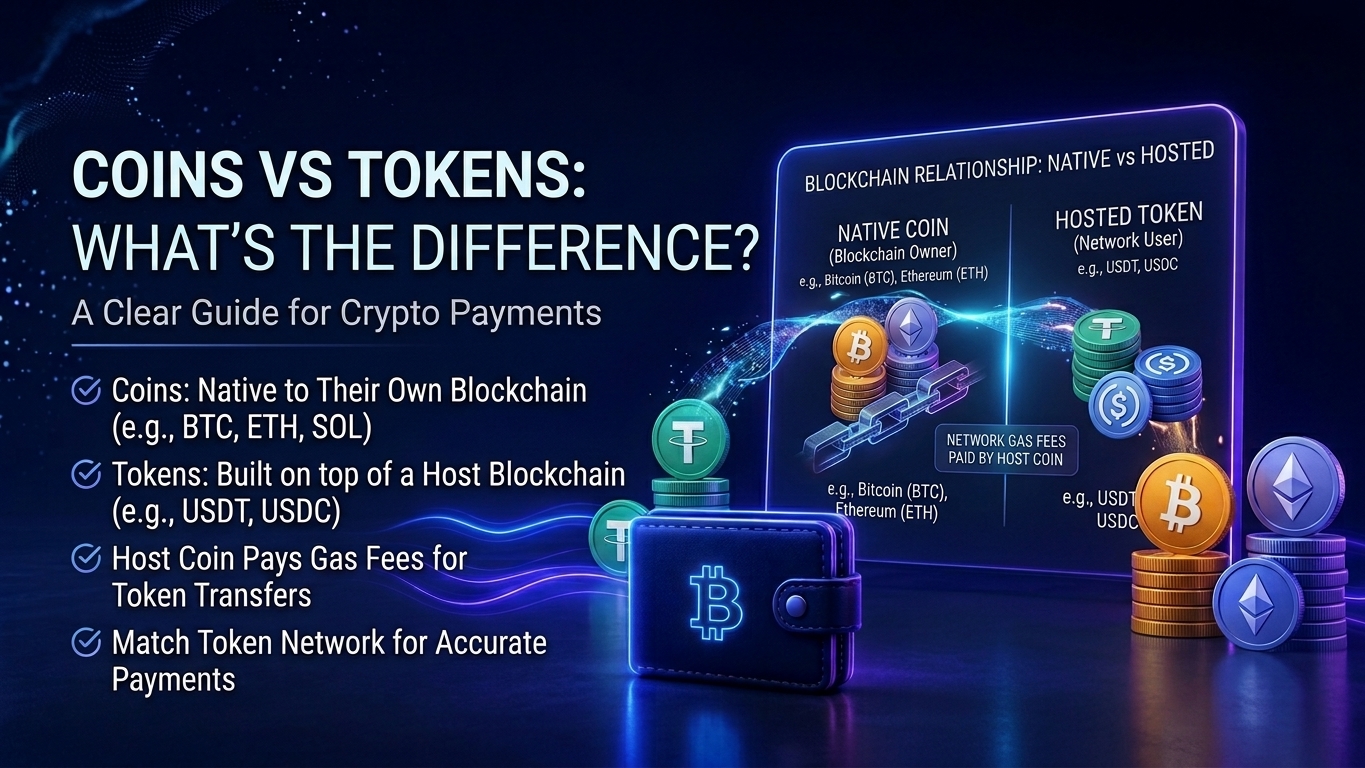








Coins vs Tokens: What’s the Difference?
People use “coin” and “token” as if they mean the same thing, but in crypto they are distinct – and knowing the difference helps you understand fees, networks and payments. The short version: a coin has its own blockchain, while a token is built on top of another blockchain. At Bcon Global we handle both across many networks every day, so this guide explains coins vs tokens clearly, with examples, and shows why the distinction matters when you accept crypto.
Once you see the pattern, you will never mix them up again. Let us start with coins.
What Is a Coin?
A coin is a cryptocurrency that runs on its own blockchain and is usually its network’s native currency. Bitcoin is a coin on the Bitcoin blockchain; Ether (ETH) is the coin of Ethereum; TRX is the coin of Tron. Coins are typically used to pay network fees, transfer value, and secure the blockchain.
Because a coin is native to its chain, it does not depend on another network to exist. When you send Bitcoin, you are moving the Bitcoin blockchain’s own currency, and the fee is paid in that same coin.
What Is a Token?
A token is a cryptocurrency created on top of an existing blockchain, using that chain’s standards. USDT and USDC, for example, are tokens issued on blockchains like Ethereum (as ERC-20 tokens) and Tron (as TRC-20 tokens). The token relies on the host chain to run, and transactions are paid for in the host chain’s coin.
That last point matters in practice: to send USDT on Ethereum, you need some ETH to cover the gas fee, because USDT is a token and ETH is the coin that powers the network. On Tron, you need a little TRX for the same reason.
Coins vs Tokens: Side by Side
The clearest way to see the difference is a direct comparison:
| Factor | Coin | Token |
| Blockchain | Its own | Built on another chain |
| Examples | BTC, ETH, TRX, SOL | USDT, USDC, ERC-20s |
| Pays network fees | Yes (native) | No (uses host coin) |
| Purpose | Currency, fees, security | Stablecoins, utility, assets |
| How many exist | Fewer (hundreds) | Many (thousands) |

As the chart illustrates, tokens far outnumber coins, precisely because it is easy to create a token on an existing blockchain, while launching a new coin means building a whole network.
Types of Tokens
Not all tokens do the same job. The main categories you will meet are:
- Stablecoins – tokens pegged to a currency like the US dollar (USDT, USDC). The most relevant for payments.
- Utility tokens – give access to a product or service within a platform.
- Governance tokens – grant voting rights in a protocol.
- Security and asset tokens – represent ownership of an underlying asset.
For accepting payments, stablecoins are the tokens that matter most, since they hold steady value and are widely used at checkout.
Why It Matters for Payments
Understanding coins vs tokens saves you real trouble when accepting crypto. Three practical points stand out. First, networks: a token exists on a specific chain, so USDT on Tron and USDT on Ethereum are the same token on different networks – and payments must match. Second, fees: sending a token requires the host chain’s coin for gas, which affects cost. Third, choice: offering both a leading coin (like Bitcoin) and stablecoin tokens (like USDT and USDC) covers what most customers want to pay with.
For payments, the practical rule is simple: accept a major coin for reach and stablecoin tokens for steady value – and always match the token to its network.
A good payment gateway hides this complexity from your customers. With Bcon Global, you accept both coins and tokens – BTC, ETH and stablecoins like USDT and USDC – across multiple networks, and each payment settles directly to your own wallet. Bcon handles the network details, so customers simply pay and you receive, non-custodial and low-cost.
Frequently Asked Questions
What is the difference between coins and tokens?
A coin has its own blockchain and is its network’s native currency (like BTC or ETH). A token is built on top of another blockchain (like USDT on Ethereum or Tron).
Is USDT a coin or a token?
USDT is a token. It is issued on host blockchains such as Ethereum (ERC-20) and Tron (TRC-20) rather than having its own chain.
Is Ethereum a coin or a token?
Ether (ETH) is a coin – the native currency of the Ethereum blockchain. Tokens like ERC-20s are built on top of Ethereum and use ETH for fees.
What is an ERC-20 token?
An ERC-20 token is a token that follows Ethereum’s ERC-20 standard, such as USDT or USDC on Ethereum. It runs on Ethereum and uses ETH for gas.
Why does the coin vs token difference matter?
It affects which network a payment uses and which coin pays the fee. Matching a token to its network is essential to avoid lost or delayed transfers.
Coins have their own blockchains; tokens are built on top of them. Coins like BTC and ETH power their networks, while tokens like USDT and USDC ride on those networks and use the host coin for fees. For payments, the practical move is to accept a major coin plus stablecoin tokens, always matched to the right network.
Bcon Global lets you accept both – coins and stablecoin tokens across multiple chains – directly to your own wallet, non-custodial, no KYC, 1% fee, with the network details handled for you.