
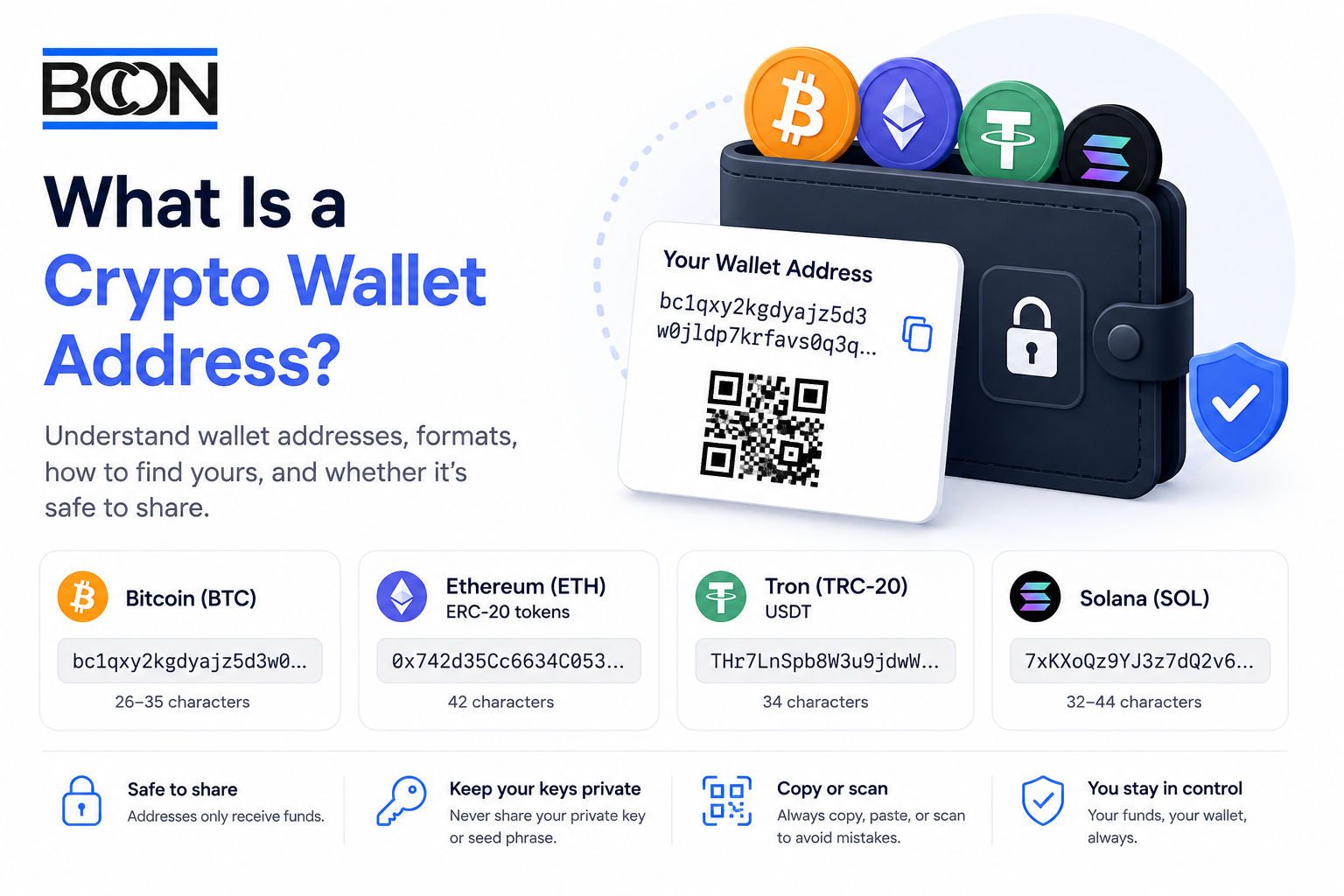








What Is a Crypto Wallet Address?
A crypto wallet address is the single most important piece of information for receiving cryptocurrency – yet it is often misunderstood. Get it right and payments land instantly; get it wrong and funds can be lost. At Bcon Global we help merchants receive crypto straight to their own wallet addresses every day, so this guide explains exactly what an address is, what the different formats look like, how to find yours, and whether it is safe to share.
By the end you will be able to read any crypto address at a glance and use yours confidently to get paid.
What Is a Wallet Address, Exactly?
A crypto wallet address is a unique string of letters and numbers that identifies where crypto can be sent on a blockchain. Think of it like an account number or an email address for money: anyone can send funds to it, but only the owner of the matching private key can spend what arrives. It is derived from your wallet’s public key, which is why it is safe to hand out for receiving payments.
Each address belongs to a specific blockchain. A Bitcoin address works on the Bitcoin network, an Ethereum address on Ethereum, and so on. Sending to the wrong network is the most common – and most costly – mistake, which is why matching the address to the coin matters.
What Does a Crypto Address Look Like?
Addresses vary by network, and knowing the format helps you avoid errors. Here are the common patterns:
- Bitcoin (BTC): starts with `1`, `3`, or `bc1` (for example, `bc1q…`), roughly 26-35 characters.
- Ethereum (ETH) and ERC-20 tokens: starts with `0x`, exactly 42 characters.
- Tron (TRC-20 USDT): starts with `T`, 34 characters.
- Solana (SOL): 32-44 characters, no fixed prefix.
Because the same USDT can exist on several networks, a USDT address is really just an address on whichever chain you chose – Ethereum, Tron or another. Always confirm both the coin and the network before sending.
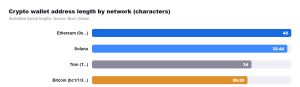
The chart shows how lengths differ across networks. The practical takeaway is simple: never type an address by hand. Always copy and paste it, or scan a QR code, then verify the first and last few characters.
Wallet Address vs Private Key: The Key Difference
This is where confusion causes real losses, so it is worth being crystal clear. Your wallet has two related parts:
| Element | What it does | Can you share it? |
| Public address | Where others send you crypto | Yes, freely |
| Public key | Used to derive the address | Yes (rarely needed) |
| Private key / seed phrase | Controls and spends your funds | Never |
Sharing your address lets people pay you and nothing more. Sharing your private key or seed phrase gives away full control of your money. Anyone who asks for your private key is trying to steal from you.
How to Find Your Wallet Address
Locating your address takes seconds in any wallet. The steps are almost identical across apps:
- Open your wallet (MetaMask, Trust Wallet, a hardware wallet app, etc.).
- Select the coin or network you want to receive.
- Tap “Receive” (or the coin’s deposit option).
- Copy the address or display the QR code shown.
- Share it with the sender, or paste it into a payment form.
Many wallets generate a fresh receiving address each time for privacy, which is normal – older addresses still work. For Bitcoin, some setups use an extended public key (xpub) to create a new address per payment automatically, which is how a payment gateway can receive to your wallet without ever touching your keys.
Is It Safe to Share Your Wallet Address?
Yes – sharing your public wallet address is safe. It only allows people to send you crypto; it cannot be used to withdraw or access your funds. Businesses publish addresses openly to receive payments and donations without any risk to the balance.
Your public address is like your bank account number for receiving money: safe to share. Your private key is the PIN and password combined – never share that.
The one privacy consideration is that blockchains are public, so anyone who knows an address can see its transaction history and balance. If you prefer more privacy, use a wallet that generates a new address per payment, or a gateway that does this for you.
Using Your Address to Get Paid
For a business, your wallet address is the foundation of accepting crypto. You can share it directly, turn it into a QR code, or connect it to a payment gateway that generates invoices and monitors the blockchain for you. The last option is the most practical at scale.
This is exactly what Bcon Global does. You link your public wallet address, and every customer payment settles directly to it – non-custodial, with no KYC and a flat 1% fee. Bcon only needs the public address to watch for incoming payments; it never asks for private keys, so your funds stay entirely under your control.
Frequently Asked Questions
What is a crypto wallet address?
It is a unique string of letters and numbers that identifies where crypto can be sent on a blockchain. It is safe to share for receiving funds, but only the private-key holder can spend what arrives.
What does a wallet address look like?
It depends on the network: Bitcoin often starts with `bc1`, Ethereum with `0x` (42 characters), and Tron with `T`. Always match the address to the coin and network.
How do I find my wallet address?
Open your wallet, select the coin, tap “Receive,” and copy the address or QR code shown. It takes only a few seconds.
Yes. A public address only lets people send you crypto. Never share your private key or seed phrase, which controls your funds.
Why does my wallet show a different address each time?
Many wallets generate a new receiving address per transaction for privacy. Older addresses still work, and all of them belong to your wallet.
A crypto wallet address is simply where crypto is sent – safe to share, unique to a network, and never to be confused with your private key. Learn the formats, always copy rather than type, and confirm the network before sending or receiving.
When you are ready to accept payments to your address, Bcon Global settles every payment straight to your own wallet – non-custodial, no KYC, 1% fee – so getting paid is as simple as sharing an address.