








Best Crypto Payment Gateways in 2026 (updated)
Choosing a crypto payment gateway in 2026 comes down to four things: who holds your money, what you pay, how much verification you need, and which coins you can accept. Get those right and the rest follows. At Bcon Global we build a gateway around exactly these priorities, so rather than just listing brand names, this guide shows you how to compare gateways properly, what the best ones have in common, and how to pick the right fit for your business.
The market has matured, and the strongest options now share a clear profile. Let us define what “best” actually means before comparing.
How to Compare Crypto Payment Gateways
A fair comparison judges every provider on the same criteria. These four decide the outcome for most businesses:
- Custody model. Non-custodial gateways settle directly to your wallet; custodial ones hold your funds first. Control and risk hinge on this.
- Fees. Look for one transparent number, ideally a flat rate near 1%, with no hidden spreads, payout charges or monthly minimums.
- KYC requirements. Less verification means faster onboarding and fewer barriers, which non-custodial gateways typically offer.
- Coins and networks. Broad support (BTC, ETH, USDT, USDC and multi-chain) means fewer customers turned away at checkout.
Weigh a gateway on all four together. A low headline fee means little if the provider holds your funds and adds hidden costs.
What the Best Gateways Have in Common
The strongest 2026 options share a consistent profile, summarized below against weaker alternatives.
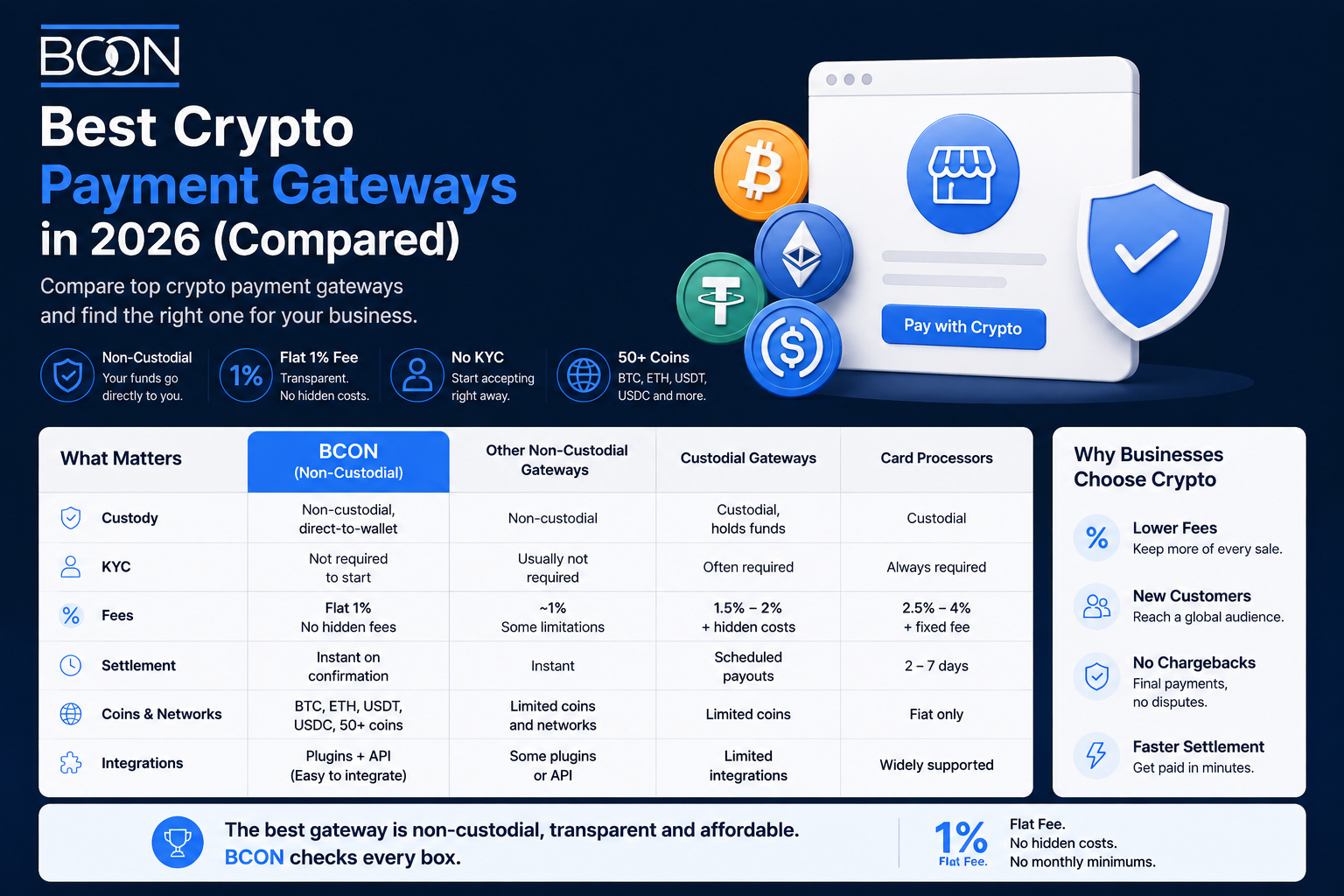
| Criterion | Weaker gateway | Best-in-class gateway |
| Custody | Custodial, holds funds | Non-custodial, direct-to-wallet |
| KYC | Required for merchant | Not required to start |
| Fees | Higher, with hidden spreads | Flat ~1%, transparent |
| Settlement | Scheduled payouts | Instant on confirmation |
| Coins | Limited | BTC, ETH, USDT, USDC, 50+ |
| Integration | One platform | Plugins + API |
Read down the right-hand column and you have a checklist for the best gateways: non-custodial, no KYC, flat fee, instant settlement, wide coin support and flexible integration. Any provider that ticks all six deserves a place on your shortlist.
Custodial vs Non-Custodial: The Deciding Factor
If you take one thing from this guide, make it this: custody is the single most important difference between gateways. A custodial gateway receives payments into its own wallets and pays you later, which reintroduces the frozen-funds and counterparty risk that crypto is meant to remove. A non-custodial gateway never touches your money, each payment settles straight to a wallet you control.
The best gateway is the one where your revenue is yours the instant a customer pays – not after a review, a payout cycle or a withdrawal fee.
For the majority of businesses, non-custodial is the safer default. It also tends to be cheaper, because the provider is not converting, storing or withdrawing your funds and cannot charge for those steps.
Fees: What You Should Pay in 2026
Pricing has converged toward transparent flat fees among the best providers, while weaker options still bury costs in spreads and payout charges. As a benchmark, expect a flat service fee around 1% from a strong non-custodial gateway, with the network fee paid by the customer.
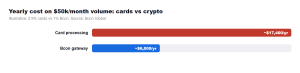
The chart puts the stakes in perspective. On $50,000 of monthly volume, card processing costs around $17,400 a year, while a flat 1% gateway costs about $6,000 – a difference of roughly $11,400 annually that stays in your business. Multiply that across years and gateway choice becomes a meaningful financial decision, not a minor setting.
Coins, Networks and Integrations
The best gateways let you accept what your customers actually use and connect to your store with minimal effort. Look for support for Bitcoin, Ethereum, USDT and USDC across multiple networks, including low-fee options, so no customer is turned away. On the integration side, ready-made plugins for platforms like WooCommerce and OpenCart cover most stores, while a clean API handles custom or headless builds.
This combination is what makes a gateway practical day to day. It should slot into your existing checkout, not force a rebuild.
Which Gateway Should Your Business Choose?
The right pick depends on your priorities, but the logic is simple:
- You want control and low, predictable fees – choose a non-custodial, flat-fee gateway.
- You need to start fast without paperwork – choose a no-KYC provider.
- You accept many coins – choose one with broad multi-chain support.
- You specifically need automatic conversion to a bank account – a custodial service may suit you, accepting the trade-offs in cost and control.
For most online businesses, the first three point to the same answer: a non-custodial, no-KYC, flat-fee gateway with wide coin support.
Where Bcon Fits
Measured against the checklist above, Bcon Global is built to tick every box: non-custodial with direct-to-wallet settlement, no KYC to start, a flat 1% fee with no monthly minimums, support for BTC, ETH, USDT, USDC and 50+ coins, and both plugins and an API. You can review the full pricing on the prices page. It is a straightforward example of the profile the best 2026 gateways share.
Frequently Asked Questions
What is the best crypto payment gateway in 2026?
The best gateway for most businesses is non-custodial, requires no KYC, charges a flat fee around 1% and supports major coins. That profile gives you control, low cost and minimal friction.
What should I look for when choosing a gateway?
Compare custody model, all-in fees, KYC requirements and supported coins and networks. Judge all four together rather than the headline rate alone.
Are non-custodial gateways better?
For most merchants, yes. They remove frozen-funds risk, settle instantly and usually cost less. Custodial suits businesses needing built-in fiat conversion.
What is the cheapest crypto payment gateway?
Usually a transparent flat-fee, non-custodial gateway with no hidden spreads or withdrawal fees. Bcon uses a flat 1%.
Which coins should a gateway support?
At minimum Bitcoin, Ethereum, USDT and USDC across multiple networks, so you can accept what your customers actually hold.
The best crypto payment gateways in 2026 share one profile: non-custodial, no KYC, a flat transparent fee and broad coin support. Compare providers on custody, cost, verification and coins together, and the right choice for most businesses becomes clear. Pick a gateway that keeps you in control and keeps your fees predictable.
Want a gateway that fits the checklist? See how Bcon Global helps you accept crypto – non-custodial, no KYC, flat 1% fee, straight to your wallet.