








How to Accept Ethereum Payments on Your Site
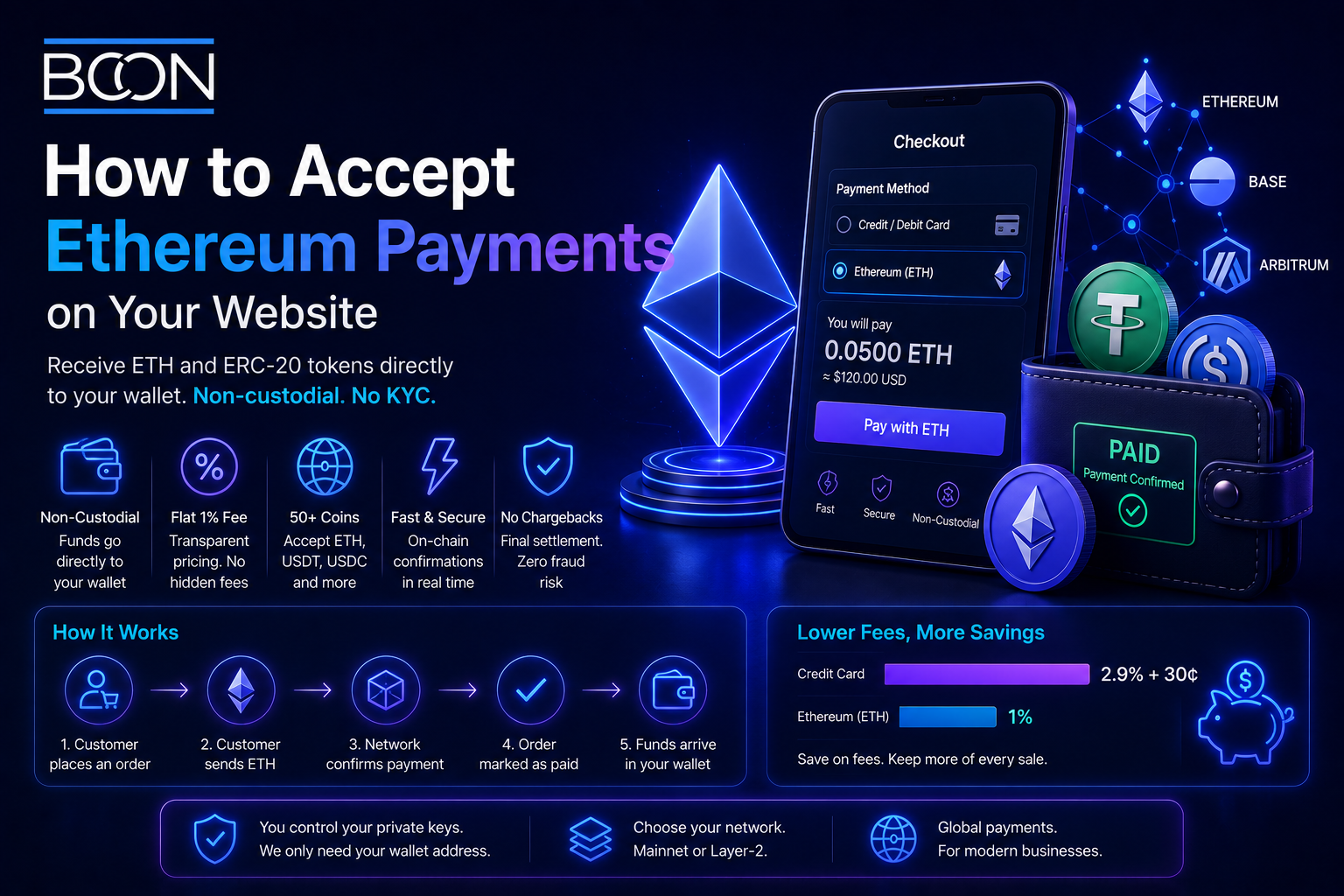
Ethereum is the second-largest cryptocurrency and the home of most stablecoins and tokens, which makes it a smart coin to accept alongside Bitcoin. Adding ETH to your checkout is straightforward: you need a wallet you control and a gateway that turns an incoming transaction into a paid order. At Bcon Global we help merchants receive Ethereum and ERC-20 tokens every day, so this guide covers the setup, how gas fees work, when to use Layer-2, and how to keep every payment under your control.
Accepting Ethereum also unlocks the huge audience that holds ETH, USDT and USDC on the network. Here is how to do it properly.
Why Accept Ethereum Payments?
Ethereum brings a large, active user base and the flexibility of tokens to your store. The practical benefits mirror the wider case for crypto, with a few ETH-specific advantages:
- Access to a massive holder base who transact on Ethereum daily.
- Stablecoin support – most USDT and USDC lives on Ethereum and its Layer-2s, so one integration covers several assets.
- Lower fees than cards, especially when you use Layer-2 networks.
- No chargebacks and final settlement, like all on-chain payments.
- Direct-to-wallet payouts with a non-custodial gateway.
Accepting ETH is less about a single coin and more about tapping into an entire ecosystem of value.
What You Need to Start
The building blocks are the same as for any crypto payment, and setup is quick:
- An Ethereum-compatible wallet you control, such as MetaMask or Trust Wallet, to receive funds.
- A crypto payment gateway that supports ETH and ERC-20 tokens.
- A store integration – a plugin for platforms like WooCommerce and OpenCart, or an API for custom sites.
With a non-custodial provider you generally do not need KYC, and there is no merchant account to apply for.
Step-by-Step: Accepting Ethereum
Follow this sequence to go live, usually within an afternoon:
- Create a gateway account and connect your Ethereum wallet address.
- Install the plugin or connect the API on your store.
- Enable ETH and any ERC-20 tokens you want, such as USDT and USDC.
- Choose your networks, including Layer-2 options for lower fees.
- Set your display currency so prices convert automatically at checkout.
- Run a test payment, then switch the method live.
When a customer checks out, they select Ethereum, send the payment from their wallet, and the gateway confirms it on-chain and marks the order paid.
Gas Fees and Layer-2: Keeping Costs Low
Ethereum charges a network fee called “gas” to process transactions, and it varies with demand. On the main Ethereum network gas can be higher during busy periods, which is why Layer-2 networks have become popular. Layer-2s like Base and Arbitrum settle to Ethereum but process transactions far more cheaply and quickly.
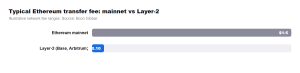
The chart shows the gap. A transfer that might cost a few dollars on Ethereum mainnet can cost cents on a Layer-2. For a merchant, supporting Layer-2 options means customers pay less in gas and are more likely to complete checkout. The gas fee is paid by the customer, not you, but lower fees still improve conversion.
| Network | Typical fee | Speed | Best for |
| Ethereum mainnet | $1-5 | Moderate | High-value, maximum compatibility |
| Layer-2 (Base, Arbitrum) | Under $0.10 | Fast | Everyday and smaller payments |
Keep Control: Choose a Non-Custodial Gateway
As with any crypto, the key decision is custody. A custodial service holds your ETH before paying you out; a non-custodial gateway sends each payment straight to your wallet. For control and security, non-custodial is the better model.
Accepting Ethereum should mean the ETH lands in your wallet – not in a provider’s account waiting for a payout.
This is how Bcon Global works: ETH and ERC-20 tokens settle directly to an address you own, there is no KYC to start, the fee is a flat 1%, and you can accept 50+ coins from a single integration. You get Ethereum at checkout without giving up control of your funds.
Do Not Forget ERC-20 Stablecoins
One of the biggest reasons to accept Ethereum is the tokens that live on it. USDT and USDC on Ethereum and its Layer-2s let price-sensitive customers pay in stable value, while still using the Ethereum network. Enabling these alongside ETH means a single integration covers volatile and stable payments at once, which is ideal for invoices and larger orders where predictability matters.
Because these are all handled through the same gateway, there is no extra setup – you simply toggle the tokens and networks you want to accept.
Security Essentials
Keeping Ethereum payments safe comes down to protecting your wallet, since non-custodial means you hold the keys. Back up your seed phrase offline, never share private keys, and verify receiving addresses before use. For larger balances, pair your hot wallet with a hardware device. The gateway only needs your public address to watch for payments, so it can never move your funds.
Frequently Asked Questions
How do I accept Ethereum on my website?
Connect an Ethereum wallet to a non-custodial gateway, install a plugin or the API, enable ETH and any ERC-20 tokens, and run a test payment. You can be live the same day.
What are gas fees?
Gas is Ethereum’s network fee for processing a transaction. It varies with demand and is paid by the customer sending the payment, not the merchant.
How can I lower Ethereum fees?
Support Layer-2 networks like Base and Arbitrum, which settle to Ethereum but cost a fraction of mainnet fees and confirm quickly.
Can I accept USDT and USDC on Ethereum?
Yes. USDT and USDC are ERC-20 tokens, so a gateway that supports Ethereum lets you accept them through the same integration.
Does accepting Ethereum require KYC?
With a non-custodial gateway like Bcon, merchant KYC is generally not required, because it never holds your funds and only needs your public address.
Accepting Ethereum opens your store to a huge audience and, through ERC-20 tokens, to stablecoins as well. Support Layer-2 networks to keep customer fees low, choose a non-custodial gateway to keep control of your funds, and you get a fast, low-cost payment option in one integration.
Ready to accept ETH and tokens? Bcon Global settles Ethereum straight to your wallet – non-custodial, no KYC, flat 1% fee.