
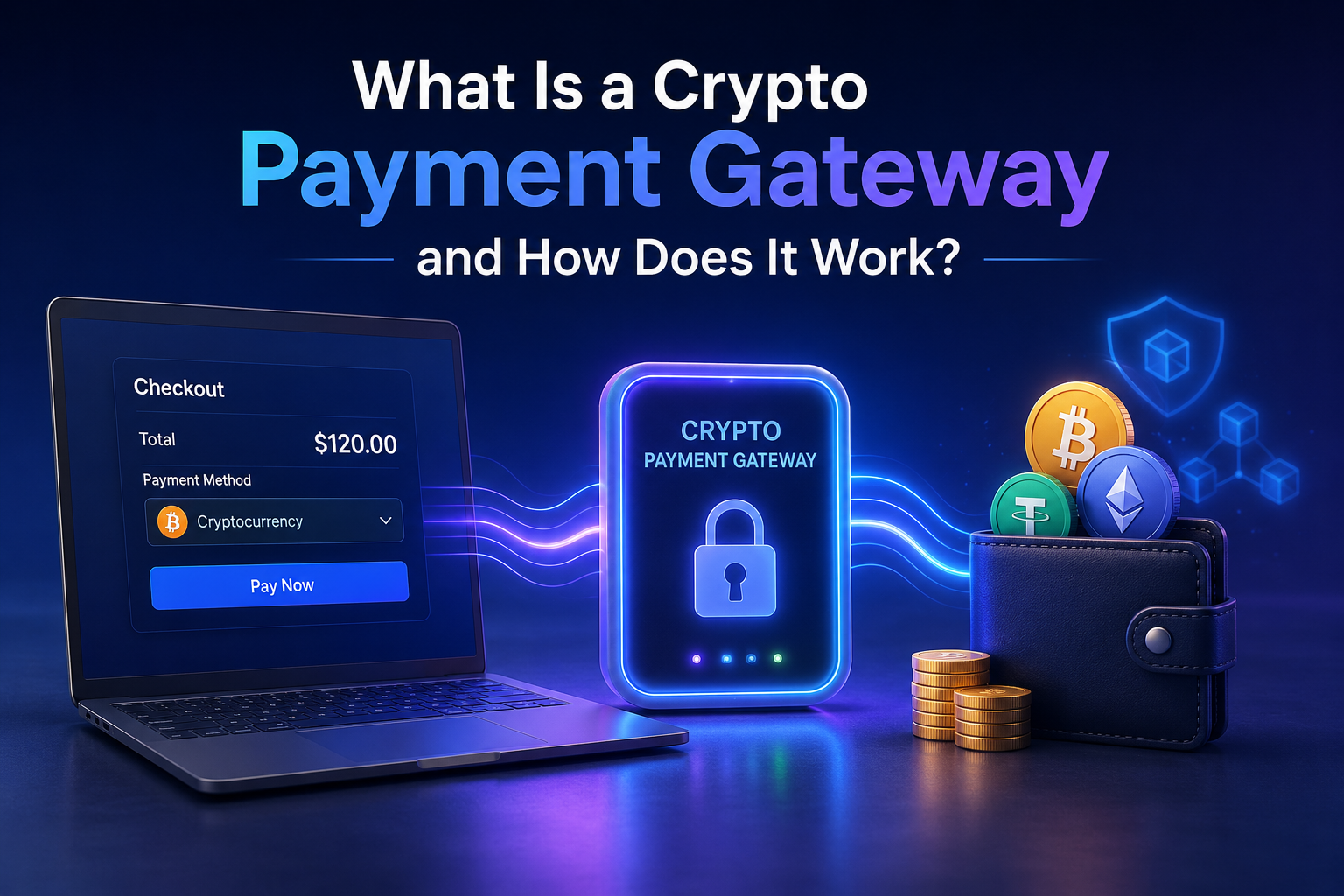








What Is a Crypto Payment Gateway and How Does It Work?
If you own an online business or are just planning to start working online, sooner or later you will still begin thinking about how to accept cryptocurrency payments. Regardless of the type of business or services, your clients will ask whether it is possible to pay with cryptocurrency. For some, it is simply more convenient; some use it to avoid the problems of global banking payments related to bank cards and transfers in general; some do it simply because they are used to it and want to keep up with technology.
As soon as you decide that it is worth starting to accept cryptocurrency payments, the following practical question will arise:
How do crypto payments actually work on a website?
Of course, you can simply specify a wallet on your website and process payments manually, but if you want everything to work properly — with invoice generation, payment tracking, and order status updates in your billing system — then that is exactly what crypto payment gateways do.
In this guide, we’ll explain what a crypto payment gateway is, how it works step by step, what types of gateways exist, and why the difference between custodial and non-custodial processing matters so much for merchants. We’ll also look at Bcon Global, a non-custodial crypto payment gateway built for businesses that want to accept crypto directly to their own wallets.
What Is a Crypto Payment Gateway?
A crypto payment gateway is a software application or service that automates the process of accepting cryptocurrency payments and connects your website, application, or billing system to the blockchain.
In simple terms, a crypto payment gateway helps you:
- create a payment invoice for the customer,
- show the exact amount of crypto to send,
- provide the correct wallet address or payment details,
- monitor the blockchain for the incoming transaction,
- verify whether the payment was completed,
- and notify your website or app so the order status can update automatically.
Without a gateway, accepting crypto usually means doing many things manually. For example, you would have to send the customer a wallet address, wait for the transfer, check the blockchain yourself, compare the amount, and then manually mark the order as paid. That may work for a freelancer with one payment per week, but it quickly becomes a problem for an e-commerce store, SaaS platform, or any business with regular transactions.
A payment gateway turns crypto payments into a normal checkout process instead of a manual wallet check.
Why Businesses Use Crypto Payment Gateways
Offering an additional payment method demonstrates your customer focus while also optimizing your business operations. Blockchain automates many accounting processes, such as maintaining transaction records and reducing data reconciliation errors. A crypto payment gateway, in turn, connects the blockchain to your website, online store, or application and automates the exchange of transaction data.
Let’s say you sell online courses for $79. A customer from Argentina wants to pay in USDT. Another customer from Germany wants to pay in BTC. A third customer from Southeast Asia uses TRON-based stablecoins because transaction fees are lower for them.
If you want to accept all these payments manually, you will spend time on repetitive tasks:
- calculating the amount in crypto,
- checking if the customer paid the right invoice through various blockchain explorers,
- confirming that the payment really arrived,
- and updating the order or subscription status yourself.
The payment gateway fully automates the entire process, monitoring the transaction from the moment a wallet address is provided to your customer until the payment is completed and the funds are received in that wallet. It also notifies your system about the payment status, allowing your system to automatically update order statuses.
How Does a Crypto Payment Gateway Work?
The process itself may vary depending on the payment gateway, but the overall logic is generally the same for all of them. Here is an example of the customer’s journey during the purchase and checkout process.
1. The customer chooses crypto at checkout
The customer adds products to the cart and then selects a payment method. In our example, they choose Cryptocurrency Payment.
For example, if the order total is $120, the gateway may prepare a payment request for 120 USDT, or convert that amount into BTC, ETH, or another supported asset depending on what the customer chooses.
2. The gateway creates the invoice
The invoice is the key part of the process. It tells the customer exactly what to pay and where to send it.
An invoice usually contains the following information, although it depends on the specific payment service:
- the amount in fiat, such as USD or EUR,
- the exact crypto amount to send,
- the selected blockchain network,
- the destination wallet address,
- and the invoice or order identifier.
This matters because crypto prices change. If you price your product in dollars but the customer pays in crypto, the gateway needs to calculate the correct amount at the time of checkout.
For example, if your service costs $50, the gateway may calculate that the customer needs to send 50 USDT on TRON or 0.00058 BTC, depending on the chosen payment method and the exchange rate at that moment.
3. The customer sends the payment
Next, the customer needs to pay the invoice. They can do this using their own wallet, a cryptocurrency exchange, or exchange services and other third-party providers. In other words, as long as they know the payment wallet address and the amount, they can complete the payment in many different ways, even if they do not personally own cryptocurrency. Compared to traditional bank payments, this is a significant advantage because it does not restrict your customers with banking verification procedures, regional policies, or similar limitations.
4. The gateway monitors the blockchain
After the customer sends the funds, the transaction appears on the blockchain, and the payment gateway starts tracking it, as well as the network confirmations.
This is where the technical side matters. The gateway checks:
- whether the payment was sent to the correct address,
- whether the amount matches the invoice,
- whether the transaction is visible on-chain,
- and whether the required number of confirmations has been reached.
These steps are very important, because the payment gateway is the one that verifies whether the payment matches the invoice. And if the logic is broken, or the gateway cannot correctly interpret amounts or wallet addresses, it may make mistakes and either ignore a valid payment or mark it as paid even though the amount does not match, etc.
5. The gateway sends a payment status update to your website
When the payment reaches the required status, the gateway notifies your website, store, or billing system.
This usually happens through a callback, webhook, or direct plugin integration.
The payment gateway sends your system a notification about the payment status, and you can use this information in any way you need. You can either use the ready-made options provided by crypto integration plugins, for example:
- marking the order as paid,
- changing the invoice status,
- unlocking a digital product,
- activating a user account,
- or sending a payment confirmation email.
In fact, the payment gateway only sends payment data, for example: status (paid / unpaid), amount, transaction number, or internal identifiers. The actual change of order statuses inside your system is done by the installed plugin that interacts with your billing system.
What Types of Crypto Payment Gateways Exist?
This is where it’s worth taking a closer look, because there are several types of crypto payment gateways, and they differ significantly in how they work. The most important difference is who controls the funds during the payment process.
In practice, crypto payment gateways usually fall into two main categories:
- custodial gateways
- non-custodial gateways
The differences in how they work have a significant impact on your day-to-day operations and, more importantly, on the risks your business faces.
Custodial Crypto Payment Gateways
Custodial payment gateways operate much like traditional banks. They process transactions through their own infrastructure and hold your funds in accounts under their control. Later, they can transfer those funds to your wallet upon request, usually charging additional withdrawal fees. At the same time, they often provide extra features, such as converting volatile cryptocurrencies into stablecoins for hedging purposes or settling funds directly to your bank account in fiat currency.
What this looks like in real life
Imagine you sell software subscriptions and use a custodial gateway. A customer pays in crypto, but the funds do not go straight to your own wallet. Instead, they first land inside the provider’s infrastructure. After that, the provider may:
- keep the funds in your account balance,
- convert them internally,
- settle them later,
- or send a withdrawal when requested.
This model can be useful if you need:
- fiat payouts to a bank account,
- internal currency conversion,
- centralized reporting inside one processor,
- or an all-in-one payment platform that handles more than just crypto.
However, both legally and technically, they operate as banks and financial intermediaries, which in turn leads to the following:
- payout delays,
- account reviews ( KYB ),
- merchant verification requests ( KYC ),
- transaction holds ( AML ),
- or limits based on internal compliance rules.
So you should weigh the pros and cons yourself.
Non-Custodial Crypto Payment Gateways
Non-custodial payment gateways work in a completely different way. Blockchain technology itself makes it possible to transfer funds while allowing third parties to track the payment, since all transaction data is recorded on the blockchain. To use this approach, you simply specify which wallet addresses the payment gateway should use and where you want to receive the funds. You do not need to provide any private keys or access credentials—only the wallet addresses.
When generating invoices, the payment gateway assigns wallet addresses from the list you have provided, monitors incoming payments to those addresses, and notifies your billing system about the transaction status.
That usually includes:
- invoice generation,
- amount calculation,
- blockchain monitoring,
- payment confirmation tracking,
- and order status notifications.
In practice, this is simply blockchain monitoring combined with the automation of specific actions. As a result, these gateways cannot freeze your funds, block your payments, or impose similar restrictions, because they simply do not have the technical ability to do so.
Why the Non-Custodial Model Matters
“Non-custodial” may sound a bit technical, but in practice, it is what fundamentally changes the way your business operates.
1. Payments go directly to your wallet
This is the key difference, because the payment gateway does not use its own wallets or accounts to receive payments for your products or services. Instead, you specify the wallet addresses where you want to receive funds. You do not provide private keys or any access credentials—only the wallet addresses. The payment gateway has no access to your funds and cannot perform any actions other than monitoring transactions on the blockchain.
2. You reduce dependency on the payment provider
Any intermediary introduces risk. If your money is held by a third party, especially in a strict jurisdiction with its own regulations, you become dependent on that provider. A non-custodial gateway gives you complete independence because this type of payment gateway is simply software that automates the same tasks you would perform manually if you were accepting crypto payments yourself.
3. It fits the original point of using crypto
The main advantage of crypto payments is their speed, simplicity, and ease of accepting payments regardless of where your customers are in the world. This is true cross-border commerce. If a payment gateway tries to fit new technology into old financial infrastructure, both the purpose and the efficiency are lost. A non-custodial gateway keeps the payment flow closer to the original wallet-to-wallet model.
4. It is often simpler operationally
It is simply much easier. When the funds are already in your wallet, it eliminates a huge number of unnecessary steps. You have probably experienced bank verification procedures and excessive bureaucracy. In this case, you can forget about all of that.
What Is Bcon Global?
Bcon Global is a non-custodial crypto payment gateway built for merchants, online stores, SaaS platforms, and developers who want to accept crypto payments directly to their own wallets.
The core idea behind Bcon is simple: the gateway should help you accept and track crypto payments, but it should not take custody of your funds. It is more of a software for automating the tracking of payments through the blockchain and sending notifications to billing systems.
How Bcon Global Works
This is true direct-to-wallet processing.
In practice, your interaction with it looks like this:
- You create a Bcon account (no documents required—just an email address and password).
- You specify your wallet addresses for different blockchains. Only the wallet addresses are required.
- You integrate Bcon through the API or a ready-made plugin.
- A customer places an order and chooses crypto payment.
- Bcon provides your wallet address for payment and tracks the required amount based on the invoice.
- The customer sends the payment directly to your wallet.
- Bcon confirms the transaction and sends the payment status back to your system.
So, Bcon acts as the payment infrastructure around the transaction, not as the holder of the funds.
Why Bcon Global’s Non-Custodial Model Is Important
The biggest practical point is control and safety.
With Bcon, you do not create a hosted balance inside the gateway and wait for payouts later. You connect your own wallet, and customer payments go there directly. Bcon does not require private keys and does not have access to merchant funds.
If someone sends you a payment, it arrives directly in your own wallet immediately, regardless of the software you use.
What Bcon Global Supports
Bcon Global supports several major blockchains:
- Bitcoin (BTC)
- Ethereum (ETH)
- BNB ( BEP-20 )
- Solana (SOL)
- TRON (TRX)
In addition to the native coins of supported blockchains, it also supports stablecoins: USDT, USDC, USDS, and TUSD across supported networks. You choose which cryptocurrencies your customers can use for payments and which wallet addresses should receive the funds.
Integrations and Use Cases
Bcon Global is designed for both standard e-commerce setups and custom payment flows.
According to its integration pages, Bcon supports API-based integration and also offers integrations for:
- WooCommerce / WordPress
- OpenCart
- WHMCS
Which makes it especially simple and fast for:
- online stores that want a ready-made checkout plugin,
- SaaS products that need API and webhook/callback logic,
- hosting businesses using WHMCS,
- and custom platforms.
Bcon Global Fees
Bcon Global takes a 1% fee per successful transaction. The fee is handled through a prepaid balance model rather than being automatically deducted from incoming payments.
Since Bcon does not hold the merchant’s incoming funds, it cannot simply take a fee from each transaction. Instead, merchants fund a prepaid balance, and Bcon deducts service fees from that balance as transactions are processed.
Here’s an example of how it works:
- your customer’s payment goes directly to your wallet,
- Bcon tracks the payment and processes the invoice,
- and Bcon charges its service fee separately through the prepaid system.
Example of Using Bcon Global
Let’s say you sell digital design templates for $150 and your customer wants to pay in USDT on TRON.
The flow may look like this:
- your website creates an order,
- Bcon generates the invoice for that order,
- the customer sees the exact amount in USDT,
- the customer sends the payment,
- the funds go directly to your wallet,
- Bcon monitors the transaction on-chain,
- and once the payment is confirmed, your website automatically marks the order as paid.
For the customer, it is just a normal payment process. For the business owner, however, it is much like receiving cash directly into their own hands.
What to Look for in a Crypto Payment Gateway
If you are still choosing a payment gateway for your needs, consider the following questions and ask them to the payment gateway you plan to use:
- Do payments go directly to my wallet, or to the provider first?
- Do I keep control of my private keys?
- Will I need to request withdrawals later?
- Does the gateway support the blockchains and stablecoins my customers actually use?
- Can I integrate it through a plugin, or do I need a custom API build?
- How are fees charged?
- Does checkout stay on my website?
- Does the gateway require KYC or KYB?
Of course, security is also important. If your money is held by a third party, the safety of your funds depends on them. If all the money is with you, then you are your own boss, but you are also personally responsible for security. Assess the risks realistically, but also look to the future and do not complicate your life unnecessarily.